Equation Demonstration -- Simple Pendulum Analysis

Click For Summary

Homework Help Overview

The discussion revolves around the analysis of a simple pendulum, specifically focusing on the transition between different mathematical representations of its motion. Participants are exploring the differential equations governing small oscillations and the relationship between angular displacement and linear position in simple harmonic motion.

Discussion Character

  • Exploratory, Mathematical reasoning, Problem interpretation

Approaches and Questions Raised

  • Participants are examining how to derive one formula from another in the context of simple harmonic motion, questioning the mathematical steps involved in transitioning from a differential equation to a sinusoidal solution.

Discussion Status

Some participants have provided insights into the nature of the differential equations involved and suggested methods for finding solutions. There is ongoing exploration of the mathematical relationships and potential approaches to demonstrate the equivalence of the formulas presented.

Contextual Notes

Participants note the complexity of deriving solutions from first principles and the constraints of the homework context, which limits the depth of explanation that can be provided. There is an acknowledgment that the transition between formulas may require advanced understanding of differential equations.

Frankie
Messages
2
Reaction score
3
Homework Statement
I need the demonstration of the simple pendulum "hourly law".
Relevant Equations
I've attached images
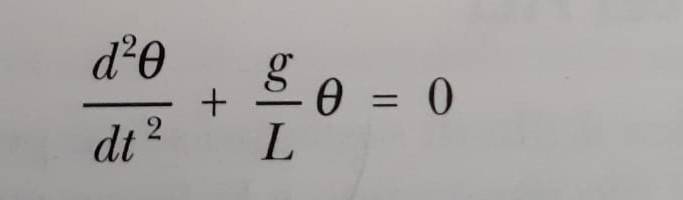
I've just studied simple pendulum: The simple pendulum (for small oscillations) differential equation is first image.
I've no problem to arrive this result and formula.
My problem is to get to the second formula by passing through another formula (Image 3) that my book mentions. I can't understand the passage.

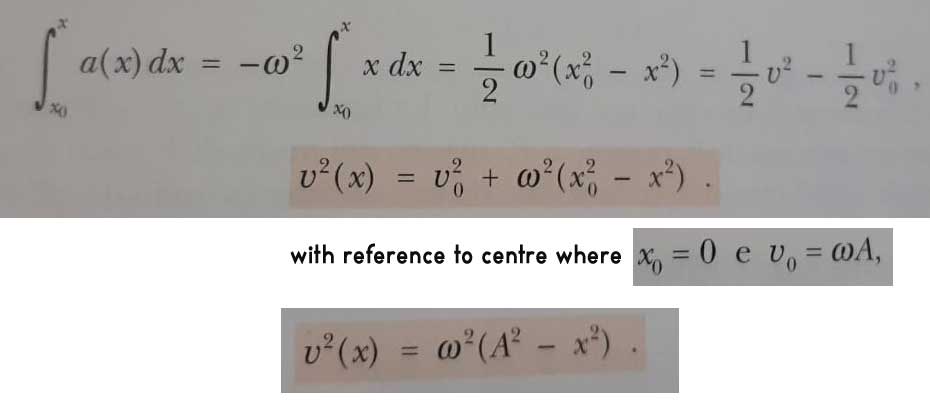
Image 3 refers to acceleration expressed as a function of the position, is a simple harmonic motion.

In the image 3 last formula refers to centre where x0 = 0 and v0=ωA

My book: "For small oscillations the diffential equation becomes that of image 1 and coincides with that of the simple harmonic motion shown in image 3 set ω2 = g / L.
In conclusion, the motion of the pendulum is harmonic oscillatory when the amplitude of the oscillations is small so that senθ ≅ θ"
And then arrives at image2.

I would need to switch from the first to the second formula.

Thank you in advance.
Formula_1.jpeg
Image 1

Formula_2.jpeg
Image 2

Formula_3.jpg
Image 3
 
  • Like
Likes   Reactions: Delta2
Physics news on Phys.org
If ##\theta## is small, then the ##x##-coordinate of the pendulum bob is ##x = L\sin{\theta} \approx L \theta##, hence if ##\theta## satisfies ##\ddot{\theta} = -\omega^2 \theta##, then ##L\ddot{\theta} = -\omega^2 L\theta \implies \ddot{x} = -\omega^2 x## in this regime. The integral they wrote down gives$$\int_{x_0}^{x} \ddot{x} dx = \int_{x_0}^x -\omega^2 x dx = \frac{1}{2} \omega^2(x_0^2 - x^2)$$However, since ##dx = \dot{x} dt##, you could also write that very same integral as$$\int_{x_0}^{x} \ddot{x} dx = \int_{t_0}^{t} \ddot{x} \dot{x} dt = \int_{t_0}^t \frac{d}{dt} \left( \frac{1}{2} \dot{x}^2 \right) dt = \frac{1}{2}v^2 - \frac{1}{2}v_0^2$$Hence, equating these gives$$\frac{1}{2} \omega^2(x_0^2 - x^2) = \frac{1}{2}v^2 - \frac{1}{2}v_0^2 \implies v^2 = v_0^2 + \omega^2 (x_0^2 - x^2)$$Does that answer your questions?
 
  • Like
Likes   Reactions: Frankie
etotheipi said:
If ##\theta## is small, then the ##x##-coordinate of the pendulum bob is ##x = L\sin{\theta} \approx L \theta##, hence if ##\theta## satisfies ##\ddot{\theta} = -\omega^2 \theta##, then ##L\ddot{\theta} = -\omega^2 L\theta \implies \ddot{x} = -\omega^2 x## in this regime. The integral they wrote down gives$$\int_{x_0}^{x} \ddot{x} dx = \int_{x_0}^x -\omega^2 x dx = \frac{1}{2} \omega^2(x_0^2 - x^2)$$However, since ##dx = \dot{x} dt##, you could also write that very same integral as$$\int_{x_0}^{x} \ddot{x} dx = \int_{t_0}^{t} \ddot{x} \dot{x} dt = \int_{t_0}^t \frac{d}{dt} \left( \frac{1}{2} \dot{x}^2 \right) dt = \frac{1}{2}v^2 - \frac{1}{2}v_0^2$$Hence, equating these gives$$\frac{1}{2} \omega^2(x_0^2 - x^2) = \frac{1}{2}v^2 - \frac{1}{2}v_0^2 \implies v^2 = v_0^2 + \omega^2 (x_0^2 - x^2)$$Does that answer your questions?
At first thank you. You have already helped me a lot and the coincidence you demonstrated is clear, but now

i can't understand this:

on a theoretical-physical level I've understood it, I miss the mathematical step

how can i pass from $$\ddot{\theta} + \frac{g}{L} \theta = 0 $$ to $$\theta = {\theta_0} \sin({ωt} +∅)$$

with ω2 = g / L.

Thanks again.
 
This is a second order homogenous differential equation in ##\theta(t)##. As with any differential equation of this form, you can trial solutions of the form ##e^{\lambda t}## and then write the complementary equation,$$\lambda^2 + \frac{g}{L} = 0 \implies \theta = \pm \sqrt{-\frac{g}{L}} = \pm i \sqrt{\frac{g}{L}} = \pm i \omega$$where we defined ##\omega := \sqrt{\frac{g}{L}}##. This means that our general solution is $$\theta(t) = Ae^{i \omega t} + Be^{-i \omega t} = (A+B)\cos{\omega t} + (A-B)i \sin{\omega t}$$or more simply, by collecting those coefficients into two arbitrary constants$$\theta(t) = C\cos{\omega t} + D\sin{\omega t} = E \sin{(\omega t + \phi)}$$Now you can use the boundary conditions to determine ##E## and ##\phi##.
 
  • Love
Likes   Reactions: Frankie
The pass is briefly as follows (this is in homework section so i cannot say the full details)

First we make two guesses that the functions ##f_1=\sin\omega t## and ##f_2=\cos\omega t## (##\omega^2=\frac{g}{L}##) verify the differential equation. Hence we know two solutions.

We know that these two solutions are linearly independent.

Then there is a theorem from the theory of vector spaces and differential equations that if for a linear differential equation of order ##n## we know ##n## linearly independent solutions ##f_1,f_2,...,f_n## then the general solution is $$f=\lambda_1f_1+\lambda_2f_2+...+\lambda_nf_n$$ where the ##\lambda_i## are any real numbers.

We apply this theorem for n=2 (the order of differential equation in this problem is 2). Then it is a matter of some trigonometry and simple algebra to prove that the general solution is equivalent to the form given in your post. (I see now that @etotheipi has posted something relevant to this).
 
  • Like
Likes   Reactions: Frankie and etotheipi
Frankie said:
Homework Statement:: I need the demonstration of the simple pendulum "hourly law".
Relevant Equations:: I've attached images

I would need to switch from the first to the second formula.

Thank you in advance.

formula_1-jpeg.jpg
formula_1-jpeg.jpg
Image 1

formula_2-jpeg.jpg
formula_2-jpeg.jpg
Image 2

Just to simplify things a little. It is difficult to ab initio generate the solution to image 1 and obtain image 2...this is the stuff of entire courses on differential equations.
Happily for the purposes of this exercise it is necessary only to show that image 2 is a solution to image 1. This requires only the ability to take derivatives of trig functions. The rest is all correct but not really necessary and probably off-putting.
 

Similar threads

Replies
7
Views
2K
Replies
17
Views
1K
  • · Replies 9 ·
Replies
9
Views
3K
  • · Replies 6 ·
Replies
6
Views
2K
  • · Replies 2 ·
Replies
2
Views
2K
  • · Replies 1 ·
Replies
1
Views
2K
  • · Replies 15 ·
Replies
15
Views
6K
Replies
11
Views
20K
Replies
4
Views
2K
  • · Replies 2 ·
Replies
2
Views
12K