Equation for an oscillating spring (w/ demping)

Join the discussion
Ask a follow-up here, or get your own question answered by working scientists, mathematicians and engineers — people, not an autocomplete.
Real named experts · corrections over time · the nuance an AI answer skips
25 replies · 2K views
link223
Messages
70
Reaction score
12
Homework Statement
A 0.835 -kg block oscillates on the end of a spring whose spring constant is k=41 N/m. The mass moves in a fluid which offers a resistive force F=−bv , where b=0.662 Ns/m.
Relevant Equations
##x(t) = Ae^{\gamma*t)*cos(\omega*t + \phi)##
yooo.
Some help on the following problem would be much appreciated.
I don't get how to solve the two equations I obtained for the COIs A and phi.

calculated: ##\omega == 7rad/s## and ##\gamma = 0.396s^-1##
for part C
we have two initial conditions:
at t = 0 > ##0 = Acos(\phi)##
at t = 1s > ##0.12 = A*e^{0.396}*cos(7 + \phi)##
Do I need to use trig identities or sometin?
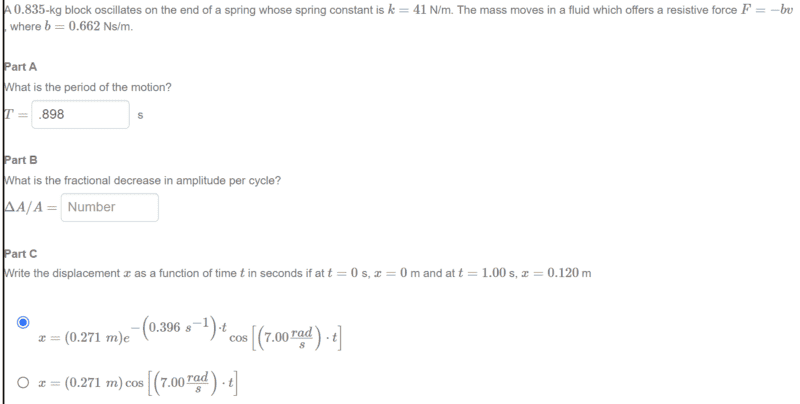
1659071596078.png

https://www.physicsforums.com/attachments/304960
 
Physics news on Phys.org
You should be able to find ##\phi## quickly from your first equation if you noticed that ##A## can't be zero (or can it be, what are your thoughts on this?)

Then once you know ##\phi## you can find ##A## from your second equation.

BTW I am not sure if you calculated ##\omega## correctly (if you want to show us how you calculated), seems to me 7 is the ##\omega_0## that is the angular frequency of the undamped system
 
Delta2 said:
You should be able to find ##\phi## quickly from your first equation if you noticed that ##A## can't be zero (or can it be, what are your thoughts on this?)

Then once you know ##\phi## you can find ##A## from your second equation.

BTW I am not sure if you calculated ##\omega## correctly (if you want to show us how you calculated), seems to me 7 is the ##\omega_0## that is the angular frequency of the undamped system
Hello, thank you for the response.
Indeed A cannot be 0 otherwise, there'd be no oscillation.
But I don't how I'd calculate ##\phi## from eq. (1), of course I know it's good for 3pi/2 and pi/2 but the problem is that I didn't see such an option in the multiple-choice selection, so I thought that it'd perhaps be some relation between the two equations. (i.e. they all just say ##cos(7t)## at the end)

And for ##\omega_0## what do you mean? it is calculated by ##\omega = \sqrt{\frac km + \frac {b^2}{4m^2}}##
 
  • Like
Likes   Reactions: Delta2
Delta2 said:
You should be able to find ##\phi## quickly from your first equation if you noticed that ##A## can't be zero (or can it be, what are your thoughts on this?)

Then once you know ##\phi## you can find ##A## from your second equation.

BTW I am not sure if you calculated ##\omega## correctly (if you want to show us how you calculated), seems to me 7 is the ##\omega_0## that is the angular frequency of the undamped system
oh dear god... my apologies there are sines in the multiple choices... didn't look through it. apologies, I'll try work it out now. Thanks.
 
  • Like
Likes   Reactions: Delta2
link223 said:
Hello, thank you for the response.
Indeed A cannot be 0 otherwise, there'd be no oscillation.
But I don't how I'd calculate ##\phi## from eq. (1), of course I know it's good for 3pi/2 and pi/2 but the problem is that I didn't see such an option in the multiple-choice selection, so I thought that it'd perhaps be some relation between the two equations. (i.e. they all just say ##cos(7t)## at the end)

And for ##\omega_0## what do you mean? it is calculated by ##\omega = \sqrt{\frac km + \frac {b^2}{4m^2}}##
Yes ok, now I see you used the correct formula for ##\omega## it is indeed rounded to 7, same as ##\omega_0##.
 
  • Like
Likes   Reactions: link223
link223 said:
And for ##\omega_0## what do you mean? it is calculated by ##\omega = \sqrt{\frac km + \frac {b^2}{4m^2}}##
Sorry for being a bit pedantic but isn't there supposed to be a minus instead of a plus, that is $$\omega=\sqrt{\frac{k}{m}-\frac{b^2}{4m^2}}$$
 
Delta2 said:
Yes ok, now I see you used the correct formula for ##\omega## it is indeed rounded to 7, same as ##\omega_0##.
what is the difference between saying ##\omega## and ##\omega_0## ?
 
Delta2 said:
Sorry for being a bit pedantic but isn't there supposed to be a minus instead of a plus, that is $$\omega=\sqrt{\frac{k}{m}-\frac{b^2}{4m^2}}$$
Oh yeah, .. you are totally right, my apologies!...
 
link223 said:
what is the difference between saying ω and ω0 ?
Delta2 said:
BTW I am not sure if you calculated ω correctly (if you want to show us how you calculated), seems to me 7 is the ω0 that is the angular frequency of the undamped system
we usually denote ω0 as the angular velocity of an undamped HO. ω02 = k/m
 
malawi_glenn said:
we usually denote ω0 as the angular velocity of an undamped HO. ω02 = k/m
oh okay thank you. So what'd then be the difference b/n angual velocity and angular frequency. We haven't studied rotational motion yet, hence why I am asking.
 
Orodruin said:
Did you solve the problem yet?
What were the other multiple choice options?
yep, forgot to post.
1659077846531.png
 
  • Like
Likes   Reactions: Delta2
link223 said:
yep, forgot to post.
View attachment 304967
As I suspected. You do not need to do any computations at all to discard all of the wrong answers:
- The first two can be discarded because they do not satisfy x=0 at t=0.
- The last and the second can be discarded because there is no damping term, just harmonic oscillation.
(So the second alternative is discarded by both arguments)

In multiple choice questions it often helps to first stop and think about if you can trivially rule out some alternatives by simple arguments. This often shows more understanding of the underlying physics than blindly entering into the algebra.
 
  • Like
Likes   Reactions: Steve4Physics and link223
Orodruin said:
As I suspected. You do not need to do any computations at all to discard all of the wrong answers:
- The first two can be discarded because they do not satisfy x=0 at t=0.
- The last and the second can be discarded because there is no damping term, just harmonic oscillation.
(So the second alternative is discarded by both arguments)

In multiple choice questions it often helps to first stop and think about if you can trivially rule out some alternatives by simple arguments. This often shows more understanding of the underlying physics than blindly entering into the algebra.
true you're right, I actually thought about as there won't be no multiple choice on the exam so most of the time I go straight for the analytical method.
Thanks for this pov.
 
also .. I actually forgot to ask..
I get ##\phi = \frac{\pi}{2}## and then ##cos(\omega + pi/2) = -sinx## ? but I think I got a negative answer for that second eq. to calculate A. and at part C you don't see any - sign ??

isn't it ##cos(-(pi/2 - x)) = sinx?## where we write a positive ##\phi## as ##cos(x - \pi/2)##
I mean.. if I get ##phi = pi/2## which is to the right in a sinosoidal func. don't I get ##cos(\omega - pi/2)## which is equal to## sin \omega##

But.. the position is written as ##x = Acos(\omega t + \phi)## with a ##+## instead of a ##-##
 
Last edited:
F me swinging... I confused myself, let me clarify.

So in the position eq. it's ##x = Acos(\omega t + \phi)##
whic means that if ##\phi == \pi/2## the cosine becomes ##cos(\omega t + pi/2) = -sin(\omega t)##
OR... my take on it which is why i don't understand why it says ##+ \phi## and not ##- \phi## in the positioni equation
because it is a phase shift to the right doesn't it become ##cos(\omega t - \pi/2)## ?
 
  • Wow
Likes   Reactions: Delta2
Delta2 said:
Yes you right you get negative A but the minus sign is neutralized by the other minus sign of ##\cos(\omega t+\frac{\pi}{2})=-\sin\omega t##
yes but not in the position equation in part C? in post #15
 
link223 said:
F me swinging... I confused myself, let me clarify.

So in the position eq. it's ##x = Acos(\omega t + \phi)##
whic means that if ##\phi == \pi/2## the cosine becomes ##cos(\omega t + pi/2) = -sin(\omega t)##
OR... my take on it which is why i don't understand why it says ##+ \phi## and not ##- \phi## in the positioni equation
because it is a phase shift to the right doesn't it become ##cos(\omega t - \pi/2)## ?
but then I guess I refer to it as being of such a form ##f(x) = Acos(bx - c)## which it is not.
 
Sorry I have lost you, the equation of position is $$x=Ae^{-0.396t}\cos(7t+\frac{\pi}{2})$$ in which if you replace ##A=-0.271## and ##\cos(7t+\frac{\pi}{2})=-\sin7t## you get option C of post #15.
 
  • Like
Likes   Reactions: link223
link223 said:
also .. I actually forgot to ask..
I get ϕ=π2 and then cos(ω+pi/2)=−sinx ? but I think I got a negative answer for that second eq. to calculate A. and at part C you don't see any - sign ??
You can pick either pi/2 or 3pi/2. It does not matter for the end result. All that will occur is that you reshuffle a minus sign into the constant A. All that matters for the solution is the product of A and the sine.
 
  • Like
Likes   Reactions: link223 and Delta2
Delta2 said:
Sorry I have lost you, the equation of position is $$x=Ae^{-0.396t}\cos(7t+\frac{\pi}{2})$$ in which if you replace ##A=-0.271## and ##\cos(7t+\frac{\pi}{2})=-\sin7t## you get option C of post #15.
owh right! my bad... okay yeah I forgot about the sign for A of courseee... thanks a lot.
 
Orodruin said:
You can pick either pi/2 or 3pi/2. It does not matter for the end result. All that will occur is that you reshuffle a minus sign into the constant A. All that matters for the solution is the product of A and the sine.
yep thanks a lot. I simply forgot the A sign, a lot of sign forgetting today it seems like ... I guess those days happen as well..
 
  • Like
Likes   Reactions: Delta2