Period and Velocity of Oscillating Sphere Attached to Spring

  • Thread starter Thread starter Nexus99
  • Start date Start date
  • Tags Tags
    Sphere Spring
Click For Summary

Homework Help Overview

The discussion revolves around a homogeneous sphere attached to a spring, focusing on its oscillatory motion on a rough horizontal plane. Participants are examining the period of oscillations, maximum angular velocity, and conditions for pure rolling, incorporating concepts from dynamics and rotational motion.

Discussion Character

  • Mixed

Approaches and Questions Raised

  • Participants explore the relationship between static and dynamic friction in the context of oscillation, questioning the assumptions made regarding friction types. Various methods are suggested, including energy conservation and analyzing forces for pure rolling conditions.

Discussion Status

There is an ongoing examination of the correctness of equations and assumptions, with some participants acknowledging errors in their reasoning. Multiple interpretations of the problem are being explored, and some guidance has been offered regarding the distinction between angular velocity and angular frequency.

Contextual Notes

Participants note issues with the rendering of LaTeX commands in the forum, which may affect the clarity of mathematical expressions shared in the discussion.

Nexus99
Messages
103
Reaction score
9
Homework Statement
Work in progress
Relevant Equations
Pure rolling condition
A homogeneous sphere of mass M and radius R is at rest on a rough horizontal plane with coefficient
of static friction μ . A spring of elastic constant k, is connected to the rotation axis of the sphere
illustrated in the figure. The center of mass of the sphere is positioned at rest so that the spring is
lengthened by a stretch equal to L, determine:
a) the period of oscillations of the sphere;
b) the maximum angular velocity of the sphere;
c) the maximum value of L for which the pure rolling speed is maintained.
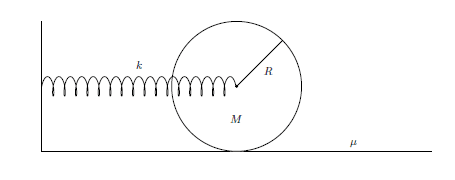
Cattura.PNG
I tried in this way:
a) if there is an oscillation there is no static friction but dynamic:
Projecting the two cardinal equations along the axis and considering the center of mass of the sphere the point about which the torque is being measured:

-F_{r} - kL = ma
F_{r}R = Ialpha = I a/R = 2/5MRa

F_{r} = 2/5Ma
- 5/7kL = ma k' = 5/7k
-k'L = ma

that is the equation of an harmonic oscillator with ω = √(5/7 k m), that represent the period of oscillations of the sphere, is this solution right?
 
Last edited by a moderator:
  • Like
Likes   Reactions: Delta2
Physics news on Phys.org
Okpluto said:
if there is an oscillation there is no static friction but dynamic:
That's a strange statement.. did you mean that?
Your equations assume static friction (αR=a).
 
  • Like
Likes   Reactions: Delta2
Yes, i realized after that i was wrong but i forgot to delete it
as for the procedure, is it correct?
 
Okpluto said:
Yes, i realized after that i was wrong but i forgot to delete it
as for the procedure, is it correct?
This is not quite right:
Okpluto said:
√(5/7 k m)
It is dimensionally wrong. You left out something. Other than that, I think it is ok.
 
haruspex said:
This is not quite right:

It is dimensionally wrong. You left out something. Other than that, I think it is ok.
Yes, i forgot a /, it should be:
ω = √(5/7 k/m)
thanks for help
 
  • Like
Likes   Reactions: Delta2
Very nice problem ( I like it a a lot really thanks for posting it @Okpluto )
For b) you got to be carefull not to confuse the angular velocity (or angular frequency) of oscillation with the angular velocity of the sphere
for c) you have already derived that for pure rolling we have $$F_r=\frac{2}{5}Ma$$. This becomes max when the acceleration ##a## becomes max and equal to ##\omega^2L##. We have to impose that $$max( F_r)\leq max(static friction)$$.
 
  • Like
Likes   Reactions: etotheipi and Adesh
Alternative method of solution: conserve energy. Let $$E = \frac{1}{2}m\dot{x}^2 + \frac{1}{2}I\omega^2 + \frac{1}{2}kx^2 = \frac{1}{2}m\dot{x}^2 + \frac{1}{2}\times \frac{2}{5}mr^2 \times {\left(\frac{\dot{x}}{r}\right)}^2 + \frac{1}{2}kx^2$$ and then set ##\frac{dE}{dt} = 0## since friction does no work during rolling: $$\frac{dE}{dt} = \frac{7}{5}m\dot{x}\ddot{x} + kx\dot{x} = 0 \implies \ddot{x} = -\frac{5k}{7m}x$$
 
Last edited by a moderator:
I think one should first assume that the system moves without slipping and find the friction force ##F=F(x,h)## where ##x## is the coordinate of the center of disk and ##h## is a constant of the energy integral. Then to consider the condition ##|F(x,h)|\le \mu mg##
 
Delta2 said:
Very nice problem ( I like it a a lot really thanks for posting it @Okpluto )
For b) you got to be carefull not to confuse the angular velocity (or angular frequency) of oscillation with the angular velocity of the sphere
for c) you have already derived that for pure rolling we have $$F_r=\frac{2}{5}Ma$$. This becomes max when the acceleration ##a## becomes max and equal to ##\omega^2L##. We have to impose that $$max( F_r)\leq max(static friction)$$.
I solved b and c in this way:

Cattura.PNG


EDIT: $$v_{cm} = \Omega R$$ not small omega
I had to write it in a Latex compiler because for me, in this forum, Latex doesn't always work for
 
Last edited by a moderator:
  • #10
Okpluto said:
I solved b and c in this way:

View attachment 263776

EDIT: $$v_{cm} = \Omega R$$ not small omega
I had to write it in a Latex compiler because for me, in this forum, Latex doesn't work (as you can see)
I think you are correct for b) and c). You could also do b) by using the equation of harmonic oscillator ##x=L\sin\omega t## and ##v_{CM}=\dot{x}=\omega L\cos\omega t## and hence setting the max value of $$max( v_{CM})=\omega L=\Omega_{max} R $$
 
  • #11
There seem to be some problems with the rendering of Latex commands, I hope they are going to be fixed soon.
 

Similar threads

Replies
1
Views
1K
  • · Replies 97 ·
4
Replies
97
Views
6K
Replies
3
Views
1K
  • · Replies 2 ·
Replies
2
Views
2K
Replies
1
Views
3K
  • · Replies 2 ·
Replies
2
Views
10K
Replies
19
Views
2K
  • · Replies 40 ·
2
Replies
40
Views
5K
Replies
9
Views
2K
  • · Replies 5 ·
Replies
5
Views
2K