Equation for the Internal Resistance of a Battery

Click For Summary
SUMMARY

The discussion focuses on calculating the internal resistance of a battery using the equation: ((Open circuit voltage / load circuit voltage) -1) * R. The Open Circuit Voltage (OCV) is defined as the voltage when no load is connected, while the Load Circuit Voltage (LCV) is the voltage when a resistor (R) is applied. By substituting specific values (OCV = 3.2V, LCV = 2.8V, R = 100 Ohm), the internal resistance (r) is calculated to be approximately 14.29 Ohms. The derivation of the equation involves solving simultaneous equations related to a potential divider circuit.

PREREQUISITES
  • Understanding of Open Circuit Voltage (OCV) and Load Circuit Voltage (LCV)
  • Basic knowledge of Ohm's Law and series circuits
  • Familiarity with algebraic manipulation of equations
  • Concept of potential divider circuits
NEXT STEPS
  • Study the derivation of the potential divider formula in electrical circuits
  • Learn about the impact of internal resistance on battery performance
  • Explore advanced techniques for measuring internal resistance in batteries
  • Investigate the applications of internal resistance calculations in battery management systems
USEFUL FOR

Electrical engineers, students in electronics, and professionals involved in battery technology and performance analysis will benefit from this discussion.

MrNewton
Messages
42
Reaction score
3
Hello,

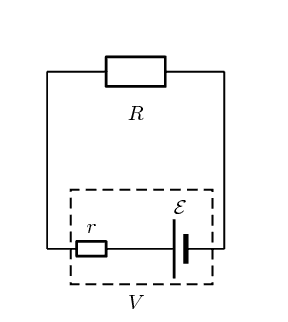
i am currently working on a project where i have to calculate the internal resistance of a battery based on the voltage drop caused by placing a resistor over the battery. I am an EE, and i understand how i can calculate the IR by schematic, but i found this equation:

((Open circuit voltage / load circuit voltage) -1) * R [1]

So the Open circuit voltage (OCV) is the voltage of the battery when nothing is connected to it. The load circuit voltage (LCV) is the voltage on the battery when a resistor (R) is placed.

So let's say OCV = 3.2V
LCD = 2.8V
R = 100 Ohm

So UR = 2.8V
IR = UR/R = 2.8/100 = 0.028A
Ur = OCV-UR = 0.4V
r = Ur/I = 0.4/0.028 = 14.2857 Ohms

If you do this by the first equation you get:
((3.2/2.8)-1)*100 = 14.2857
1592389529958.png


MY QUESTION: How did the get the first equation [1]? I can't simplify my equations and get the first equation.
 
Physics news on Phys.org
It's a series resistance, so LCV = R*I = R*OCV/(R+r). Solve for r and you get equation 1.
 
  • Like
Likes   Reactions: vanhees71, cnh1995 and Dale
What? I don't get it. Sorry :D
 
MrNewton said:
What? I don't get it. Sorry :D
It's the same as for a simple Potential Divider circuit. The ratio of the voltages across the Load and Internal resistors is the same as the ratio of the resistors. The total voltage is the emf (no load) voltage.
It boils down to solving two simultaneous equations. A bit of lower school Algebra.
 
  • Like
Likes   Reactions: Merlin3189
What is unclear?

The total resistance is R+r. This leads to a current of I=OCV/(R+r). The voltage at the outside resistor is then LCV =R*I=OCV/(R+r).
From there it's elementary algebra to get r=... Start by multiplying both sides of equation by (R+r).

Nearly the same steps as you did with numbers, just with the more general variables.
 
UR = LCV
i = LCV/R
Ur=OCV-UR
r=Ur/i = (OCV-UR)/i = (OCV-LCV)/i
r=(OCV-LCV)/(LCV/R) = (OCV/LCV -1)R
 

Similar threads

  • · Replies 105 ·
4
Replies
105
Views
12K
  • · Replies 12 ·
Replies
12
Views
6K
  • · Replies 10 ·
Replies
10
Views
2K
  • · Replies 9 ·
Replies
9
Views
4K
  • · Replies 16 ·
Replies
16
Views
2K
  • · Replies 3 ·
Replies
3
Views
2K
  • · Replies 9 ·
Replies
9
Views
2K
  • · Replies 1 ·
Replies
1
Views
2K
  • · Replies 11 ·
Replies
11
Views
2K
  • · Replies 3 ·
Replies
3
Views
3K