toolpusher123
- 64
- 0
Equations of Motion, help...
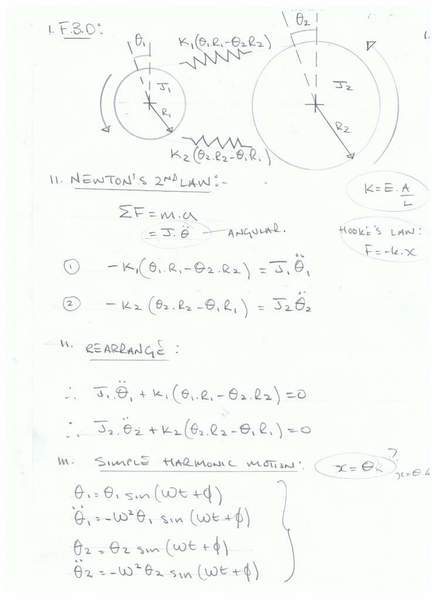
I'm attempting to draw a 'free body diagram' of 2 pulley's connected by a belt (open configuration), and hence derive the 'equations of motion'.
The issue I'm having is in regard to, the 'tight' & 'slack' sides & wheather they should be modeled in exactly the same way? Will the difference enter the problem when I put the spring constants in (K)?
Hooke's Law: F=-K.x
Newton's 2nd Law: ∑F=m.a ∴ T=J.θ"
F=Force
m=mass, J= mass moment of inertia
a=acceleration, θ"=angular acceleration,
x=displacement, θ=angular displacement
k=spring constant
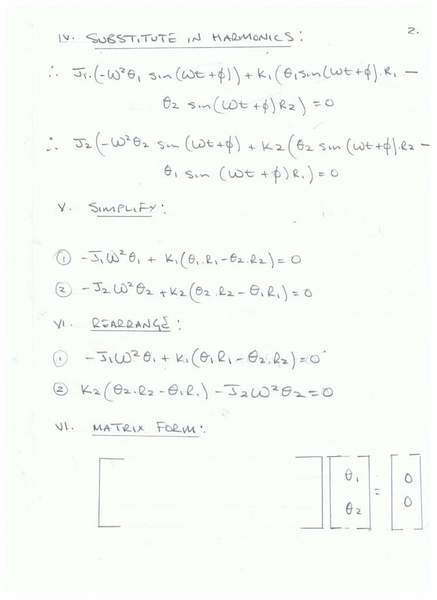
J1*θ"1+K1(θ1*r1-θ2*r2)=0
J2*θ"2+K2(θ2*r2-θ1*r1)=0
I've attached a drawing, it makes interpretation much easier, thanks...
Homework Statement
I'm attempting to draw a 'free body diagram' of 2 pulley's connected by a belt (open configuration), and hence derive the 'equations of motion'.
The issue I'm having is in regard to, the 'tight' & 'slack' sides & wheather they should be modeled in exactly the same way? Will the difference enter the problem when I put the spring constants in (K)?
Homework Equations
Hooke's Law: F=-K.x
Newton's 2nd Law: ∑F=m.a ∴ T=J.θ"
F=Force
m=mass, J= mass moment of inertia
a=acceleration, θ"=angular acceleration,
x=displacement, θ=angular displacement
k=spring constant
The Attempt at a Solution
J1*θ"1+K1(θ1*r1-θ2*r2)=0
J2*θ"2+K2(θ2*r2-θ1*r1)=0
I've attached a drawing, it makes interpretation much easier, thanks...