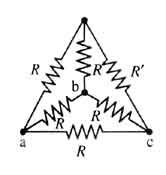
Equilavent Resistance of a Triangular Circuit

Dilemma
Messages
15
Reaction score
1
Hello,

Circuit:
mage=https%3A%2F%2Fphysics.knox.edu%2FOnlineHW%2Fphys130a%2Fspring%2Fhomework%2F09%2F02%2FP26_36.jpg


1. Homework Statement

Determine the net resistance between points a and c and a and b. Assume R' ≠ R.

Homework Equations


ε - IR = 0
V = IR

The Attempt at a Solution


http://i.imgur.com/Y2KPI20.jpg

I applied an emf between the points a and c, and tried to solve using Kirchhoff's rules. The question suggests me to use symmetry at junctions but I can not see any.

Thanks in advance.

 
Physics news on Phys.org
Hi Di, :welcome:,

From the picture it is not clear what you are doing. A few words might help. What do you mean when you write V = (a+b+c) Req ? To me a is the leftmost point in the circuit and you can't use a symbol twice.

There is no symmetry to exploit for the resistance between points a and c , but there is for the resistance between a and b.
 
BvU said:
There is no symmetry to exploit for the resistance between points a and c

Yes there is some symmetry you can exploit for a-c and it allows you to remove a resistor.
 
CWatters said:
Yes there is some symmetry you can exploit for a-c and it allows you to remove a resistor.

Ignore that. I didn't spot the R' not equal to R.
 
Thank you so much for your replies. a, b, and c denote the currents passing through each resistor. I'm using Kirchhoff's idea of "The directed sum of the electrical potential differences (voltage) around any closed network is zero "(Wiki). Therefore ε - Ia+b+cReq = 0

I noticed the so-called symmetry between the points a and b, though I can not utilize that because of the resistance R'.

If this question were not to include an hint, I would not ask this question and try to solve the mathematical equations that I discovered. The hint makes me wonder if I have been following the wrong path from the beginning.

I should also mentioned that I'm currently trying to find the Req between the points a and c.
 
Have you investigated whether ΔY or YΔ transformations might be useful here? When the symmetry is right they can be very easy to apply :wink:
 
Dilemma said:
I noticed the so-called symmetry between the points a and b, though I can not utilize that because of the resistance R'.
And what voltage difference do you expect over R' in the a-b case ?
 
Hello BvU,

Which part of the question are you focusing on? As I said, I'm currently trying to calculate the equivalent resistance between the points a and c.

Since you pointed out, second part of the question seems pretty straightforward, I shouldn't had that part included in the question. The potential difference on R' should be zero and the rest is very easy to calculate.

Dear gneill,

I do not know what those transformations are. I googled it but couldn't find a relevant source.
 
Dilemma said:
I do not know what those transformations are. I googled it but couldn't find a relevant source.
They are also called Delta-Y and Y-Delta.
 
  • #10
I believe we will not be covering that in my Phys102 class.
 
  • #11
Dilemma said:
I believe we will not be covering that in my Phys102 class.
Well, it is nevertheless a useful tool for simplifying resistor networks when you run into Y or Δ shaped configurations. In many cases it can allow you to avoid turning to writing and solving KVL and KCL equations, and let's you proceed with standard series and parallel reductions. The transformations are trivial when all the resistors have the same value.

Unless a problem explicitly tells you to solve by a certain method it should be fair game to use these transformations.
 
  • Like
Likes Dilemma

Similar threads

  • · Replies 18 ·
Replies
18
Views
3K
  • · Replies 3 ·
Replies
3
Views
2K
  • · Replies 11 ·
Replies
11
Views
2K
  • · Replies 8 ·
Replies
8
Views
2K
  • · Replies 8 ·
Replies
8
Views
3K
  • · Replies 10 ·
Replies
10
Views
900
  • · Replies 9 ·
Replies
9
Views
2K
  • · Replies 31 ·
2
Replies
31
Views
4K
  • · Replies 6 ·
Replies
6
Views
2K
  • · Replies 15 ·
Replies
15
Views
2K