Equilibrium Constant Table Method

Join the discussion
Ask a follow-up here, or get your own question answered by working scientists, mathematicians and engineers — people, not an autocomplete.
Real named experts · corrections over time · the nuance an AI answer skips
10 replies · 4K views
TheRedDevil18
Messages
406
Reaction score
2
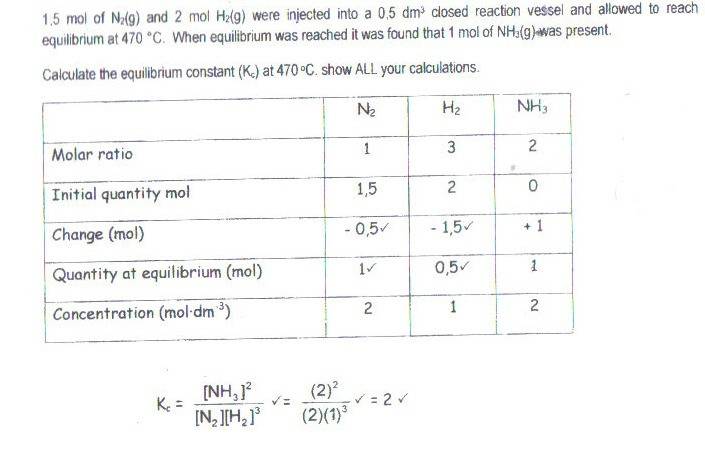
Hi, I just want someone to explain this table to me please, I am totally confused especially with the Change(mol).
Question below:
2drrole.jpg
 
Chemistry news on Phys.org
If 1 Mole of NH3 is produced, how many moles of N2 and H2 were used to do that?
Hint: Use the molar ratio.

If you know the initial quantity and the change, you get the quantity at equilibrium.
 
How?, still a bit confused. Could you show me?
 
Is "how" related to the quantity at equilibrium?
This is a simple addition. If you start with X moles and produce Y moles, you have X+Y moles.

Is "how" related to the other part?
Just keep in mind that the total number of atoms (both for N and H) cannot change.
 
I mean the Change, how do they get the change?
 
To produce 2 molecules of NH3, you need 1 molecule of N2 (to have 2 N atoms).
To produce 1 molecule of NH3, you need 1/2 molecule of N2.
To produce 1 mole of NH3 (this is given), you need 1/2 moles of N2.

It is that easy.
 
Okay I understand it now, mole ratio N2:NH3 1/2*1=0.5 and H2:NH3 3/2*1=1.5, the signs are negative because they are being used up right?
 
What would happen if the change is negative for NH3, Would it now mean that NH3 is being reversed back into its reactants and the reactants would be positive?
 
Okay I think that's it, Thanks for your help