Equilibrium of a Non-concurrent force system

Click For Summary
SUMMARY

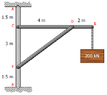
The discussion revolves around solving the equilibrium of a non-concurrent force system involving points A, B, C, D, and F. Participants emphasize the necessity of visualizing the forces and moments acting on the structure, suggesting that the problem can be simplified by treating the entire structure as a triangle. The importance of clearly showing work and calculations is highlighted, as it aids in identifying errors and understanding the problem better. Ultimately, the conversation stresses the need for a systematic approach to analyze the equilibrium conditions of the system.

PREREQUISITES
  • Understanding of static equilibrium principles
  • Knowledge of force and moment calculations
  • Familiarity with structural analysis concepts
  • Ability to visualize mechanical systems and their interactions
NEXT STEPS
  • Study the principles of static equilibrium in mechanical systems
  • Learn how to calculate moments about points in a structure
  • Explore methods for simplifying complex structures in analysis
  • Investigate the role of pivot supports in maintaining equilibrium
USEFUL FOR

Engineering students, structural analysts, and anyone involved in mechanics or physics who seeks to understand the principles of equilibrium in non-concurrent force systems.

hokage12368
Messages
4
Reaction score
0
Homework Statement
The frame is supported in pivots at A and B. Compute the horizontal reaction at A and the horizontal and vertical components of the reaction at B. Neglect the weight of the beams
Relevant Equations
How to compute it? Do I need to get the value of individual forces before I get the value of A and B?
IMG_20220208_081804.jpg
I tried solving it but I don't know how to start because I think that the given values are insufficient. I first tried to compute for individual forces of C, D, and F but I can't their values.
 

Attachments

  • 2.png
    2.png
    7.9 KB · Views: 182
Physics news on Phys.org
You need to show us what you tried so we can see where you're getting stuck.
 
vela said:
You need to show us what you tried so we can see where you're getting stuck.
IMG_20220208_084305.jpg

I try the moment of A and B but I don't know how to proceed after this or does my solution wrong?
 
Try considering the equilibrium of the horizontal rod first.
 
vela said:
Try considering the equilibrium of the horizontal rod first.
It is the same, after that I don't know how to proceed. May I know if the given values is sufficient to solve the problem? Maybe that's the problem why I can't solve it
 
Posting that you can't solve a problem isn't helpful. We can't see your paper or read your mind. Please show us your work.
 
vela said:
Posting that you can't solve a problem isn't helpful. We can't see your paper or read your mind. Please show us your work.
IMG_20220208_092431.jpg

Sorry, I as said before other than getting the equilibrium of A, B and C I don't know how to proceed anymore that's why other than what I posted here which is an incomplete solution, I don't have a complete solution. That's why I am asking for help on how to proceed or am I doing it right because I can't proceed any further.
 
Why all this fascination with detail, following forces through all the members ?
The particular structure shown weighs nothing and is perfectly rigid.
So step outside the box and replace the entire structure by one triangle, ABC.
Allow the problem to collapse, so you can see the solution in your head.
Or am I missing something ?
 
  • Like
Likes   Reactions: vela and Lnewqban
hokage12368 said:
View attachment 296760
Sorry, I as said before other than getting the equilibrium of A, B and C I don't know how to proceed anymore that's why other than what I posted here which is an incomplete solution, I don't have a complete solution. That's why I am asking for help on how to proceed or am I doing it right because I can't proceed any further.
Welcome!
Did you get any progress?
Can you visualize the function of each pivot support?
The frame and the load can rotate around the vertical axis A-B.
How are the pivots A and B stopping it from sliding down or tilting over?
 

Similar threads

  • · Replies 31 ·
2
Replies
31
Views
4K
  • · Replies 2 ·
Replies
2
Views
3K
  • · Replies 6 ·
Replies
6
Views
2K
  • · Replies 1 ·
Replies
1
Views
2K
  • · Replies 5 ·
Replies
5
Views
2K
Replies
6
Views
5K
  • · Replies 27 ·
Replies
27
Views
3K
  • · Replies 1 ·
Replies
1
Views
2K
  • · Replies 5 ·
Replies
5
Views
2K
  • · Replies 6 ·
Replies
6
Views
4K