maitake91
- 9
- 4
- Homework Statement
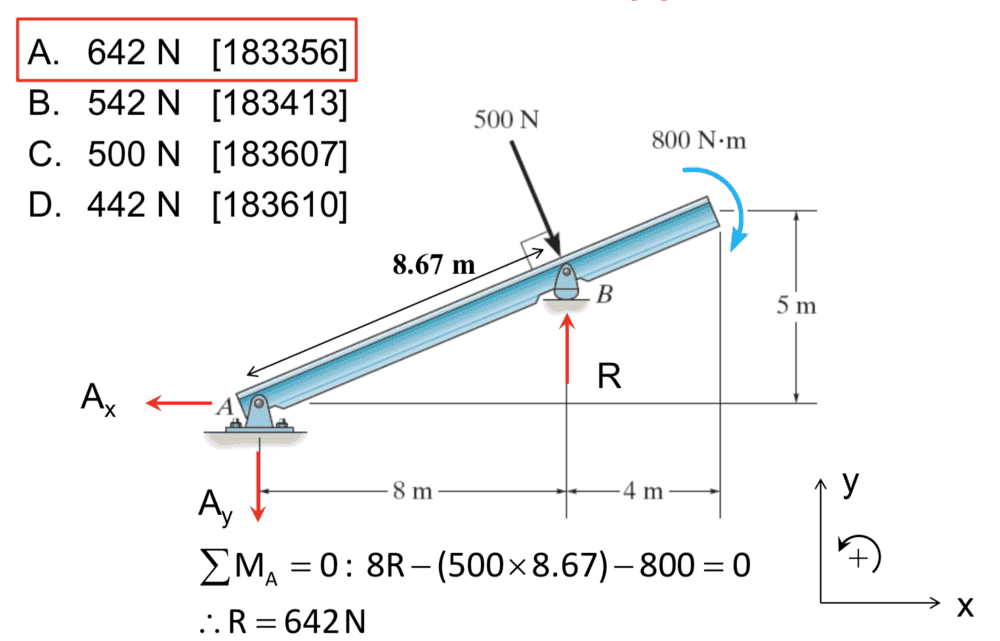
- Solve the value of R based on the diagram attached.
- Relevant Equations
- Sum of moment in equilibrium = 0
Summary:: I need some help with moment when using equations of equilibrium
Edit: Sorry I forgot to say what the question was! The question was to solve the value of R based on the diagram below alone.
I was solving the question below and I tried to resolve R into a force that is perpendicular to the beam, but I couldn't. So then I looked at the workout for the answer, and apparently you don't have to do that, since they just used R to multiply 8. I don't understand why this is the case. By intuition, I imagine if I tried to push a beam with the same force but did it diagonally instead of at a position perpendicularly towards the beam, it makes more sense to me that it would spin slower. Please can someone explain to me why I am wrong? I would really appreciate the help.
Edit: Sorry I forgot to say what the question was! The question was to solve the value of R based on the diagram below alone.
I was solving the question below and I tried to resolve R into a force that is perpendicular to the beam, but I couldn't. So then I looked at the workout for the answer, and apparently you don't have to do that, since they just used R to multiply 8. I don't understand why this is the case. By intuition, I imagine if I tried to push a beam with the same force but did it diagonally instead of at a position perpendicularly towards the beam, it makes more sense to me that it would spin slower. Please can someone explain to me why I am wrong? I would really appreciate the help.
Last edited:
 !
!
