Equipotential surfaces for an electric dipole

Click For Summary
SUMMARY

The discussion centers on the nature of equipotential surfaces for an electric dipole, specifically addressing the misconception that these surfaces are spherical. Participants assert that the equipotential surfaces are not spherical but rather take on a more complex shape, potentially resembling ellipses or other non-standard curves. The mathematical expressions for the potential field of a dipole are referenced, emphasizing that the equipotential lines do not conform to simple geometric shapes. The conclusion drawn is that the only true equipotential surface is the equatorial plane bisecting the dipole axis.

PREREQUISITES
  • Understanding of electric dipoles and their potential fields
  • Familiarity with equipotential surfaces and their properties
  • Knowledge of polar coordinates and their application in physics
  • Basic proficiency in mathematical modeling and analysis
NEXT STEPS
  • Study the mathematical derivation of the electric potential for a dipole using the formula $$V = \frac{k~p~\cos(\theta)}{r^2}$$
  • Explore the concept of equipotential surfaces in different geometries, including ellipsoidal shapes
  • Learn about the implications of dipole moments in molecular physics, particularly in polar molecules
  • Investigate the use of plotting software to visualize equipotential surfaces and lines for electric dipoles
USEFUL FOR

Students and professionals in physics, particularly those focusing on electromagnetism, electrical engineering, and molecular chemistry, will benefit from this discussion. It provides insights into the complexities of electric dipole behavior and equipotential surface analysis.

vcsharp2003
Messages
913
Reaction score
179
Homework Statement
Question:
Equipotential surfaces associated with an electric dipole are

a) spheres centered on the dipole

b) cylinders with axes along the dipole moment.

c) planes parallel to the dipole moment.

d) planes perpendicular to the dipole moment.

e) None of the above
Relevant Equations
None
The answer is given as (a), but I think it's not correct based on the equipotential surfaces diagram given in our book for an electric dipole as below.

The red dashed lines, which are supposed to be the equipotential surfaces, are surely not representing a sphere centred at the dipole center. So, in my view, the correct answer is "(e) None of the above".
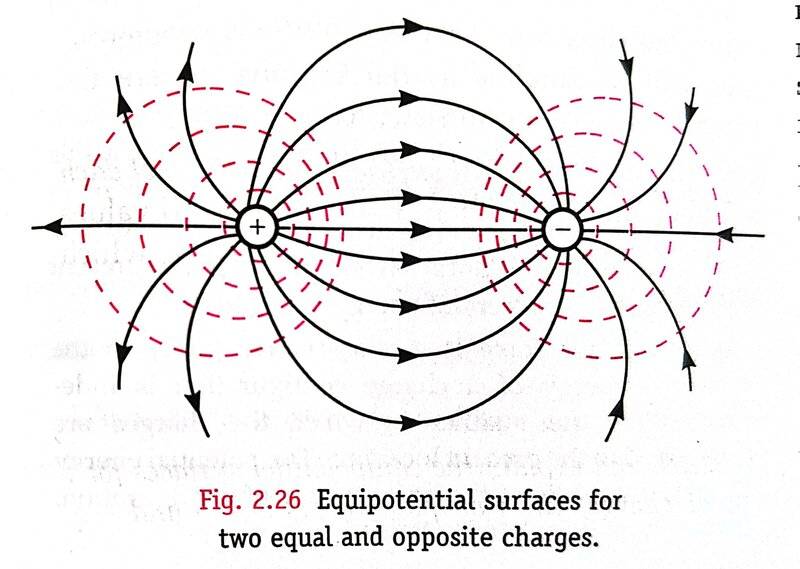
CamScanner 04-19-2023 11.49_1.jpg
 
Last edited:
Physics news on Phys.org
I would agree with you. To me arguing that the equipotential surfaces of a dipole are spheres centered at the dipole is essentially saying that a dipole and a monopole are the same thing……which is insane.

Physical dipole or ideal dipole.
 
  • Like
Likes   Reactions: topsquark, DeBangis21 and vcsharp2003
PhDeezNutz said:
I would agree with you.
Ok. Thanks for your answer. One more question regarding this example. Are the equipotential surfaces for a dipole still spherical or are they some form of a conic?
 
That you can answer yourself using the expressions for the potential field...
:smile:

##\ ##
 
  • Like
Likes   Reactions: topsquark and vcsharp2003
vcsharp2003 said:
Ok. Thanks for your answer. One more question regarding this example. Are the equipotential surfaces for a dipole still spherical or are they some form of a conic?

Are we talking about a physical dipole or an ideal dipole?

for an ideal dipole definitely not because the spacing is so small the equipotential lines will smoosh together.

I'd have to work it out for a physical dipole.
 
  • Like
Likes   Reactions: vcsharp2003
PhDeezNutz said:
Are we talking about a physical dipole or an ideal dipole?

for an ideal dipole definitely not because the spacing is so small the equipotential lines will smoosh together.

I'd have to work it out for a physical dipole.
As a guess, just by looking at the diagram, each dashed red line is definitely not a circle, so probably it would be some sort of an ellipse. And therefore, each equipotential surface would not be spherical.
 
Simply write down the potential ##\Phi(\vec{r})## for a dipole and check, what the surfaces ##\Phi(\vec{r})=\text{const}## are.
 
  • Like
Likes   Reactions: topsquark and vcsharp2003
One knows by (anti)symmetry that the plane between them is equipotential usually chosen =0
 
  • Like
Likes   Reactions: topsquark and vcsharp2003
  • #10
Well, that plane can be considered a (rather big :wink:) sphere ...

##\ ##
 
  • Like
  • Haha
Likes   Reactions: topsquark, PhDeezNutz and vanhees71
  • #11
centered very far away
 
  • Like
Likes   Reactions: topsquark and PhDeezNutz
  • #12
This is an elaboration of post #7 by @vanhees71.

Say it is true that "spheres centered on the dipole" are equipotentials. Call the direction of the dipole ##\mathbf{\hat z}.~## You could go to distance ##r## at angle ##\theta## relative to ##z## and construct such a sphere of radius ##r## centered at the dipole. Now go to the diametrically opposing point on the sphere and see whether the potential has the same value as the starting point. It does not. In fact it is the negative of that value. That's because $$V_i=\frac{k~p\cos(\theta)}{r^2}~~\text{and}~~V_f=\frac{k~p\cos(\theta + \pi)}{r^2}=-\frac{k~p\cos(\theta)}{r^2}=-V_i.$$The two points on the surface of the sphere are not at the same potential. One can see that the only equipotential is the ##xy##-plane where ##\theta = \frac{\pi}{2}## and ##V_i=V_f=0.##
 
Last edited:
  • Like
Likes   Reactions: topsquark, vcsharp2003, hutchphd and 1 other person
  • #13
BvU said:
Well, that plane can be considered a (rather big :wink:) sphere ...

##\ ##
Why would that plane be a sphere? Or maybe you were just joking.

The zero potential points will lie only on the equatorial plane that bisects the dipole axis and is perpendicular to the dipole axis, since all points on such a plane will be equidistant from either +q or -q charge resulting in algebraic sum of the potentials due to +q and -q being zero.
 
  • #14
vcsharp2003 said:
Why would that plane be a sphere?
A plane is the limit of a sphere radius r, centre at r from O, as r tends to infinity.
It is treated as a special case of a sphere in some branches of geometry, such as https://en.wikipedia.org/wiki/Inversive_geometry
 
  • Like
Likes   Reactions: topsquark and vcsharp2003
  • #15
haruspex said:
A plane is the limit of a sphere radius r, centre at r from O, as r tends to infinity.
It is treated as a special case of a sphere in some branches of geometry, such as https://en.wikipedia.org/wiki/Inversive_geometry
I see. I never knew that. Thankyou.
 
  • #16
vcsharp2003 said:
each dashed red line is definitely not a circle

BvU said:
Don't look like no spheres to me though
Quite…

##\frac 1{\sqrt{y^2+(x-a)^2}}-\frac 1{\sqrt{y^2+(x+a)^2}}=c##
##y^2+(x+a)^2+y^2+(x-a)^2-2\sqrt{(y^2+(x+a)^2)(y^2+(x-a)^2)}=c^2(y^2+(x+a)^2)(y^2+(x-a)^2)##
##2(y^2+x^2+a^2)-2\sqrt{(y^2+x^2+a^2+2xa)(y^2+x^2+a^2-2xa)}=c^2(y^2+x^2+a^2+2xa)(y^2+x^2+a^2-2xa)##
Writing ##z^2=(x^2+y^2+a^2)## and ##w^4=z^4-4a^2x^2##:
##2z^2=2w^2+c^2w^4##
 
  • Like
Likes   Reactions: BvU and vcsharp2003
  • #17
haruspex said:
Quite…

##\frac 1{\sqrt{y^2+(x-a)^2}}-\frac 1{\sqrt{y^2+(x+a)^2}}=c##
##y^2+(x+a)^2+y^2+(x-a)^2-2\sqrt{(y^2+(x+a)^2)(y^2+(x-a)^2)}=c^2(y^2+(x+a)^2)(y^2+(x-a)^2)##
##2(y^2+x^2+a^2)-2\sqrt{(y^2+x^2+a^2+2xa)(y^2+x^2+a^2-2xa)}=c^2(y^2+x^2+a^2+2xa)(y^2+x^2+a^2-2xa)##
Writing ##z^2=(x^2+y^2+a^2)## and ##w^4=z^4-4a^2x^2##:
##2z^2=2w^2+c^2w4##
If I wanted to know the equation of the red dashed line i.e. equation of red dashed curve in two dimensions like in terms of x and y, then would I plugin z = 0 in the final form of equation of the surface you have got? If I do that then the first term on the right side would be an imaginary term.
 
Last edited:
  • #18
vcsharp2003 said:
If I wanted to know the equation of the red dashed line i.e. equation of red dashed in two dimensions like in terms of x and y, then would I plugin z = 0 in the final form of equation of the surface you have got? If I do that then the first term on the right side would be an imaginary term.
My z has nothing to do with x,y,z coordinates.
 
  • Like
Likes   Reactions: vcsharp2003
  • #19
haruspex said:
My z has nothing to do with x,y,z coordinates.
I see.
 
  • #20
haruspex said:
My z has nothing to do with x,y,z coordinates.
I did my own analysis, as shown below, to get the equation of an equipotential line that is shown in my original post ( i.e. not an equipotential surface). I end up with an equation that's impossible to interpret as being an equation of some standard curve like circle or ellipse.

CamScanner 04-20-2023 14.04_1.jpg
 
  • #21
vcsharp2003 said:
I did my own analysis, as shown below, to get the equation of an equipotential line that is shown in my original post ( i.e. not an equipotential surface). I end up with an equation that's impossible to interpret as being an equation of some standard curve like circle or ellipse.
… as the image @BvU linked illustrates.
 
  • Like
Likes   Reactions: vcsharp2003
  • #22
haruspex said:
… as the image @BvU linked illustrates.
I see. Then, one can conclude that the red dashed line is surely neither a circle nor an ellipse. It's just some non-standard closed curve.
 
  • #23
vcsharp2003 said:
I see. Then, one can conclude that the red dashed line is surely neither a circle nor an ellipse. It's just some non-standard closed curve.
Right.
 
  • Like
Likes   Reactions: PhDeezNutz and vcsharp2003
  • #24
vcsharp2003 said:
I did my own analysis, as shown below, to get the equation of an equipotential line that is shown in my original post ( i.e. not an equipotential surface). I end up with an equation that's impossible to interpret as being an equation of some standard curve like circle or ellipse.
The point dipole potential in polar coordinates shown in post #12 is easier to handle. It is an approximation in the limit ##r=\sqrt{x^2+y^2}>>a##, i.e. for distances much larger than the separation between charges. You can get this result using a Taylor expansion of your expression for small ##a/r.##

You can make a polar plot of equipotentials, quite easily, if you have a plotting program. The relevant equation is obtained as follows $$V=\frac{k~p~\cos(\theta)}{r^2}=\text{const.}\implies r=\pm C\sqrt{\cos(\theta)}~.$$ Below are shown equipotential plots for ##C=1, \frac{3}{2},2##. Positive values in blue, negative values in red. Note that there is no separation between equipotentials at the origin as expected for a pure point dipole.
Dipole.jpg
 
  • Like
Likes   Reactions: BvU, vcsharp2003, vanhees71 and 1 other person
  • #25
kuruman said:
The point dipole potential in polar coordinates shown in post #12 is easier to handle. It is an approximation in the limit r=x2+y2>>a, i.e. for distances much larger than the separation between charges.
I used to think that a point dipole is one in which the positions of +q and
-q charges coincide like in non-polar dielectrics. But, it seems, I was wrong.
 
  • #26
vcsharp2003 said:
I used to think that a point dipole is one in which the positions of +q and
-q charges coincide like in non-polar dielectrics. But, it seems, I was wrong.
It's just a model for finding the electric potential of, for example, polarized atoms or molecules in which the positive charge density ##\rho_+## and the negative charge density ##\rho_-## come into play. The monopole term is $$Q=\int_V\left(\rho_+(r)+\rho_-(r)\right)dV$$ and is zero if the atom or molecule is neutral. The dipole term of the atom is the charge density weighted by the position of the charge, $$\vec{p}=\int_V\left[\rho_+ (r) +\rho_-(r)\right]~\vec{r}~dV =\int_V\rho_+(r)~\vec{r}~dV+ \int_V\rho_-(r)~\vec{r}~dV.$$ This term may or may not be zero depending on how the positive and negative charges are distributed within the atom or molecule. Notably, the water molecule has a dipole moment which can be considered a point dipole but the picture is not that of a positive and a negative point charge separated by some distance.
 
  • Like
Likes   Reactions: vcsharp2003

Similar threads

  • · Replies 19 ·
Replies
19
Views
2K
Replies
1
Views
2K
Replies
2
Views
3K
  • · Replies 2 ·
Replies
2
Views
2K
Replies
1
Views
2K
  • · Replies 25 ·
Replies
25
Views
2K
Replies
1
Views
1K
  • · Replies 6 ·
Replies
6
Views
3K
  • · Replies 1 ·
Replies
1
Views
5K
  • · Replies 21 ·
Replies
21
Views
2K