Understanding Theorem 3.43: Comparing U_B & V_k in Stromberg's Book

  • Context: MHB 
  • Thread starter Thread starter Math Amateur
  • Start date Start date
  • Tags Tags
    Equivalent Theorem
Click For Summary
SUMMARY

The discussion centers on Theorem 3.43 from Karl R. Stromberg's "An Introduction to Classical Real Analysis," specifically regarding the enumeration of sets in the proof. Participants clarify that the sets \( V_k \) are indeed elements of the collection \( \mathscr{V} \), which consists of open sets in the space \( X \). The choice to denote these sets as \( V_k \) rather than \( U_{B_k} \) is attributed to authorial preference and notation conventions in mathematics, not to any inherent difference in the sets themselves.

PREREQUISITES
  • Understanding of set theory and indexed sets
  • Familiarity with open sets in topology
  • Knowledge of limits and continuity in real analysis
  • Basic comprehension of mathematical notation and terminology
NEXT STEPS
  • Study the concept of indexed families of sets in topology
  • Review the definitions and properties of open sets in metric spaces
  • Examine the proofs of other theorems in Stromberg's book for context
  • Learn about notation conventions in mathematical proofs
USEFUL FOR

Students of real analysis, mathematicians interested in topology, and anyone seeking to deepen their understanding of Theorem 3.43 in Stromberg's work.

Math Amateur
Gold Member
MHB
Messages
3,920
Reaction score
48
I am reading Karl R. Stromberg's book: "An Introduction to Classical Real Analysis". ... ...

I am focused on Chapter 3: Limits and Continuity ... ...

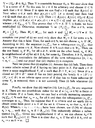
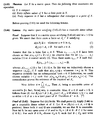
I need further help in order to fully understand the proof of Theorem 3.43 on pages 105-106 ... ... Theorem 3.43 and its proof read as follows:

View attachment 9149
View attachment 9150

At about the middle of the above proof by Stromberg we read the following:

" ... ... Otherwise enumerate $$\mathscr{V}$$ as $$\{ V_k \}_{ k = 1 }^{ \infty }$$. ... ... "I am wondering what are the $$V_k$$ ... are they elements of $$\mathscr{V}$$ (... that is, the $$U_B$$) ... or are they sets of some kind ... ... can someone please explain and elucidate the nature of the $$V_k$$ ...

... indeed maybe the $$V_k$$ are just equal to the $$U_B$$ ... in that case why not enumerate $$\mathscr{V}$$ as $$\{ U_{ B_k } \}_{ k = 1 }^{ \infty }$$ ...

Hope someone can help ...

Peter
 

Attachments
  • Stromberg - 1 - Theorem 3.43 ... ... PART 1 ... .... .png
    Stromberg - 1 - Theorem 3.43 ... ... PART 1 ... .... .png
    46.1 KB · Views: 158
  • Stromberg - 2 - Theorem 3.43 ... ... PART 2 ... .... ... .png
    Stromberg - 2 - Theorem 3.43 ... ... PART 2 ... .... ... .png
    57 KB · Views: 140
Last edited:
Physics news on Phys.org
Peter said:
At about the middle of the above proof by Stromberg we read the following:

" ... ... Otherwise enumerate $$\mathscr{V}$$ as $$\{ V_k \}_{ k = 1 }^{ \infty }$$. ... ... "I am wondering what are the $$V_k$$ ... are they elements of $$\mathscr{V}$$ (... that is, the $$U_B$$) ... or are they sets of some kind ... ... can someone please explain and elucidate the nature of the $$V_k$$ ...

... indeed maybe the $$V_k$$ are just equal to the $$U_B$$ ... in that case why not enumerate $$\mathscr{V}$$ as $$\{ U_{ B_k } \}_{ k = 1 }^{ \infty }$$ ...
I haven't read this proof carefully, but I am sure that you are correct: the elements of $$\mathscr{V}$$ are exactly the sets $$U_B$$, and it would be quite permissible to enumerate them as $$\{ U_{ B_k } \}_{ k = 1 }^{ \infty }$$ (though that implies that you have enumerated the sets $$U_B$$). I think that Stromberg found it better to enumerate the sets in $$\mathscr{V}$$ directly, rather than indirectly by enumerating the sets in $\mathscr{B}$. In that way, he avoids cumbersome double subscripts.
 

First of all, it's great that you are reading Stromberg's book and focusing on Chapter 3. Limits and continuity can be a challenging topic, so it's understandable that you may need some extra help understanding Theorem 3.43.

To answer your question, V_k are indeed elements of \mathscr{V}, which is the collection of all open sets in the space X. In other words, they are sets of some kind. The reason for enumerating them as V_k instead of U_{B_k} is simply a matter of notation and preference. Both notations are commonly used in mathematics, so it's up to the author's discretion which one they choose to use in their proof.

In this case, Stromberg has chosen to use V_k to represent the elements of \mathscr{V}, which is a common notation for indexed sets. It's important to note that the notation V_k does not necessarily mean that the sets are equal to U_B. V_k is just a way to refer to the elements of \mathscr{V} in the proof.

I hope this helps clarify the nature of V_k in the proof of Theorem 3.43. If you have any further questions or need more clarification, don't hesitate to ask. Good luck with your studies!
 

Similar threads

Replies
2
Views
2K
Replies
2
Views
2K
Replies
5
Views
2K
Replies
2
Views
2K
Replies
2
Views
2K
  • · Replies 5 ·
Replies
5
Views
3K
Replies
2
Views
2K
  • · Replies 7 ·
Replies
7
Views
2K
  • · Replies 3 ·
Replies
3
Views
2K
Replies
2
Views
2K