Discussion Overview
The discussion centers on the relationship between escape velocity and the radius of the Earth, exploring whether escape velocity is directly or inversely proportional to the radius. Participants examine different formulas and concepts related to gravitational acceleration and potential energy, considering various assumptions such as uniform density.
Discussion Character
- Exploratory, Technical explanation, Debate/contested
Main Points Raised
- Some participants note that there are two different formulas for escape velocity, leading to confusion about its dependence on the radius of the Earth.
- It is proposed that gravitational acceleration (g) is inversely proportional to the square of the radius, which suggests that as the radius increases, g decreases, affecting escape velocity.
- One participant emphasizes the need to clarify which quantities are held constant when determining the relationship between escape velocity and radius.
- Another participant discusses the relationship between escape velocity and gravitational potential energy, presenting equations that relate these concepts.
- There is mention of the potential difference between the surface and infinity, and how this relates to escape velocity.
- Some participants express confusion about the mathematical notation used in the discussion, seeking clarification on LaTeX rendering.
Areas of Agreement / Disagreement
Participants express differing views on the nature of the relationship between escape velocity and the radius of the Earth, with no consensus reached on whether it is directly or inversely proportional. The discussion remains unresolved regarding the proper dependence of escape velocity on radius.
Contextual Notes
Participants discuss various assumptions, such as the uniformity of density, which may affect the conclusions drawn about escape velocity and gravitational acceleration.
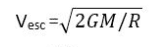 and
and
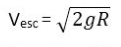 . If we look at the first formula we see that escape velocity is inversely proportional to the square root of Radius of Earth. While in the second formula, escape velocity is directly proportional to the square root of Radius of Earth.