How Does the Euler-Lagrange Equation Apply to Parametric Solutions?

  • Thread starter Thread starter Another
  • Start date Start date
  • Tags Tags
    Euler-lagrange
Click For Summary
The discussion centers on the application of the Euler-Lagrange equation to parametric solutions, specifically addressing the definition of a function in the context of the equation y_x = (b+y)/(a-y)². The book presents a solution in the form y = y(θ(x)), which is derived from a clever substitution that simplifies solving the differential equation. There is a noted concern about the exponent in the equation, suggesting it should be 1/2 instead of 2. This substitution facilitates finding a parametric solution, expressed as y(θ) and x(θ), where θ serves as a parameter. The conversation emphasizes the importance of understanding these relationships in solving differential equations effectively.
Another
Messages
104
Reaction score
5
Homework Statement
I am wondering about definition of a function
Relevant Equations
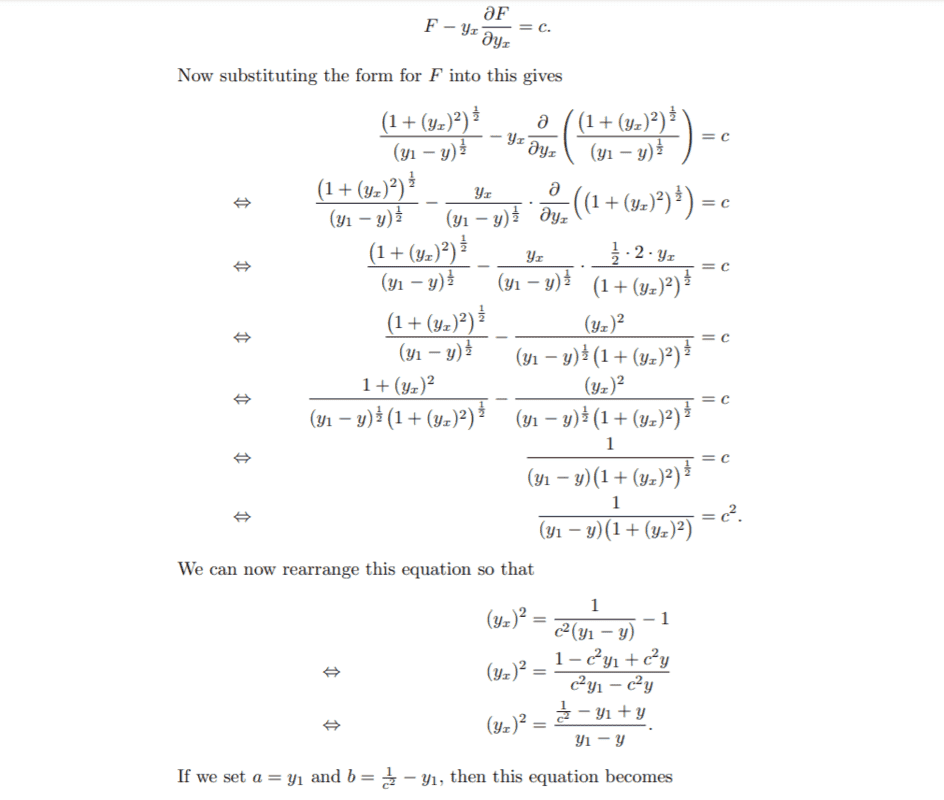
## F = \frac{(1+(y_x)^2)^{\frac{1}{2}}}{(y_1-y)^{\frac{1}{2}}}##
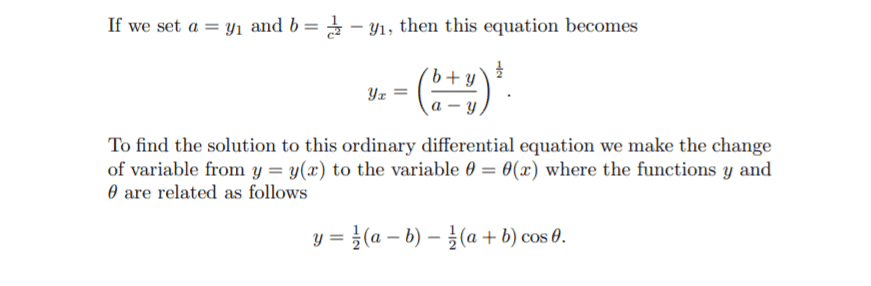
My question : I am wondering about definition of a function. when ##y_x = (\frac{b+y}{a-y})^2##

Why in this book is defined solution ##y = y(x)## in from ## y = y(θ(x))## . And have a relationship in the form

## y = \frac{1}{2} (a-b) - \frac{1}{2} (a+b) cosθ ## ?

_____________________________________________________________________________________________________________________________________
In this book is defined ## F = \frac{(1+(y_x)^2)^{\frac{1}{2}}}{(y_1-y)^{\frac{1}{2}}}##

The E-L equation in case F = ##F(y,y_x)## ===> ##F - y_x \frac{∂F}{∂y_x} = c## when c is constant.
qqwqwqw.png


aasdd.png
 
Physics news on Phys.org
Another said:
My question : I am wondering about definition of a function. when ##y_x = (\frac{b+y}{a-y})^2##
The exponent should be 1/2 rather than 2.

Why in this book is defined solution ##y = y(x)## in from ## y = y(θ(x))## . And have a relationship in the form

## y = \frac{1}{2} (a-b) - \frac{1}{2} (a+b) cosθ ## ?
This is just a very clever substitution that allows you to fairly easily find a solution of the differential equation, ##y_x = (\frac{b+y}{a-y})^{1/2}##. It yields a solution in parametric form: ##y(\theta)## ; ##x(\theta)##, where ##\theta## is a parameter.
 
TSny said:
The exponent should be 1/2 rather than 2.This is just a very clever substitution that allows you to fairly easily find a solution of the differential equation, ##y_x = (\frac{b+y}{a-y})^{1/2}##. It yields a solution in parametric form: ##y(\theta)## ; ##x(\theta)##, where ##\theta## is a parameter.
thank you very much
 
The book claims the answer is that all the magnitudes are the same because "the gravitational force on the penguin is the same". I'm having trouble understanding this. I thought the buoyant force was equal to the weight of the fluid displaced. Weight depends on mass which depends on density. Therefore, due to the differing densities the buoyant force will be different in each case? Is this incorrect?

Similar threads

  • · Replies 5 ·
Replies
5
Views
2K
Replies
4
Views
4K
Replies
8
Views
2K
Replies
42
Views
3K
Replies
1
Views
1K
  • · Replies 15 ·
Replies
15
Views
6K
  • · Replies 11 ·
Replies
11
Views
1K
  • · Replies 9 ·
Replies
9
Views
2K
Replies
3
Views
974