Evanescent field of a waveguide

Click For Summary
SUMMARY

The discussion centers on the behavior of the evanescent field in waveguides, particularly focusing on the differences in field decay between cladding and air. It highlights the significance of refractive indices and the application of Snell's law in understanding mode field behavior. The equation derived from the wave equation, ##\nabla^2 \psi + k_i^2 \psi = 0##, is crucial for analyzing the transverse mode functions across different media. The conversation also addresses the impact of the propagation constant, ##\gamma##, on field decay, emphasizing that greater damping leads to shorter distances for the evanescent field.

PREREQUISITES
  • Understanding of waveguide theory and evanescent fields
  • Familiarity with Snell's law and refractive indices
  • Knowledge of wave equations and propagation constants
  • Basic concepts of scalar fields and separation of variables
NEXT STEPS
  • Study the derivation and implications of the wave equation in different media
  • Explore the mathematical principles behind Snell's law and its applications in optics
  • Investigate the effects of refractive index on evanescent field behavior in various materials
  • Learn about the significance of the propagation constant, ##\gamma##, in waveguide applications
USEFUL FOR

Optical engineers, physicists, and students studying waveguide technology or photonics will benefit from this discussion, particularly those interested in the behavior of evanescent fields and their applications in optical systems.

Sciencestd
Messages
60
Reaction score
9
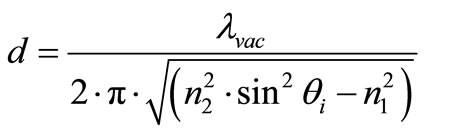
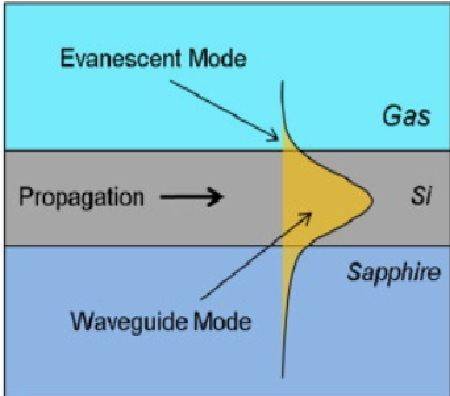
If we look to the figure, in several articles they mentioned that the part of the mode field, the tail of the mode field diameter, travel in the cladding, this maybe I can understand that because of a little change between the refractive indices of the core and the cladding, then the transverse mode field will encounter less change. Then they mentioned that the other side they took off the cladding so now let say it is air, then the length of the evanescent field in that side obey to the equation as in the second picture, and the field is rapidly decaying... Why?! What is the physical reason? which equations include that? why should the transvers part changed to this situation?
Images source: https://www.researchgate.net/publication/44067714 and scirp.org
physics forum.jpg
ygmsc.jpg
 
Science news on Phys.org
If I take the equation at face value (it looks real sensible)

## n_{\text{Si}}^2 \sin^2 \theta - n_{\text{gas}}^2 \gt n_{\text{Si}}^2 \sin^2 \theta - n_{\text{Sapphire}}^2##

so that

## d_{\text{gas}} \lt d_{\text{Sapphire}}## since ##n_{\text{gas}}\approx 1 \lt d_{\text{Sapphire}}##

In a wave guide one can always separate (as a product of functions) the transverse wave from the longitudinal because of translational symmetry along the guide. The transverse mode function obeys a wave equation in each medium each with a different propagation factor.
 
  • Like
Likes   Reactions: Sciencestd
Thank so much for your help! :)
I have two questions: The first equation I can seek from Snell's law, but why to square them?
The second question is why then the mode field tail in sapphire can reach several micrometers but the evanescent field in low medium like gas just few nanometers (it's wavelength dependent in the equation "d=..")?
 
Sciencestd said:
The first equation I can seek from Snell's law, but why to square them?
Let's assume planar geometry with scalar field, ##\psi(x,y,z)##. The wave equation is,

## \nabla^2 \psi + k_i^2 \psi = 0##

where ##i## is Gas, Si, or Sapphire depending on where the point ##(x,y,z)## is. The wave number, ##k_i = \omega n_i##, so the square comes from the wave equation. ##\omega## is the angular frequency, ##\omega = 2\pi f##.

[sorry for all the edits]

Sciencestd said:
The second question is why...

Use separation of variables (I can do this because I chose plain geometry)

## \psi(x,y,z) = \chi(x)\eta(y)e^{-i\gamma z}##

and grind. I'd look at the case ##\eta(y) = 1## so it drops out. Note that one must solve for ##\gamma## the waveguide propagation constant. The wave equation for ##\chi## is one dimensional,

##\frac{d^2\chi}{dx^2} + (k^2_i - \gamma^2)\chi = 0##

##\gamma## is a constant for any given solution of the full problem. What happens when ##\gamma \gt k_i## is ##\chi## becomes exponentially damped. The bigger the dampening the shorter the distance.
 
Last edited:
  • Like
Likes   Reactions: Sciencestd
I'm really very grateful to you... thank you so much! I have now the way to think about it... thank you :) for now I don't have questions..
 
  • Like
Likes   Reactions: berkeman and Paul Colby

Similar threads

  • · Replies 6 ·
Replies
6
Views
2K
  • · Replies 3 ·
Replies
3
Views
3K
  • · Replies 14 ·
Replies
14
Views
2K
  • · Replies 2 ·
Replies
2
Views
2K
  • · Replies 1 ·
Replies
1
Views
1K
  • · Replies 2 ·
Replies
2
Views
1K
  • · Replies 1 ·
Replies
1
Views
2K
  • · Replies 5 ·
Replies
5
Views
2K
  • · Replies 2 ·
Replies
2
Views
1K
  • · Replies 5 ·
Replies
5
Views
2K