Exam help regarding heat exchanger, forced convection questions

Click For Summary

Discussion Overview

The discussion revolves around preparing for an exam question related to heat exchangers and forced convection within the context of power cycles. Participants seek to understand how these concepts interrelate, particularly in the absence of prior integrated examples in their coursework.

Discussion Character

  • Homework-related
  • Exploratory
  • Debate/contested

Main Points Raised

  • One participant expresses concern about the lack of integrated examples of power cycles and heat exchangers in their coursework, specifically mentioning that they have only studied these topics independently.
  • Another participant suggests looking for problems involving condensers and boilers in heat transfer textbooks as relevant examples.
  • Some participants speculate that the exam may involve designing a heat exchanger based on input from a power cycle.
  • There is a request for specific example questions that would provide input values from a power cycle and output values for a heat exchanger.
  • One participant mentions having a design question related to heat exchangers but without a power cycle context, expressing uncertainty about what to prepare for the exam.
  • Another participant notes that if the exam problem involves a condenser, the working fluid will be condensing at nearly constant temperature, while a boiler scenario would involve hot gas and boiling liquid interactions.
  • One participant expresses gratitude for the input received, indicating that the discussion has been helpful in clarifying expectations for the exam.

Areas of Agreement / Disagreement

Participants generally agree that the exam will likely involve design questions related to heat exchangers, but there is uncertainty about the specifics of the questions and whether they will focus on condensers, boilers, or both. Multiple competing views remain regarding the exact nature of the exam questions.

Contextual Notes

Participants have not resolved the specifics of how to integrate power cycles with heat exchangers in their exam preparation, and there are limitations in their prior coursework that may affect their understanding.

Hammad
Messages
22
Reaction score
1
hello,

im in bachelors mechanical engineering programme and my thermodynamics papers are in few days

one question is related to heat exchangers or forced convection, but our professor has hinted that in the exam the question regarding heat exchanger, forced convection will be a case study of a power cycle where a heat exchanger will be attached to it, forced convection will be part of it. issue is we have been taught powercycles and heat exchangers/forced convection independently and we have not done any questions on powercycles and heat exchangers/forced convection together.

mainly we have done shell tube heat exchangers using both LMTD and NTU methods and not other heat exchangers like regenerator, power collectors, cooling towers etc.In forced convection, we have simply used reynold's analogy, mcadams equaion, prandtl, nusselt, reynolds number to calculate the rate of heat transfer.

our professor has told us that we won't have to calculate enthalpies, entropies but the question will be mainly about input and output for the heat exchanger (i think he is talking about Qin and Qout). he says that it will be case study about a power cycle where they will zoom into heat exchanger.

i have asked our professor to give us any example, so that we can have some idea regarding the data given, the questions asked and how the calculations for heat exchanger and power cycle can be relatable, but so far he has not given us anything.

so can you guys help me understand how to relate the powercycles and heat exchangers and any example to show what questions can be asked and what things to know to answer the questions.

an example question i found from internet is this one:
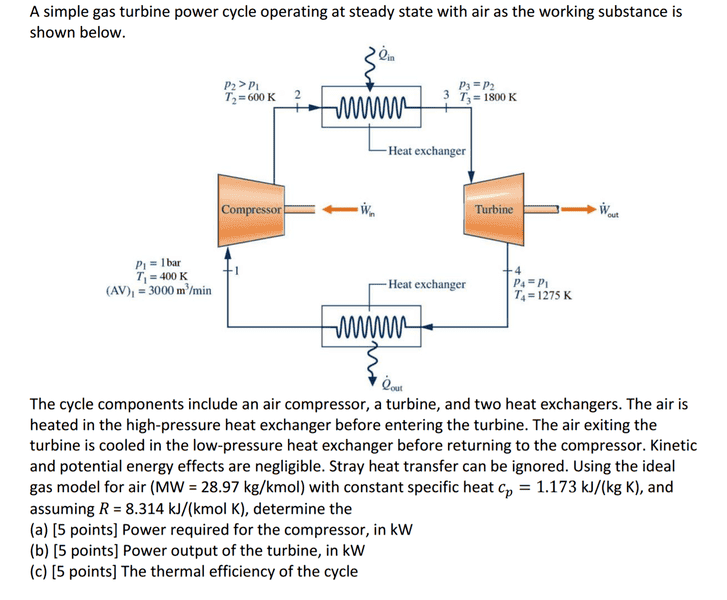
media%2Fd0f%2Fd0f716d6-625b-4d86-a3a5-77acabe306f1%2FphpZQ1q1g.png


i also don't know if there will be one or more than one heat exchanger.
 

Attachments

  • media%2Fd0f%2Fd0f716d6-625b-4d86-a3a5-77acabe306f1%2FphpZQ1q1g.png
    media%2Fd0f%2Fd0f716d6-625b-4d86-a3a5-77acabe306f1%2FphpZQ1q1g.png
    53.9 KB · Views: 947
Last edited:
Engineering news on Phys.org
Well, for power cycles, you are going to be talking condensers and boilers. So, in your heat transfer book, look for problems involving these.
 
  • Like
Likes   Reactions: Hammad
Well, from my opinion you will ask to design a heat exchanger that will give some output of fluid heat regarding to the fluid input from the power cycle
 
  • Like
Likes   Reactions: Hammad
andrewtirtawijaya said:
Well, from my opinion you will ask to design a heat exchanger that will give some output of fluid heat regarding to the fluid input from the power cycle

can you please give any example or elaborate on possible question which will give input values of power cycle and output values for heat exchanger?

i have a design question related to heat exchanger but there is no power cycle involved here is the question

upload_2017-12-17_19-56-28.png


the solution of this question is very scary to say the least. The above user stats that it will be about boiler and condenser, i don't know which one to prepare.
 

Attachments

  • upload_2017-12-17_19-56-28.png
    upload_2017-12-17_19-56-28.png
    23.5 KB · Views: 937
Hammad said:
can you please give any example or elaborate on possible question which will give input values of power cycle and output values for heat exchanger?

i have a design question related to heat exchanger but there is no power cycle involved here is the question

View attachment 216938

the solution of this question is very scary to say the least. The above user stats that it will be about boiler and condenser, i don't know which one to prepare.
Let's see you solve this problem. What have you done so far?
 
  • Like
Likes   Reactions: Hammad
Chestermiller said:
Let's see you solve this problem. What have you done so far?

i already have the solution, but such a lengthy qoestion won't come i guess.

upload_2017-12-18_0-22-33.png


upload_2017-12-18_0-23-41.png


upload_2017-12-18_0-23-17.png


upload_2017-12-18_0-23-56.png


upload_2017-12-18_0-24-11.png


upload_2017-12-18_0-24-22.png


upload_2017-12-18_0-24-47.png


upload_2017-12-18_0-24-57.png


upload_2017-12-18_0-25-7.png


upload_2017-12-18_0-25-27.png


upload_2017-12-18_0-25-38.png


upload_2017-12-18_0-25-49.png
 

Attachments

  • upload_2017-12-18_0-22-33.png
    upload_2017-12-18_0-22-33.png
    24.8 KB · Views: 1,042
  • upload_2017-12-18_0-23-0.png
    upload_2017-12-18_0-23-0.png
    14.3 KB · Views: 616
  • upload_2017-12-18_0-23-17.png
    upload_2017-12-18_0-23-17.png
    22 KB · Views: 899
  • upload_2017-12-18_0-23-41.png
    upload_2017-12-18_0-23-41.png
    15.7 KB · Views: 944
  • upload_2017-12-18_0-23-56.png
    upload_2017-12-18_0-23-56.png
    21.5 KB · Views: 931
  • upload_2017-12-18_0-24-11.png
    upload_2017-12-18_0-24-11.png
    25.2 KB · Views: 961
  • upload_2017-12-18_0-24-22.png
    upload_2017-12-18_0-24-22.png
    13.5 KB · Views: 952
  • upload_2017-12-18_0-24-36.png
    upload_2017-12-18_0-24-36.png
    13.3 KB · Views: 554
  • upload_2017-12-18_0-24-47.png
    upload_2017-12-18_0-24-47.png
    13.4 KB · Views: 963
  • upload_2017-12-18_0-24-57.png
    upload_2017-12-18_0-24-57.png
    16.6 KB · Views: 959
  • upload_2017-12-18_0-25-7.png
    upload_2017-12-18_0-25-7.png
    18.9 KB · Views: 954
  • upload_2017-12-18_0-25-19.png
    upload_2017-12-18_0-25-19.png
    10.8 KB · Views: 577
  • upload_2017-12-18_0-25-27.png
    upload_2017-12-18_0-25-27.png
    9.4 KB · Views: 935
  • upload_2017-12-18_0-25-38.png
    upload_2017-12-18_0-25-38.png
    17 KB · Views: 959
  • upload_2017-12-18_0-25-49.png
    upload_2017-12-18_0-25-49.png
    15.8 KB · Views: 944
Hammad said:
This looks pretty good. Is this your solution, or is it a solution that was provided for you. Could you do it yourself? If so, then you should have no difficulties with an exam problem.

If the exam problem involves a condenser in a power cycle, then the working fluid is going to be condensing (pretty much at constant temperature). So the problem will involve heat transfer coefficients from condensing vapors (i.e., high heat transfer coefficients). If the problem involves a boiler, then there will be a hot gas passing through the tubes of the heat exchanger, and a boiling liquid outside the tubes. The tubes will be bare, and not in a shell.
 
  • Like
Likes   Reactions: Hammad
hello guys,

i just want to thank chestermiller and andrewtirtawijaya, for your input, you were correct that there would be design question, although i left the question on choice, but i appreciate the help i got.

This forum is a very nice forum and i have got spot on help for all the issues i have tried to address.

thanks again
 
  • Like
Likes   Reactions: berkeman

Similar threads

  • · Replies 2 ·
Replies
2
Views
1K
  • · Replies 4 ·
Replies
4
Views
6K
  • · Replies 1 ·
Replies
1
Views
2K
  • · Replies 1 ·
Replies
1
Views
2K
Replies
2
Views
3K
Replies
14
Views
2K
  • · Replies 1 ·
Replies
1
Views
1K
Replies
4
Views
4K
  • · Replies 13 ·
Replies
13
Views
3K
  • · Replies 4 ·
Replies
4
Views
15K