Exit flow rate in a Plate Heat Exchanger

Click For Summary

Discussion Overview

The discussion revolves around calculating the outlet flow rate, mass flow rate, or velocity of water from a plate heat exchanger in a cascade system. Participants explore the implications of pressure loss in the heat exchanger on these parameters, particularly in the context of a project involving heating water from various temperatures.

Discussion Character

  • Technical explanation, Conceptual clarification, Debate/contested

Main Points Raised

  • One participant describes a system where hot water from a boiler enters a heat exchanger at 65 degC and exits at 50 degC, with the goal of heating another fluid from 45 degC to 60 degC.
  • Another participant questions the clarity of the initial query, particularly regarding the volume flow rate of 5 m3/h and its source.
  • A participant clarifies that the 5 m3/h flow rate is supplied by the hot water boiler and specifies that the outlet refers to the 50 degC output entering a second heat exchanger.
  • Concerns are raised about whether pressure loss in the heat exchanger (considering 0.1 bar) would affect the velocity of the fluid at the exit.
  • Some participants assert that there would be no significant change in velocity or mass flow rate due to pressure loss in the heat exchanger.
  • A participant expresses a previous misunderstanding regarding the relationship between pressure loss, velocity, and flow rate, indicating a shift in their understanding after receiving clarification.

Areas of Agreement / Disagreement

There is some agreement among participants that pressure loss does not significantly affect the mass flow rate. However, the initial question regarding the impact of pressure loss on velocity remains somewhat contested, with varying interpretations of the implications.

Contextual Notes

The discussion includes assumptions about the system's behavior under specific conditions, such as the effects of pressure loss and the constancy of mass flow rate, which may depend on additional factors not fully explored.

harishree90
Messages
3
Reaction score
0
TL;DR
Calculation of Exit Mass flow rate in a Plate Heat Exchanger to design a Cascade Heating Network
Hello All,

I am working on a project with plate heat exchangers connected in a cascade system to heat up water connections in a huge system

The Problem Statement :

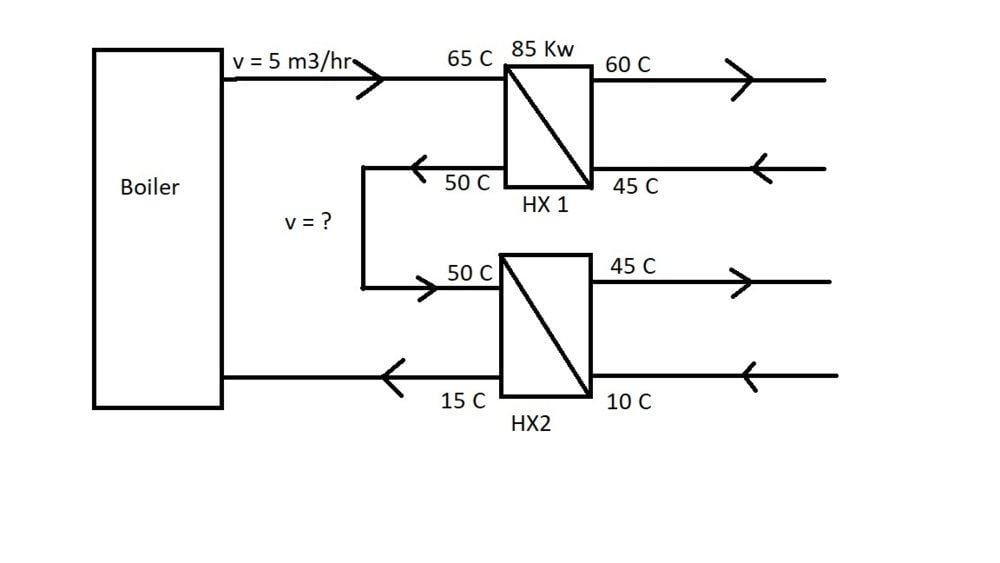
A boiler produces and circulates hot water at 65 degC to a Heat Exchanger and come out at 50 degC, where as the other fluid is also water which needs to be heated to 60 degC from 45 degC , The volume flow rate of hot water is at 5.0 m3/hr and the dia meter of the pipe is DN50

Using energy Equilibrium , Heat transfer rate in the first heat exchanger

Q = m X Cp X ΔT which come around 85KW
HX.jpg

now from the outlet of the Heat Exchange in the hot Side which is at 50 degC, I am connecting it as an Input to another heat Exchanger, which is also used to heat water from 10 degC to 45 degC and the hot water connected back to the Boiler which is at 15 degC

My question is, how can I calcuate the volume flow rate or mass flow rate or velocity of water at the outlet in the first heat exchanger which acts as an Input to second HX, so that I can calculate the heat transfer rate of the second HX to determine if need to have a pump in the circuit.

Thanks in Advance
If my question is not clear please let me know

 
Engineering news on Phys.org
Hello harishree, :welcome:

Your question is indeed unclear to me: if the volume flow is not 5 m3/h, where would the difference go ?

And the 5 m3/h, where does that come from, if not from a pump ?

Or:
With 'outlet' you mean the 60 C outlet ? Your heat exchange rate of 87 kW more or less dictates 5 m3/h too (with the given ##\Delta##T)
 
  • Like
Likes   Reactions: harishree90
BvU said:
Hello harishree, :welcome:

Your question is indeed unclear to me: if the volume flow is not 5 m3/h, where would the difference go ?

And the 5 m3/h, where does that come from, if not from a pump ?

Or:
With 'outlet' you mean the 60 C outlet ? Your heat exchange rate of 87 kW more or less dictates 5 m3/h too (with the given ##\Delta##T)

Thank you for the reply

The 5 m3/h volume flow at the inlet of the heat exchanger comes from a hot water boiler.

And by Outlet I mean the output with 50 C which acts as a input to the second heat exchanger.

My question is ...due to pressure loss in the heat exchanger (Considering 0,1 bar), will there be a change in velocity of the fluid at the exit (at 50 C) ?
 
harishree90 said:
Thank you for the reply

The 5 m3/h volume flow at the inlet of the heat exchanger comes from a hot water boiler.

And by Outlet I mean the output with 50 C which acts as a input to the second heat exchanger.

My question is ...due to pressure loss in the heat exchanger (Considering 0,1 bar), will there be a change in velocity of the fluid at the exit (at 50 C) ?
No significant change. And, of course, the mass flow rate won't change at all.
 
  • Like
Likes   Reactions: harishree90
Chestermiller said:
No significant change. And, of course, the mass flow rate won't change at all.

Thank you for the explanation Chestermiller and BvU

I was under the wrong idea that since there will be a pressure loss in the heat exchanger, it would affect the velocity and the flow rate also.
Now I understand
 

Similar threads

  • · Replies 3 ·
Replies
3
Views
3K
  • · Replies 4 ·
Replies
4
Views
2K
  • · Replies 3 ·
Replies
3
Views
2K
Replies
22
Views
4K
Replies
1
Views
1K
  • · Replies 5 ·
Replies
5
Views
2K
  • · Replies 6 ·
Replies
6
Views
14K
  • · Replies 3 ·
Replies
3
Views
3K
  • · Replies 9 ·
Replies
9
Views
6K
Replies
7
Views
2K