Expectation Value Notation in Griffiths QM Textbook Third Edition

Click For Summary
SUMMARY

The discussion focuses on the notation of expectation values in the third edition of Griffiths' "Introduction to Quantum Mechanics." Specifically, it highlights the inconsistency in notation when deriving the uncertainty principle in Chapter 3, where Griffiths uses operator notation for the expectation value of an observable. The expectation value is defined as <A> = <ψ|&#hat;A|ψ>, emphasizing that expectation values pertain to observables rather than operators. Participants agree that the notation may stem from author preference, despite the potential for confusion.

PREREQUISITES
  • Understanding of quantum mechanics fundamentals
  • Familiarity with operator notation in quantum mechanics
  • Knowledge of expectation values and their significance
  • Basic grasp of the uncertainty principle
NEXT STEPS
  • Study the derivation of the uncertainty principle in Griffiths' "Introduction to Quantum Mechanics"
  • Explore the implications of operator notation in quantum mechanics
  • Research the differences between observables and operators in quantum theory
  • Examine other quantum mechanics textbooks for notation consistency
USEFUL FOR

Students of quantum mechanics, educators teaching quantum physics, and researchers interested in the nuances of notation in quantum theory.
Icycub
Messages
12
Reaction score
1
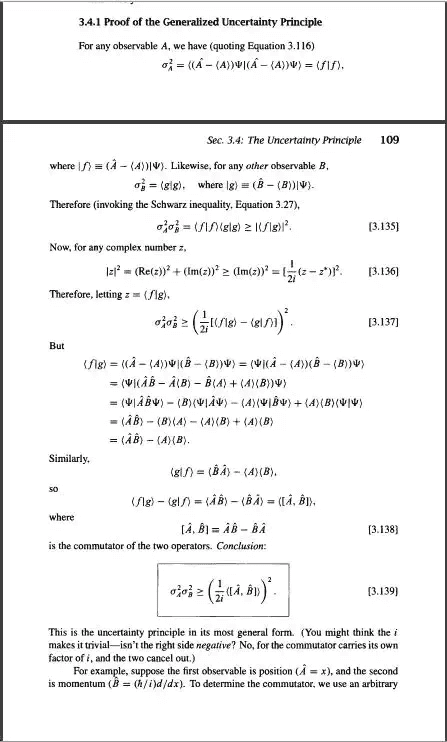
In the 3rd edition of the Introduction to Quantum Mechanics textbook by Griffiths, he normally does the notation of the expectation value as <x> for example. But, in Chapter 3 when he derives the uncertainity principle, he keeps the operator notation in the expectation value. See the pasted page. I don't understand why he suddenly keeps the operator notation for the expectation value and for just one of the expectation values in the group below. Is there a physical reasoning for this or was it just author preference?
1603740187943.png
 
Physics news on Phys.org
Icycub said:
But, in Chapter 3 when he derives the uncertainity principle, he keeps the operator notation in the expectation value. See the pasted page. I don't understand why he suddenly keeps the operator notation for the expectation value and for just one of the expectation values in the group below.
I think he is quite consistent in his notation here. What would you propose ?
 
BvU said:
I think he is quite consistent in his notation here. What would you propose ?
Yes, he roughly follows the same notation except for the <A^B^>. He doesn't explain why he does that, I'm assuming it's just preference.
 
Icycub said:
Yes, he roughly follows the same notation except for the <A^B^>. He doesn't explain why he does that, I'm assuming it's just preference.
Technically, if we have an observable ##A##, represented by operator ##\hat A## and the system in state ##\psi##, then: ##\langle A \rangle## is the expected value of measurements of ##A## (for a system in state ##\psi##); and, ##\langle \hat A \rangle = \langle \psi |\hat A|\psi \rangle##.

And, of course, we have: ##\langle A \rangle = \langle \hat A \rangle##.
 
  • Like
Likes BvU
Yes, that's common practice of physicists' sloppy notation. If you are pedantic, the expectation values are of course expectation values of observables, not operators, but the operators are of course used to describe observables in quantum mechanics. The correct notation is
$$\langle A \rangle=\langle \psi|\hat{A} \psi \rangle,$$
where ##|\psi \rangle \langle \psi|## describing the state the particle is prepared in when measuring the observable ##A##, which is represented by the self-adjoint operator ##\hat{A}##.
 
  • Like
Likes etotheipi and BvU
i am self learning physics. have you ever worked your way backwards again after finishing most undergrad courses? i have textbooks for junior/senior physics courses in classical mechanics, electrodynamics, thermal physics, quantum mechanics, and mathematical methods for self learning. i have the Halliday Resnick sophomore book. working backwards, i checked out Conceptual Physics 11th edition by Hewitt and found this book very helpful. What i liked most was how stimulating the pictures...

Similar threads

  • · Replies 7 ·
Replies
7
Views
3K
  • · Replies 8 ·
Replies
8
Views
4K
  • · Replies 5 ·
Replies
5
Views
2K
  • · Replies 23 ·
Replies
23
Views
6K
  • · Replies 13 ·
Replies
13
Views
5K
Replies
2
Views
4K
  • · Replies 16 ·
Replies
16
Views
3K
  • · Replies 3 ·
Replies
3
Views
1K
Replies
4
Views
3K
  • · Replies 3 ·
Replies
3
Views
1K