Experimental Virial Equation for real gases

  • Context: High School 
  • Thread starter Thread starter tanaygupta2000
  • Start date Start date
  • Tags Tags
    Experimental Gases
Click For Summary
SUMMARY

The discussion centers on the experimental virial equation for real gases, specifically the equation Pv = A(1 + BP) for small values of pressure (P). As pressure approaches zero, the product 'Pv' does not tend to zero due to the presence of the virial constants A and B, which introduce non-ideal behavior corrections. The conversation highlights that at low pressures, gases approximate ideal behavior, while deviations occur at higher pressures, necessitating the use of the virial expansion for accurate modeling. Reference is made to "Chemical Engineering Thermodynamics" by Smith & van Ness for further reading on this topic.

PREREQUISITES
  • Understanding of the ideal gas law (PV = nRT)
  • Familiarity with virial coefficients and their significance in gas behavior
  • Basic knowledge of thermodynamics principles
  • Experience with pressure-volume relationships in gases
NEXT STEPS
  • Study the derivation and application of the virial equation in real gas scenarios
  • Explore the concept of virial coefficients and their calculation methods
  • Learn about deviations from ideal gas behavior at high pressures
  • Read "Chemical Engineering Thermodynamics" by Smith & van Ness for in-depth understanding
USEFUL FOR

Students and professionals in chemical engineering, thermodynamics researchers, and anyone interested in the behavior of real gases under varying pressure conditions.
tanaygupta2000
Messages
208
Reaction score
14
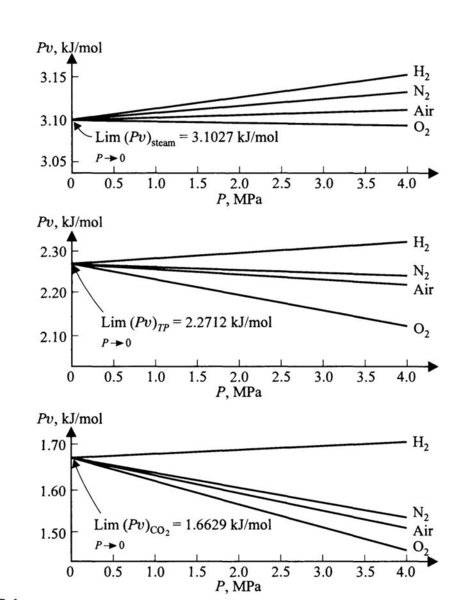
In the experimental virial equation for real gases,
Pv = A(1+BP) (for small values of P)
as 'P' approaches zero, then why do we get some finite value of 'Pv' instead of approaching to zero value, since 'Pv' is directly proportional to 'P' ?

{P = Pressure of gas, v = Molar volume of gas, A,B = Virial Constants}
Screenshot_2018-09-08-06-42-30-043_com.adobe.reader.jpeg
 

Attachments

  • Screenshot_2018-09-08-06-42-30-043_com.adobe.reader.jpeg
    Screenshot_2018-09-08-06-42-30-043_com.adobe.reader.jpeg
    30.8 KB · Views: 622
Physics news on Phys.org
At low pressure, gases behave more and more ideally. Boyle's law has ##PV = ## constant. A non-zero constant ! ##PV = n RT## in the ideal gas law .
At higher pressures you get deviations and the virial expansion is one way to introduce a correction.

Read up in e.g. Smith & van Ness: Chemical engineering thermodynamics

PS has your source some caption with the three figures ? What do they represent ?
 

Similar threads

  • · Replies 2 ·
Replies
2
Views
2K
  • · Replies 0 ·
Replies
0
Views
1K
  • · Replies 23 ·
Replies
23
Views
3K
Replies
24
Views
3K
  • · Replies 2 ·
Replies
2
Views
2K
Replies
3
Views
2K
Replies
16
Views
4K
  • · Replies 14 ·
Replies
14
Views
3K
  • · Replies 1 ·
Replies
1
Views
1K
  • · Replies 1 ·
Replies
1
Views
3K