Explain chemical formulas PO43-

Click For Summary
SUMMARY

The discussion centers on the chemical formula PO43-, specifically the representation of its components and their electronic configurations. The formula indicates that phosphorus (P) is bonded to four oxygen (O) atoms, with three single bonds and one double bond. The charge of -3 arises from the formal charges calculated for each oxygen atom, where the three single-bonded oxygens each carry a -1 charge, while the double-bonded oxygen and phosphorus have no formal charge. The total electron count in the structure is 32, leading to the conclusion that PO43- is a polyatomic ion with a net charge of -3.

PREREQUISITES
  • Understanding of Lewis structures
  • Knowledge of formal charge calculations
  • Familiarity with electron sharing and bonding types (single and double bonds)
  • Basic concepts of ionic species and their charges
NEXT STEPS
  • Study Lewis structures in detail to visualize molecular bonding
  • Learn about formal charge calculations and their applications in molecular chemistry
  • Explore hybridization and its role in bonding, particularly for phosphorus
  • Investigate the properties and behaviors of polyatomic ions, focusing on phosphate
USEFUL FOR

Chemistry students, educators, and professionals interested in molecular structure, bonding theories, and the behavior of polyatomic ions in chemical reactions.

Robotesco
Messages
13
Reaction score
0
PO43-

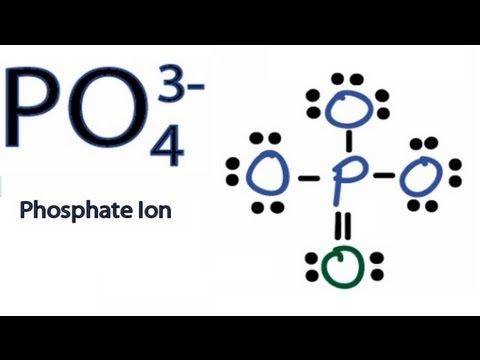
I Understand the 4 represents how many oxygen atoms are bonded to the Phosphate. What exactly does the 3 and its - sign represent? By the image, I can tell the difference between the 3 oxygen atoms and the single isolated one, with the double || symbol, has a different electronic composition. Explain why the single | symbol is used and why the isolated O atom uses two ||s. Please also describe the difference between the two electronic compositions. Why does it show 3 pairs of dots on the O33-s and a double pair on the single O2-
hqdefault.jpg
 
Chemistry news on Phys.org
The superscript indicates the magnitude and charge of ionic species, monatomic or polyatomic.
 
P has 5 elecrons in outer shell, O has 6 electrons in outer shell. So P + 4O has 5 + 24 = 29 electrons in outer shells
Dots represent single electrons.
Bar is a pair of electrons shared
Double bar is 2 pairs of electrons shared

Total electrons in diagram = 22 dots + 3 bars + 1 double bar = 22 + 6 + 4 = 32 electrons
So the ion has 32-29=3 more electrons than the neutral atoms. This is a charge of -3

As far as I understand it (not very far!) the 3 O each have one extra electron and share an electron with P. Each bar is the sharing of 2 electrons.
The last O has no extra electons, but shares two from the P.
Why the P still sees this as only 2 electrons, I don't know, maybe some sort of dative bond? ( I don't really understand hybrid orbitals & all that qed stuff.)
Phosphorus is funny stuff and appears to exhibit various valencies and bonding combinations. You'll just have to wait for Borek or some other expert to help with that. (Or read about it. There are some pretty detailed explanations I've found, but way over my old head.)
 
Have you ever used 'Formal Charge' equation to define the oxidation state of an element in a compound? For PO43-, let the single bonded oxygens be Oxy(1), Oxy(2), Oxy(3) and the double bonded Oxy(4). For Oxys (1 - 3), each has a -1 formal charge... The formal charge equation is FC = V - (B/2) - N; V = valence of element, B = number of bonded electrons, N = number of non-bonded electrons. (Note: B for - O is 2e-, B for = O is 4e- ; N for - O (3 non-bonded pair = 6 electrons) and O (2 non-bonded pair = 4 electrons).

For PO43-
Single bonded Oxys ( 1 - 3 ) FC (on each) = V - B/2 - N = 6 - 2/2 - 6 = -1
Double bonded Oxy ( #4 ) FC = V - B/2 - N = 6 - 4/2 - 6 = 0
Phosphorous FC = V - B/2 - N = 5 - (10/2) - 0 = 0
The only elements of the structure carrying a formal charge are the three single bonded oxygens; so ∑ ( - O ) = 3( -1) = -3. Phosphorous and Oxy (4) with double bond FC = 0. => [ (-1) for Oxy#1 ] + [ (-1) for Oxy#2 ] + [ (-1) for Oxy#3 ] + [ (0) for Oxy#4 ] + [ (0) for Phosphorous ] = Net charge for polyion phosphate = -3
 

Similar threads

Replies
1
Views
2K
  • · Replies 1 ·
Replies
1
Views
2K
  • · Replies 1 ·
Replies
1
Views
2K
  • · Replies 9 ·
Replies
9
Views
2K
Replies
8
Views
4K
  • · Replies 9 ·
Replies
9
Views
11K
  • · Replies 6 ·
Replies
6
Views
3K
  • · Replies 9 ·
Replies
9
Views
3K
Replies
9
Views
4K
  • · Replies 11 ·
Replies
11
Views
3K