Discussion Overview
The discussion revolves around the behavior of cathode rays in a Crookes tube, specifically whether they are curved by the electric fields created by the anode. Participants explore the implications of anode presence, electric field patterns, and the operational principles of the tube.
Discussion Character
- Exploratory, Technical explanation, Debate/contested
Main Points Raised
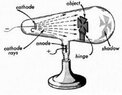
- Some participants describe the cathode rays moving in straight lines initially, with the anode positioned beneath them.
- Others explain that the anode's presence is crucial for maintaining a significant cathode current due to the insulating properties of the glass wall.
- A participant questions whether the system would function similarly without an anode, suggesting that the cathode current would be insufficient without it.
- There are inquiries about the electric field line patterns within the Crookes tube, with some suggesting that the field lines may curve towards the anode.
- One participant argues that the diagram representing the setup might be more of an artistic impression rather than an accurate depiction of the device's operation.
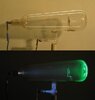
- Another participant discusses the role of the Maltese cross and its connection to the electric field lines, suggesting that the cross's design may influence electron behavior.
- Concerns are raised about the historical design of the Crookes tube and whether it was optimized for electron optics.
- Some participants note that the internal surface of the tube may have been treated to enhance conductivity, impacting the behavior of the cathode rays.
- There is a suggestion that the brightness of the glow in the tube may indicate the influence of the anode on the electric fields around the cross.
Areas of Agreement / Disagreement
Participants express multiple competing views regarding the role of the anode and the behavior of electric fields in the Crookes tube. The discussion remains unresolved, with no consensus on whether the cathode rays are curved by the anode fields.
Contextual Notes
Limitations include assumptions about the electric field configurations, the influence of the tube's internal surface treatment, and the historical context of Crookes tube design. The discussion does not resolve the complexities of electron optics involved.