Exploring the Mysteries of Cryogenic Electron Emission

  • Context: Graduate 
  • Thread starter Thread starter rhody
  • Start date Start date
  • Tags Tags
    Electron Emission
Click For Summary

Discussion Overview

The discussion centers on the phenomenon of cryogenic electron emission observed in photomultipliers at very low temperatures. Participants explore the causes and implications of this emission, particularly focusing on the behavior of dark rates as temperature decreases, and the mechanisms involved in electron emission without light.

Discussion Character

  • Exploratory
  • Technical explanation
  • Debate/contested
  • Experimental/applied

Main Points Raised

  • Some participants note that the dark rate decreases with temperature until about 220 K, after which it levels off and then begins to rise again, suggesting complex underlying mechanisms.
  • One participant raises the possibility that natural background sources, such as K-40 in the glass substrate and cosmic rays, could influence the observed electron emissions.
  • Questions are posed regarding the type of photocathode used and how its resistivity varies with temperature, as well as the implications of charge buildup on the photocathode.
  • Another participant suggests investigating the role of multiply-charged positive ions being accelerated towards the photocathode, although this idea is met with skepticism due to inconsistencies with observed data.
  • Discussion includes the mechanism of secondary-electron emission in dynodes and the typical voltage used across them, indicating a technical interest in the operational aspects of photomultipliers.

Areas of Agreement / Disagreement

Participants express various hypotheses and questions regarding the mechanisms of cryogenic electron emission, with no consensus reached on the causes or implications of the observed phenomena. Multiple competing views remain regarding the factors influencing dark rates and the role of different sources of emission.

Contextual Notes

Some limitations include the dependence on specific experimental setups and the need for further investigation into the mechanisms of emission, as well as the potential influence of external factors like cosmic rays and background radiation.

Who May Find This Useful

This discussion may be of interest to researchers and practitioners in the fields of photodetection, cryogenics, and those studying electron emission phenomena in low-temperature physics.

rhody
Gold Member
Messages
679
Reaction score
3
Physics.org: March 10, 2010 By Lisa Zyga
f098xw.jpg

comments go here
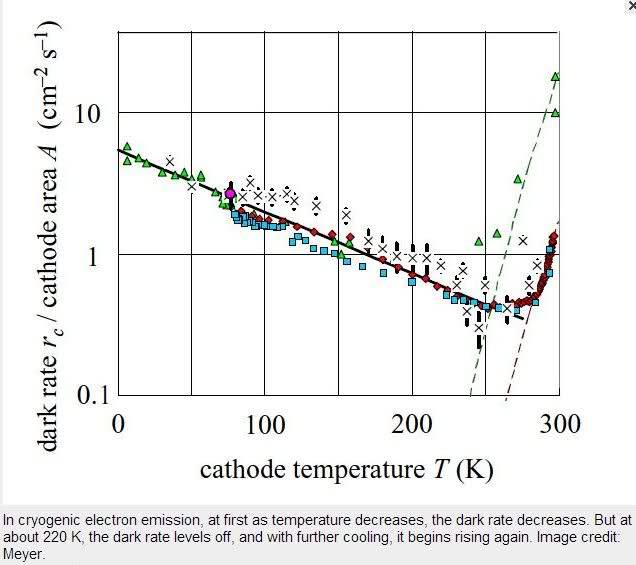
In cryogenic electron emission, at first as temperature decreases, the dark rate decreases. But at about 220 K, the dark rate levels off, and with further cooling, it begins rising again. Image credit: Meyer.

(PhysOrg.com) -- At very cold temperatures, in the absence of light, a photomultiplier will spontaneously emit single electrons. The phenomenon, which is called "cryogenic electron emission," was first observed nearly 50 years ago. Although scientists know of a few causes for electron emission without light (also called the dark rate) - including heat, an electric field, and ionizing radiation - none of these can account for cryogenic emission. Usually, physicists consider these dark electron events undesirable, since the purpose of a photomultiplier is to detect photons by producing respective electrons as a result of the photoelectric effect.

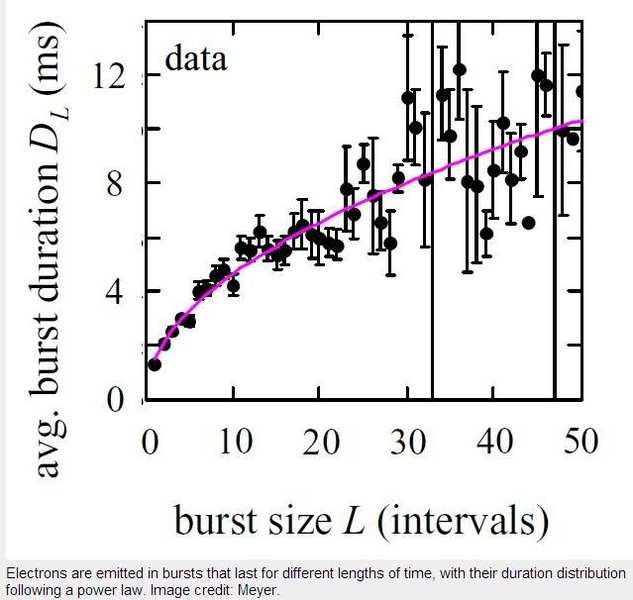
Hans-Otto Meyer, a physics professor at Indiana University has shown that the electron firings are distributed in time, in burst patterns, but in a "peculiar, correlated way", he believes the correlation involves some kind of trapping mechanism, not yet fully understood.

From the article,
Specifically, within a burst, events first occur rapidly, and then less and less frequently as the burst “fades away.”

and again later,
Among his interesting observations are that the cryogenic emission rate does not depend on whether the device is cooling or warming up, but only on the current temperature. Overall, the properties of cryogenic electron emission don’t fit with any other known spontaneous emission process, including thermal emission, field emission, radioactivity, or penetrating radiation such as cosmic rays.

Meyer concludes:
“Nature at very low temperatures has a lot of surprises up her sleeve,” Meyer said. “I don't want to speculate as to what will turn out to be the explanation of cryogenic emission, but I would not be surprised if the http://www.iue.tuwien.ac.at/phd/wessner/node31.html" plays an important role.”

rrnxmt.jpg


Having looked at the band structure link posted above I realize why I belong to PF, this concept is best understood and explained by the physicist's who share and collaborate here.
Ideas as to the cause or causes of this phenomenon ?

Rhody...
 
Last edited by a moderator:
Physics news on Phys.org


Since I'm also working in photodetector, photocathodes, and the likes, here's what I've deciphered so far from this, based on my understanding of it, and my discussion with others.

It would be nice to know the rate of this single-electron emissions. Why? This is because there are other possible source that could trigger such emissions:

1. Most of these photomultipliers have K-40 in the glass substrate. So you have a nature background source.

2. Is the rate of emission similar to the rate of cosmic ray hitting the photomultiplier? Trying to shield against this isn't that easy.

How these translates into the observed behavior as temperature is lowered is still debatable. But it would be useful to make sure that none of these are the trigger, so that we can eliminate the obvious sources.

Zz.


Is the photocathode on a glass plate (like a semitransparent end-window photocathode for a photomultiplier), or on a solid meta-backed photocathode, like a 1P21 side-on internal photocathode? How does the resistivity of the semi-transparent photocathode vary with temperature? Can slow charge buildup on/in the photocathode drain into the external circuit easily at all temperatures without voltage buildup?

Bob S


Bob S said:
Is the photocathode on a glass plate (like a semitransparent end-window photocathode for a photomultiplier), or on a solid meta-backed photocathode, like a 1P21 side-on internal photocathode? How does the resistivity of the semi-transparent photocathode vary with temperature? Can slow charge buildup on/in the photocathode drain into the external circuit easily at all temperatures without voltage buildup?

Bob S

Hi Bob,

Sorry for not posting a link to the article in the original post, here it is: http://www.physorg.com/news187421719.html"

Here is the description of the experiment from the link above, I don't believe it addresses your question though...

In his experiments, Meyer placed a photomultiplier inside an empty container, which he then submerged in liquid nitrogen or helium. Using radiation cooling, he cooled the photomultiplier to a temperature of 80 K (-193° C) after about one day, and to 4 K (-269° C) in another day. With this setup, he could detect cryogenic dark events, which are shown to be caused by single electrons emitted from the cathode of the photomultiplier.

As previous research has shown, starting from room temperature, the dark rate decreases as temperature decreases, but only up to a point. Below about 220 K (-53° C), the dark rate levels off. With further cooling, it begins to rise, and continues to increase at least down to 4 K (-269° C), the lowest temperature for which Meyer has data. Most of Meyer’s experiments were performed at around 80 K (-193° C).

Rhody...
 
Last edited by a moderator:


Read the actual paper. He used a particular Hamamatsu photomultiplier.

Zz.


ZapperZ said:
Read the actual paper. He used a particular Hamamatsu photomultiplier..
After reading the online paper about the observed cryogenic emission, I would investigate the possibility of multiply-charged positive ions being accelerated slowly from the region of the first dynode to the photocathode, and imbedding in the photocathode. Could positive ions from further up the dynode chain be accelerated down the dynode chain with some multiplication and eventually accelerated as multiple positive ions to the photocathode?

Bob S


Bob S said:
After reading the online paper about the observed cryogenic emission, I would investigate the possibility of multiply-charged positive ions being accelerated slowly from the region of the first dynode to the photocathode, and imbedding in the photocathode. Could positive ions from further up the dynode chain be accelerated down the dynode chain with some multiplication and eventually accelerated as multiple positive ions to the photocathode?

Bob S

This would be puzzling if it occurs.

These ions are typically generated by electrons crashing into some surface. This means that the higher the energy of the electrons, the more one tends to get these back-bombarding ions. This has been investigated before (it is a particular concern to me since these back-bombarding ions can destroy/degrade the photocathode surface, which is my responsibility). However, in Fig. 2 of the paper, the dark current rate remains constant at 81K even when the working voltage is increased. This is inconsistent with the presence of such ions.

Zz.


Hello,

Hamamatsu has a nice picture of a photomultiplier:

http://learn.hamamatsu.com/articles/photomultipliers.html

I've actually never worked with a dynode, but I am wondering if they work by secondary-electron emission and sequent multiplication? Also, how many volts are usually across the series of dynodes? Thanks

modey3
 
Last edited by a moderator:


Modey3 said:
Hello,

Hamamatsu has a nice picture of a photomultiplier:

http://learn.hamamatsu.com/articles/photomultipliers.html

I've actually never worked with a dynode, but I am wondering if they work by secondary-electron emission and sequent multiplication? Also, how many volts are usually across the series of dynodes? Thanks

modey3

That is the mechanism for the multiplication of the original electrons coming from the photocathode. This is true for multichannel plate as well.

I'm guessing that the working voltage is the same as that used in this experiment in Fig. 2, which would be of the order of 1-2 kV.

Zz.
 
Last edited by a moderator:
  • #10


ZapperZ said:
Read the actual paper. He used a particular Hamamatsu photomultiplier.
All of the measurements were taken on photomultipliers with transparent end windows (photocathode). The rising cryogenic electron emission with decreasing temperature is puzzling, and could be associated with the photocathode resistivity (with a thin (transparent?) platinum backing). Have any tests been made on photomultipliers with solid metal photocathodes, like the 1P21? This would determine whether the cryo electron emission is due to the photocathode design, or some other phenomenon.

Bob S
 
  • #11


As a wild and unfounded guess I offer slow-electron/phonon scattering in the photo cathode. Primary photons in the photo cathode might come from cosmic rays or radioactive sources, but the interaction of the resulting electrons (secondary electrons, Auger electrons, whatever) with lattice vibrations might have some impact on these electrons' ability to travel through the cathode and leave it on the side of the focusing electrode. In a similar meachanism as the one which reduces a metal's conductivity with increasing temperature, this might make SE transmittance to the dynode setup less likely at higher phonon density of states (i.e., at higher temperatures).
The correlated bursts might then be related to multiple secondary electrons related to a single initial event (e.g., cosmic ray, radioactivity, etc), which just happen to travel different multi-scattered paths through the photo cathode. The actual effective movement of low-energy electrons inside a material subject to scattering is actually quite slow (in the order of cm/s), if i remember correctly. So that might lead to a measurable spread of the burst events in the ms--s range.
 
  • #12


cgk said:
As a wild and unfounded guess I offer slow-electron/phonon scattering in the photo cathode. Primary photons in the photo cathode might come from cosmic rays or radioactive sources, but the interaction of the resulting electrons (secondary electrons, Auger electrons, whatever) with lattice vibrations might have some impact on these electrons' ability to travel through the cathode and leave it on the side of the focusing electrode. In a similar meachanism as the one which reduces a metal's conductivity with increasing temperature, this might make SE transmittance to the dynode setup less likely at higher phonon density of states (i.e., at higher temperatures).
The correlated bursts might then be related to multiple secondary electrons related to a single initial event (e.g., cosmic ray, radioactivity, etc), which just happen to travel different multi-scattered paths through the photo cathode. The actual effective movement of low-energy electrons inside a material subject to scattering is actually quite slow (in the order of cm/s), if i remember correctly. So that might lead to a measurable spread of the burst events in the ms--s range.

However, if you note, in the paper, the author explicitly indicated that, based on a series of measurements, the dark counts originates out of the photocathode and not due to any secondary emission. One can sort of see this when he increased the working voltage and no change in the dark count rates occurs. Now unless one wants to argue that he has exceeded the saturation voltage for the photomultiplier, that observation is very hard to reconcile with the idea that this is all coming from the action of the secondary electrons.

I'll be able to test just the photocathode alone in a few months when we finally finish setting up our bialkali photocathode fabrication system, hopefully with cryogenics capability. We might even try to get the same glass windows that are used in these Hamamatsu photomultiplier as substrates. The only concern I have is how small the photocurrent will be coming just from the photocathode itself without any amplification from a MCP or other charge multiplier.

Zz.
 
  • #13


ZapperZ said:
However, if you note, in the paper, the author explicitly indicated that, based on a series of measurements, the dark counts originates out of the photocathode and not due to any secondary emission.

I'm sorry, I used confusing terminology: What I meant were ``secondary electrons'' *in* the photocathode, in the sense of the secondary electrons (SE) mechanism of image formation in a scanning electron microscope (not secondary electrons in the dynode electron multiplication steps).
Basically, some single high-energy charged particle in the photocathode (say, 10keV or more, wherever that might come from) could generate a great number of semi-free low-energy secondary electrons inside the photocathode by an avalance excitation process. These slow electrons would then be subjected to various random lattice scattering events, making their travel through the cathode very slow. The dependence BurstDuration ~ BurstSize^(1/2) quoted in the paper also reminds me of the lattice random walks such generated SEs would be subjected to.

Of course, this is still some wild guess, and I do not claim to have any truth in it.
 
  • #14


cgk said:
I'm sorry, I used confusing terminology: What I meant were ``secondary electrons'' *in* the photocathode, in the sense of the secondary electrons (SE) mechanism of image formation in a scanning electron microscope (not secondary electrons in the dynode electron multiplication steps).
Basically, some single high-energy charged particle in the photocathode (say, 10keV or more, wherever that might come from) could generate a great number of semi-free low-energy secondary electrons inside the photocathode by an avalance excitation process. These slow electrons would then be subjected to various random lattice scattering events, making their travel through the cathode very slow. The dependence BurstDuration ~ BurstSize^(1/2) quoted in the paper also reminds me of the lattice random walks such generated SEs would be subjected to.

Of course, this is still some wild guess, and I do not claim to have any truth in it.

Hum... the problem here is that the photocathode is rather thin. The photomultiplier works in the transmission mode, meaning that you have an almost transparent photocathode on the glass surface. The thickness of the photocathode is very much less than the electron escape depth for a typical photoelectron (in the eV range). So your 10 keV particles don't interact with the photocathode that easily.

Zz.
 

Similar threads

  • · Replies 15 ·
Replies
15
Views
4K
  • · Replies 3 ·
Replies
3
Views
2K
  • · Replies 3 ·
Replies
3
Views
5K
  • · Replies 9 ·
Replies
9
Views
1K
  • · Replies 62 ·
3
Replies
62
Views
11K
  • · Replies 4 ·
Replies
4
Views
5K
  • · Replies 5 ·
Replies
5
Views
3K
  • · Replies 1 ·
Replies
1
Views
6K
  • · Replies 10 ·
Replies
10
Views
3K
  • · Replies 2 ·
Replies
2
Views
5K