Exponential potential energy state diagram

Click For Summary

Homework Help Overview

The discussion revolves around understanding an exponential potential energy state diagram, focusing on the properties of the potential function and its implications for force and energy. Participants analyze the behavior of the potential function, its derivatives, and the relationship between potential energy and mechanical energy.

Discussion Character

  • Exploratory, Conceptual clarification, Mathematical reasoning, Problem interpretation, Assumption checking

Approaches and Questions Raised

  • Participants discuss the characteristics of the potential function, including its limits, intercepts, and symmetry. They explore the implications of the force derived from the potential energy and question the assumptions related to the direction of force and energy conservation. A separate off-topic question about power and work is also raised, leading to discussions about the validity of formulas in different contexts.

Discussion Status

Some participants express confidence in their understanding of the potential energy problem, while others seek clarification on specific points, particularly regarding the relationship between force and potential energy. The off-topic question about power has led to a productive exchange about the conditions under which certain equations apply, though no consensus has been reached on all points.

Contextual Notes

Participants note that the discussion includes both a primary focus on potential energy and a secondary, off-topic question regarding power and work, which introduces additional complexity to the conversation. There is an acknowledgment of the limitations of certain formulas when applied to non-uniform paths.

ThEmptyTree
Messages
55
Reaction score
15
Homework Statement
A particle of mass ##m## moves in one dimension. Its potential energy is given by $$U(x) = −U_0e^{-x^2/a^2}$$ where ##U_0## and ##a## are constants.
(a) Draw an energy diagram showing the potential energy ##U(x)##. Choose some value for the total mechanical energy ##E## such that ##−U_0 < E < 0##. Mark the kinetic energy, the potential energy and the total energy for the particle at some point of your choosing.
(b) Find the force on the particle as a function of position ##x##. Express you answer in terms of some or all of the following: ##x, a,## and ##U_0##.
(c) Find the speed at the origin ##x = 0## such that when the particle reaches ##x = \pm a##, it stops momentarily and reverses the direction of its motion. Express you answer in terms of some or all of the following: ##x, a, m## and ##U_0##.
Relevant Equations
For one-dimensional kinematics $$F_c=\frac{dU}{dx}$$
It is my second "energy state diagram problem" and I would want to know if I am thinking correctly.

First I have done some function analysis to get a glimpse of the plot:
- no roots but ##\lim\limits_{x\to-\infty}U(x)=\lim\limits_{x\to+\infty}U(x)=0##
- y interception: ##U(0)=-U_0##
- even function: ##U(x)=U(-x)##
- first derivative: ##\frac{dU(x)}{dx}=\frac{2U_0x}{a^2}e^{-x^2/a^2}## so the function is decreasing on ##(-\infty;0)## but increasing on ##(0;+\infty)##

So my answer at (a):
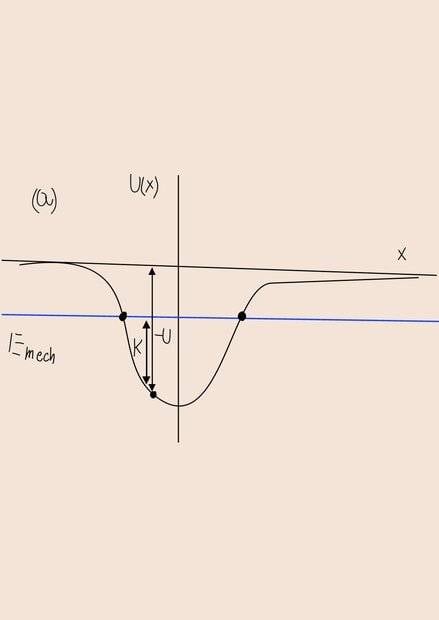
(a).jpg
(b) Using the fact that the net conservative force is the space derivative of potential: $$F_c(x)=\frac{2U_0x}{a^2}e^{-x^2/a^2}$$

(c) Turnaround points are at ##x=\pm a## which is solution to the equation ##U(x)=E_{mech}##
So ##E_{mech}=-\frac{U_0}{e}##
At the origin ##E_{mech}=K(0)+U(0)=\frac{1}{2}mv_0^2-U_0\Rightarrow v_0=\sqrt{2\Big(1-\frac{1}{e}\Big)\frac{U_0}{m}}##

Is it ok?
 
Physics news on Phys.org
All looks good.
 
haruspex said:
All looks good.
Thanks!

Just a quick off-topic question pleaase
In my physics book it states that "Power is the ratio between work ##W## done by a force during a time interval ##\Delta{t}## and the time interval. Hence ##P_{ave}=\frac{W}{\Delta{t}}=\vec{F}\cdot\vec{v_{ave}}##."

My attempt to prove: ##\vec{F}\cdot\vec{v_{ave}}=\vec{F}\cdot\frac{\Delta{\vec{r}}}{\Delta{t}}##. The next step would be to say that ##\vec{F}\cdot\Delta{\vec{r}}=W## but isn't this true only for one-dimensional motion? From what I've learned for non uniform path the work is the line integral of the scalar product between the force and the infinitesimal displacement. Then for non uniform path the average power is ##P_{ave}=\frac{W_{ave}}{\Delta{t}}## ?
 
Last edited:
If F = dU/dx, then F points towards regions with higher potential. Think about if this makes sense or not.
 
Orodruin said:
If F = dU/dx, then F points towards regions with higher potential. Think about if this makes sense or not.
When the potential is increasing (positive derivative) the force is negative (points to the left) and when the potential is decereasing (negative derivative) the force is positive (points to the right). Related to that, one analogy that we can make is that the graph metaphorically represents the motion of a ball that slides down the hill starting from a point below the mechanical energy, but doesn't have enough kinetic energy to get past the turnaround point, so it's "trapped" in the hill. I understand that.
ThEmptyTree said:
Thanks!

Just a quick off-topic question pleaase
In my physics book it states that "Power is the ratio between work ##W## done by a force during a time interval ##\Delta{t}## and the time interval. Hence ##P_{ave}=\frac{W}{\Delta{t}}=\vec{F}\cdot\vec{v_{ave}}##."

My attempt to prove: ##\vec{F}\cdot\vec{v_{ave}}=\vec{F}\cdot\frac{\Delta{\vec{r}}}{\Delta{t}}##. The next step would be to say that ##\vec{F}\cdot\Delta{\vec{r}}=W## but isn't this true only for one-dimensional motion? From what I've learned for non uniform path the work is the line integral of the scalar product between the force and the infinitesimal displacement. Then for non uniform path the average power is ##P_{ave}=\frac{W_{ave}}{\Delta{t}}## ?

^ That was a separate question for a completely different thing.
 
ThEmptyTree said:
The next step would be to say that ##\vec{F}\cdot\Delta{\vec{r}}=W## but isn't this true only for one-dimensional motion? From what I've learned for non uniform path the work is the line integral of the scalar product between the force and the infinitesimal displacement.
I don't see any contradiction. If ##\vec{F}\cdot\Delta{\vec{r}}=\Delta W## (your version omitted the delta) then ##W=\int \vec{F}\cdot d{\vec{r}}##.
 
haruspex said:
I don't see any contradiction. If ##\vec{F}\cdot\Delta{\vec{r}}=\Delta W## (your version omitted the delta) then ##W=\int \vec{F}\cdot d{\vec{r}}##.
I did not omit the delta. This is what says in my book. However I agree with the delta.

As of what I know, we can only integrate if we are working with infinitesimal quantities, whereas ##\Delta{\vec{r}}## and ##\Delta{t}## are finite quantities as described in my book.
 
ThEmptyTree said:
I did not omit the delta.
I wrote that your version omitted the delta, not that you were responsible for the omission.
ThEmptyTree said:
As of what I know, we can only integrate if we are working with infinitesimal quantities, whereas ##\Delta{\vec{r}}## and ##\Delta{t}## are finite quantities as described in my book.
##\vec{F}\cdot\Delta{\vec{r}}=\Delta W## is only an approximation for small changes. In general, the direction of the force may change along the way. It is only exact if the direction of F is constant.
Taking the limit produces the integral and renders the equation exact.
 
haruspex said:
I wrote that your version omitted the delta, not that you were responsible for the omission.

##\vec{F}\cdot\Delta{\vec{r}}=\Delta W## is only an approximation for small changes. In general, the direction of the force may change along the way. It is only exact if the direction of F is constant.
Taking the limit produces the integral and renders the equation exact.
Exactly, so after all the formula ##P_{ave}=\vec{F}\cdot\vec{V_{ave}}## only works for constant direction. This is what intrigued me, because they did not specify it. Thanks.

(This is somewhat explainable because at the level of the book students are not supposed to know calculus so nor how to deal with non uniform paths, but I just wanted to make sure)
 
  • #10
ThEmptyTree said:
Exactly, so after all the formula ##P_{ave}=\vec{F}\cdot\vec{V_{ave}}## only works for constant direction.
If applying it over an extended period (and displacement), if the force varies at all (not just in direction) then it is unclear what F to use.
 
  • Like
Likes   Reactions: ThEmptyTree
  • #11
ThEmptyTree said:
When the potential is increasing (positive derivative) the force is negative (points to the left) and when the potential is decereasing (negative derivative) the force is positive (points to the right).
Is this the case for your result above?
 
  • #12
Orodruin said:
Is this the case for your result above?
Umm.. I think so, maybe?
 
  • #13
ThEmptyTree said:
Umm.. I think so, maybe?
What is the sign of your force when x>0?
 
  • Like
Likes   Reactions: hutchphd
  • #14
Orodruin said:
What is the sign of your force when x>0?
Negative, the function is increasing?

EDIT: OH F**K I FORGOT THE -

Thanks for noticing.

How can I edit the post tho?
 

Similar threads

Replies
7
Views
2K
Replies
5
Views
1K
  • · Replies 3 ·
Replies
3
Views
1K
  • · Replies 4 ·
Replies
4
Views
2K
  • · Replies 1 ·
Replies
1
Views
2K
  • · Replies 19 ·
Replies
19
Views
2K
Replies
8
Views
1K
Replies
25
Views
1K
  • · Replies 15 ·
Replies
15
Views
2K