Extremely confused on finding eigenvectors

  • Context: Undergrad 
  • Thread starter Thread starter Jorge Cantu
  • Start date Start date
  • Tags Tags
    Confused Eigenvectors
Click For Summary
SUMMARY

This discussion centers on the process of finding eigenvectors for a matrix, specifically with eigenvalues 7 and -2. To determine eigenvectors, one must first compute the determinant of the matrix A minus cI, where c represents the eigenvalue. The solutions to the resulting cubic equation yield the eigenvalues, and subsequently, the eigenvectors can be found by solving the homogeneous system associated with each eigenvalue. The discussion emphasizes the importance of understanding determinants and the properties of symmetric matrices, which guarantee independent eigenvectors.

PREREQUISITES
  • Understanding of eigenvalues and eigenvectors
  • Knowledge of determinants and their calculation
  • Familiarity with homogeneous systems of equations
  • Concept of nullspace in linear algebra
NEXT STEPS
  • Study the process of calculating determinants using cofactor expansion
  • Learn how to solve homogeneous systems of equations
  • Explore the properties of symmetric matrices and their eigenvectors
  • Investigate the implications of eigenvalues in different fields, particularly in linear transformations
USEFUL FOR

Students and professionals in mathematics, particularly those studying linear algebra, as well as anyone involved in fields requiring matrix computations and eigenvalue analysis.

Jorge Cantu
Messages
1
Reaction score
0
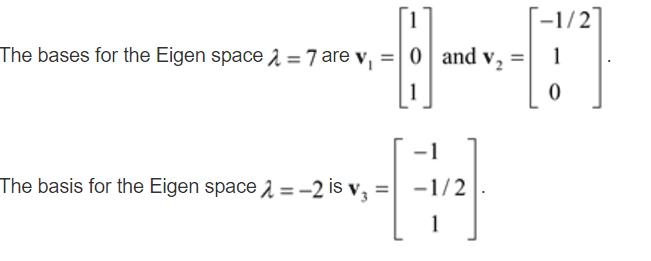
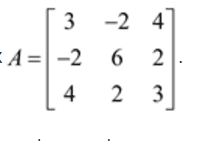
Extremely confused on finding eigenvectors? Below I have a picture that gives the matrice and the eigenvectors. How did the solution find these eigenvectors??
i.e. the eigenvalues are 7 and -2
2liii68.png

2hxuk4y.png

IMAGE LINKS
http://tinypic.com/r/2liii68/9
http://tinypic.com/view.php?pic=2liii68&s=9#.VkY_YfmrSUk
 
Last edited by a moderator:
Physics news on Phys.org
an eigenvalue for a matrix A is a number c such that the matrix A-cI is singular. So to find them we set the determinant of that matrix equal to zero and solve the resulting cubic equation if we can. Then afterwards, we have the numbers c that work, and using each one in its turn we actually find the kernel vectors of the matrices A-cI. Remark: Since the matrix is symmetric about the main diagonal you are guranteed to have 3 independent eigenvectors, even if some of the eigenvalues are repeated. So you have to know how to take determinants, and then you have to know how to solve a homogeneous system.
 
Last edited by a moderator:
You can also see it in the equivalent sense that , for a matrix/operator A, an eigenvalue ##\lambda## is the set of solutions for ##\lambda ## to the equation :

## Ax= \lambda x ## (There may be no Real solutions or solutions over fields that are not algebraically closed. For Reals, this may be the case for square matrices of even dimension).

You can then expand , like Mathwonk said, the polinomyal ## Det(A- \lambda I )x =0 ## using , e.g., cofactor expansion and then find the roots , if any (when the base field is not algebraically closed.)

Once you find the eigenvalues, the eigenvectors are a basis for the nullspace of the above equation. Note that the collection of eigenvectors forms a subspace of the domain.
 

Similar threads

  • · Replies 2 ·
Replies
2
Views
3K
  • · Replies 7 ·
Replies
7
Views
10K
Replies
1
Views
1K
  • · Replies 9 ·
Replies
9
Views
2K
  • · Replies 7 ·
Replies
7
Views
3K
Replies
8
Views
2K
  • · Replies 1 ·
Replies
1
Views
3K
  • · Replies 4 ·
Replies
4
Views
6K
  • · Replies 18 ·
Replies
18
Views
4K
Replies
1
Views
5K