Face Chromatic Number of A Graph

  • Thread starter Thread starter Cuttlas
  • Start date Start date
  • Tags Tags
    Graph
Click For Summary

Homework Help Overview

The discussion revolves around determining the face chromatic number of a given graph, with participants presenting differing opinions on its value based on visual representations and theoretical reasoning.

Discussion Character

  • Exploratory, Assumption checking, Conceptual clarification

Approaches and Questions Raised

  • Participants are questioning the validity of the face chromatic number being 4, with some suggesting it is 2 based on their own colorings of the graph's faces. There is a discussion on the implications of vertex chromatic numbers and the characteristics of bipartite graphs.

Discussion Status

The conversation is ongoing, with participants expressing confusion and seeking clarification on the correct face chromatic number. Some guidance has been offered regarding the properties of bipartite graphs, but no consensus has been reached.

Contextual Notes

Participants are grappling with the definitions and properties of face chromatic numbers versus vertex chromatic numbers, and there is mention of visual representations that may influence their understanding.

Cuttlas
Messages
15
Reaction score
0
Hi

What is the face chromatic number for the Graph Below?
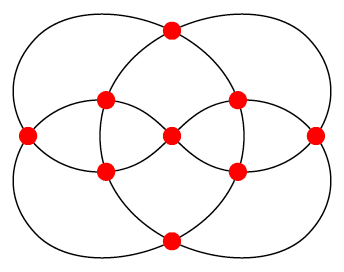
CurvedDualHerschel.png


Thank You
 
Physics news on Phys.org
Four.
 
Why is it 4? Look at image below, the face chromatic number is 2, so it should not be 4. Could u please explain for me how did u get 4?

kswex.jpg
 
Cuttlas said:
Why is it 4? Look at image below, the face chromatic number is 2, so it should not be 4. Could u please explain for me how did u get 4?

It can't be the chromatic number of the vertices either, because that's equal to 3.
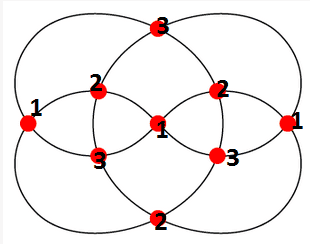
attachment.php?attachmentid=72625&stc=1&d=1409586092.png


The chromatic number of a map with one ore more closed loops as borders is always 2. You get a bipartite graph with all the nodes that are separated from the outside with an odd number of borders on one side, and those separated by an even number of borders on the other side.
 

Attachments

  • chrnum.png
    chrnum.png
    8.8 KB · Views: 579
willem2 said:
It can't be the chromatic number of the vertices either, because that's equal to 3.

attachment.php?attachmentid=72625&stc=1&d=1409586092.png

If It can not be 2, then How I painted the Graph's Faces with only two colors? As you can see Faces in painted graph with different colors is not Adjacent with each other. So it means I did the painting correctly. But I think I'm mistaking. Could u please upload the painted graph which u think it is right?
 
Cuttlas said:
If It can not be 2, then How I painted the Graph's Faces with only two colors? As you can see Faces in painted graph with different colors is not Adjacent with each other. So it means I did the painting correctly. But I think I'm mistaking. Could u please upload the painted graph which u think it is right?

I think willem2 was agreeing with you that the face chromatic number is not 4.
 
haruspex said:
I think willem2 was agreeing with you that the face chromatic number is not 4.

:) Yes, it seems your right. Then Does it mean I'm right? The Face chromatic number is 2 or 3?
 
Cuttlas said:
:) Yes, it seems your right. Then Does it mean I'm right? The Face chromatic number is 2 or 3?
Your own diagram seems to prove it's 2. Why are you unsure?
 

Similar threads

  • · Replies 6 ·
Replies
6
Views
2K
  • · Replies 7 ·
Replies
7
Views
1K
  • · Replies 6 ·
Replies
6
Views
2K
  • · Replies 1 ·
Replies
1
Views
2K
Replies
3
Views
1K
  • · Replies 2 ·
Replies
2
Views
1K
  • · Replies 9 ·
Replies
9
Views
1K
  • · Replies 12 ·
Replies
12
Views
7K
Replies
1
Views
2K
  • · Replies 9 ·
Replies
9
Views
1K