Falling hailstones hitting two car windscreens

Click For Summary
SUMMARY

The discussion focuses on the physics of hailstones impacting two car windscreens, emphasizing the need for a clear understanding of vector addition and reference frames. Participants highlight the importance of correctly interpreting angles of incidence and reflection, specifically ##\theta_1## and ##\alpha_1##, in the context of the cars' motion. Key equations discussed include ##\alpha_1 + 2\theta_1 = \frac{\pi}{2}## and the relationship between the velocities of the hailstones and the cars, expressed as ##\frac{v_1}{v_2}##. A systematic approach to solving the problem involves understanding the graphical representation of these vectors.

PREREQUISITES
  • Understanding of vector addition in physics
  • Familiarity with reference frames in motion
  • Knowledge of trigonometric relationships involving angles
  • Ability to interpret graphical representations of physical scenarios
NEXT STEPS
  • Study the principles of vector addition in physics
  • Learn about reference frames and their impact on observed motion
  • Explore trigonometric identities and their applications in physics problems
  • Practice solving problems involving angles of incidence and reflection
USEFUL FOR

Students studying physics, particularly those focusing on mechanics and kinematics, as well as educators seeking to enhance their teaching methods in vector analysis and reference frames.

DifferentialGalois
Messages
68
Reaction score
25
Homework Statement
Two motor cars have their wind screens at ##\theta_1=15^{\circ}## and ##\theta_2=30^{\circ}## respectively. While moving in a hailstorm the drivers see the hailstones bounced by the wind screen of their cars in the vertical direction. What is the ratio ##\dfrac{v_1}{v_2}## of the velocities of the cars ##?## Assume the hailstorms fall vertically.
Relevant Equations
SEE HW STMENT
I tried to construct a diagram, but to no avail, since I don't really understand the qn. However, my professor provided me with this graphical depiction (that i obviously don't understand)
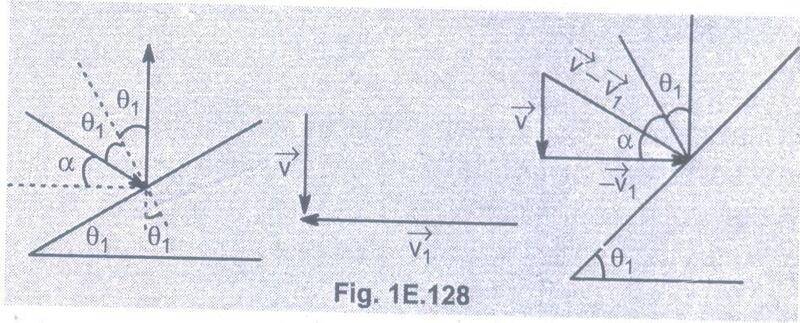
Book's vector diagram
 
Physics news on Phys.org
It's hard to tell which part of it you are not understanding without first showing some attempt.
 
  • Like
Likes   Reactions: phinds
verbal explanation thus far:
Hailstones bounce in the vertical direction which implies that the angle of reflection is ##\theta_1## as shown in figure, which is same as angle of incidence in the cars' reference frame. Velocity of hailstones relative to the first car is ##\dfrac{v_1}{v_2}## as shown in the figure.
 
DifferentialGalois said:
verbal explanation thus far:
Hailstones bounce in the vertical direction which implies that the angle of reflection is ##\theta_1## as shown in figure, which is same as angle of incidence in the cars' reference frame. Velocity of hailstones relative to the first car is ##\dfrac{v_1}{v_2}## as shown in the figure.
There is some confusion in the subscripts.
Since the windscreen angle is drawn differently in the left and right diagrams I assume these are for the two cars, but both diagrams show ##\theta_1, v_1##, both use ##\alpha## instead of ##\alpha_1, \alpha_2##.
The speed of the hailstones relative to that of the first car is ##\frac v{v_1}##, not ##\frac{v_1}{v_2}##.

What is the relationship between ##v, v_1, \alpha_1##?
What is the relationship between ##\theta_1, \alpha_1##?
 
haruspex said:
There is some confusion in the subscripts.
Since the windscreen angle is drawn differently in the left and right diagrams I assume these are for the two cars, but both diagrams show ##\theta_1, v_1##, both use ##\alpha## instead of ##\alpha_1, \alpha_2##.
The speed of the hailstones relative to that of the first car is ##\frac v{v_1}##, not ##\frac{v_1}{v_2}##.

What is the relationship between ##v, v_1, \alpha_1##?
What is the relationship between ##\theta_1, \alpha_1##?
who knows? i have no idea.
 
DifferentialGalois said:
who knows? i have no idea.
Look at the right hand diagram. There is a triangle with sides labelled ##v, v_1## and an angle ##\alpha##. What equation relates them, given that v is vertical and v1 horizontal?

Look at the left hand diagram. What is the angle between the horizontal dashed line and the vertical arrow? What angles lie between them?
 
haruspex said:
Look at the right hand diagram. There is a triangle with sides labelled ##v, v_1## and an angle ##\alpha##. What equation relates them, given that v is vertical and v1 horizontal?

Look at the left hand diagram. What is the angle between the horizontal dashed line and the vertical arrow? What angles lie between them?
##\alpha + 2\theta_1=\frac{\pi}{2} and \tan{\alpha}-\dfrac{v}{v_1}##
but i still dont understand how they constructed that diagram.
 
My first thought is that you will need a clear strategy. The velocities of the cars, presumably, are to be calculated in the ground frame. Whereas, the driver's observations are in their moving reference frames.

There's a lot to get straight before you can begin to solve this. Tricky, IMO.
 
Last edited:
  • #10
DifferentialGalois said:
but i still dont understand how they constructed that diagram.
There is some law about reflection at work in the cars frame of reference?
 
  • #11
erobz said:
There is some law about reflection at work in the cars frame of reference?
Which is another unstated assumption in the question.
 
  • Like
Likes   Reactions: erobz
  • #12
Fixing up your LaTeX and other details:
DifferentialGalois said:
##\alpha_1 + 2\theta_1=\frac{\pi}{2} ## and ##\tan{\alpha_1}=\dfrac{v}{v_1}##
but i still dont understand how they constructed that diagram.
The diagram is using a graphical way to add vectors.
The hail has a vertically down velocity of ##v##. In car 1's frame of reference it also has a horizontal velocity to the right of ##v_1##. Adding these two vectors gives the velocity of the hail relative to car 1.
 
  • #13
haruspex said:
Fixing up your LaTeX and other details:

The diagram is using a graphical way to add vectors.
The hail has a vertically down velocity of ##v##. In car 1's frame of reference it also has a horizontal velocity to the right of ##v_1##. Adding these two vectors gives the velocity of the hail relative to car 1.
Alr could u provide me a solution. Then i'll be happy. Thank you sir.
 
  • #14
No one else will be happy with that result.
 
  • #15
DifferentialGalois said:
Alr could u provide me a solution. Then i'll be happy. Thank you sir.
I think you have a solution, but you don't understand it. The key point is that when we move to the car's reference frame, the velocity of the hailstones (in that reference frame) has the same vertical component (##v##) and also a horizontal component ##-v_1## or ##-v_2## respectively.

At this point you can analyse the scenario as if the car were stationary and the hailstones were being fired it at an angle with these velocity components.

A bit of trigonometry is needed to show that, if the windscreen is at an angle ##\theta## with the horizontal, then the angle of incidence of the hailstones is also ##\theta##. Given that the hailstones bounce vertically in the car frame. This is the diagram you were given.

That's all you need to derive an expression for ##\frac {v_1} v## in terms of ##\theta_1## and the same for ##v_2##.

You can then put these equations together to express the ration ##\frac{v_1}{v_2}## in terms of some trig function of ##\theta_1## and ##\theta_2##.

The solution involves these four steps and the associated calculations. Can you identify which parts of this solution you do not understand?
 
  • Like
Likes   Reactions: hutchphd
  • #16
DifferentialGalois said:
Alr could u provide me a solution. Then i'll be happy. Thank you sir.
Please try to identify the step you do not understand in post #12 or #15.
 
  • #17
haruspex said:
Please try to identify the step you do not understand in post #12 or #15.
All the steps
 
  • Sad
Likes   Reactions: PeroK
  • #18
DifferentialGalois said:
All the steps
If that is true, then the problem is too advanced for you at this stage. You should find some simpler problems and revise your trigonometry.
 
  • #19
PeroK said:
If that is true, then the problem is too advanced for you at this stage. You should find some simpler problems and revise your trigonometry.
i mean i can treat it like a math problem, by writing down the logical conclusions:
##\tan{\alpha}=\tan{\left(\dfrac{\pi}{2}-2\theta_1\right)}-\cot{2\theta_1}##

𝑣/𝑣1=cot(2𝜃_1) then would the v/v2 be the same, i cant seem to justify why?
then the ratio is apparently 3, but also not sure why.
 
  • #20
DifferentialGalois said:
i mean i can treat it like a math problem, by writing down the logical conclusions:
##\tan{\alpha}=\tan{\left(\dfrac{\pi}{2}-2\theta_1\right)}-\cot{2\theta_1}##
That doesn't look right. ##\alpha## is directly related to ##2\theta##.
 
  • #21
PeroK said:
That doesn't look right. ##\alpha## is directly related to ##2\theta##.
IT LITERALLY IS AS IT SAYS.
 
  • #22
DifferentialGalois said:
IT LITERALLY IS AS IT SAYS.
I wouldn't recommend "shouting" at the people trying to help you...It's impolite.

You have the following equation(s):

$$\alpha_i + 2 \theta_i = \frac{\pi}{2}$$

The value of ## \theta_i ## is fixed for each car. What is ## \alpha_i ## in terms of ##v,v_i## for a particular car?
 
  • Like
Likes   Reactions: berkeman and Steve4Physics
  • #23
Hi @DifferentialGalois. For the moment, forget about the original problem. Can you answer this...

A hailstone is falling vertically downwards at speed ##v## relative to the ground

You are driving (on the ground, straight and horizontally) at speed ##u## relative to the ground (and the hailstone's trajectory is directly in front of you).

In your (the car’s) frame of reference the hailstone appears to be moving at angle ##\alpha## to the vertical.

Can you find a formula for ##\alpha## in terms of ##u## and ##v##?

Edit: Ha! @erobz beat me too it.
 
Last edited:
  • Like
Likes   Reactions: erobz
  • #24
DifferentialGalois said:
IT LITERALLY IS AS IT SAYS.
@PeroK means more directly than in your equation in post #19. It does not need to involve any trig functions. How you got that is mysterious, and it cannot be right since it reduces to ##\tan(\alpha)=0##. Please post your steps.
 

Similar threads

  • · Replies 5 ·
Replies
5
Views
2K
Replies
5
Views
2K
Replies
5
Views
2K
Replies
15
Views
2K
Replies
20
Views
5K
  • · Replies 11 ·
Replies
11
Views
2K
  • · Replies 2 ·
Replies
2
Views
1K
  • · Replies 19 ·
Replies
19
Views
2K
  • · Replies 23 ·
Replies
23
Views
3K
  • · Replies 14 ·
Replies
14
Views
3K