Falling rotating sphere and displacements

Join the discussion
Ask a follow-up here, or get your own question answered by working scientists, mathematicians and engineers — people, not an autocomplete.
Real named experts · corrections over time · the nuance an AI answer skips
10 replies · 2K views
LoveBoy
Messages
44
Reaction score
1

Homework Statement


proxy.php?image=http%3A%2F%2Fi.imgur.com%2FN04l7ru.png


Homework Equations


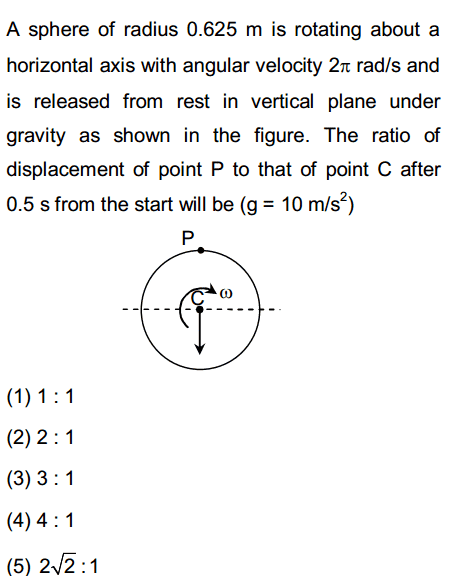
How to locate the point P and C after 0.5s from their initial position ?

The Attempt at a Solution


Well i don't know whether it would be correct way to start the problem i.e find the centripetal acceleration .
 
on Phys.org
You can find how far C moves in 0.5 sec, since it is the centre of gravity of the sphere.
So you know the two positions of the sphere and where P is at each position.
Then simply work out PP' and CC' and find the ratio.
 
To compute for the displacement of point C use the equation for free falling bodies. As for point P, compute for the angle using the angular velocity and you will find that it has traveled all the way to the other side of the sphere (be careful here as you are dealing with displacement, not total distance). With that you should be able to get the ratio.
 
As C is in free fall condition,so
0Vs5NZr.png

rickz02 said:
As for point P, compute for the angle using the angular velocity and you will find that it has traveled all the way to the other side of the sphere (be careful here as you are dealing with displacement, not total distance).
How to find angle using angular velocity ?
 
distance = velocity x time so angle = angular velocity x time

You can work that out from the question, because the angular velocity is given as radians per second. So if you multiply it by seconds, you will get radians.

PS. They've given a really easy angular velocity.
 
i got π radians.
So, displacement of point P would be 2r=1.25 m
 
I think you're forgetting that as P rotates round the sphere, the whole sphere is moving down.
If the sphere were not rotating, P would move the same distance as C (1:1), but the rotation adds to the displacement of P.
 
Okay.
So answer would be 2:1.