Fan Selection for air cooling of a computer

Click For Summary

Discussion Overview

The discussion revolves around the principles of air flow and pressure changes in a fan system for computer cooling, focusing on the assumptions made in a formal solution presented in a textbook. Participants explore the implications of these assumptions in the context of fluid dynamics, particularly regarding velocity and pressure at different points in the system.

Discussion Character

  • Technical explanation
  • Conceptual clarification
  • Debate/contested

Main Points Raised

  • One participant expresses hesitation about the assumption that velocities at points 3 and 4 are the same, questioning the reasoning behind this choice.
  • Another participant suggests that at point 3, air is sucked in at a velocity 'v', and at point 4, it is pushed out at the same velocity 'v', assuming no energy losses.
  • A different participant argues that the assumption of equal velocities at points 3 and 4 is justified due to the constant tube diameter and the in-compressibility of the fluid, leading to a constant mass flow.
  • One participant proposes that fans primarily change pressures through their work when sucking air.
  • Another participant reiterates the idea that the funnel-shaped intake accelerates air, while the cylindrical section does not result in net acceleration, raising questions about deriving pressure results from this observation.

Areas of Agreement / Disagreement

Participants express differing views on the assumptions made regarding air velocities and pressure changes, indicating that multiple competing perspectives remain without a clear consensus.

Contextual Notes

The discussion involves assumptions about fluid dynamics, including the in-compressibility of air and the effects of tube geometry on airflow, which may not be fully resolved or universally accepted among participants.

mech-eng
Messages
826
Reaction score
13
Moved from a technical forum, so homework template missing
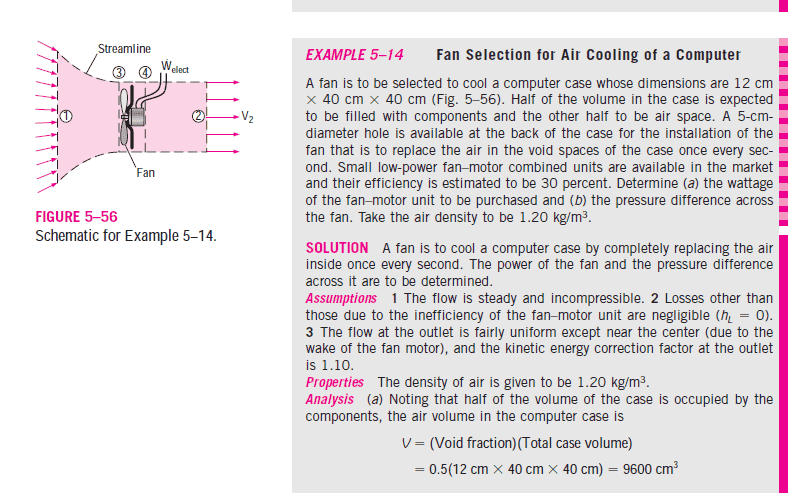
I 90% understand the question and solution but unfortunately I have some hesitations about the formal solution in the book.
fan select.png

fan select 2.png


First of all, when calculating P4-P3, choosing lines and points on them, why do book assume velocities of 3 and 4 to be the same?

http://opencourses.emu.edu.tr/pluginfile.php/4500/mod_resource/content/1/Chapter5.pdf

Thank you.
 
Physics news on Phys.org
I'm not familiar with the equations, but at point 3 the air will be sucked in at some velocity 'v' and just at 4 it will be pushed out at the same velocity 'v' excluding any energy losses.
 
mech-eng said:
why does book assume velocities of 3 and 4 to be the same?
Because the tube diameter is constant between 3 and 4, and assuming in-compressible fluid, the density does not change. Mass flow is constant or else mass would be accumulating. So from point 4 to the end of the exhaust tube, velocity and pressure ideally remain constant. Afterwards, the pressure would normally decrease and velocity would increase, affected by viscous reaction with the surrounding air.
 
  • Like
Likes   Reactions: CivilSigma
Can we say as one consequence that when fans sucking airs, they just change their pressures at first by fan work?

Thank you.
 
mech-eng said:
Can we say as one consequence that when fans sucking airs, they just change their pressures at first by fan work?
Looking at the diagram, the funnel shaped tube intake would correspond to accelerating air. Within the cylindrical part of the tube, there would be no net acceleration in the direction of the tube.
 
Last edited:
rcgldr said:
Looking at the diagram, the funnel shaped tube intake would correspond to accelerating air. Within the cylindrical part of the tube, there would be no next acceleration in the direction of the tube.

Yes, this can be another result from directly looking the scheme but what about deriving a result for pressures?

Thank you.
 

Similar threads

Replies
24
Views
3K
  • · Replies 5 ·
Replies
5
Views
5K
  • · Replies 7 ·
Replies
7
Views
4K
  • · Replies 7 ·
Replies
7
Views
4K
  • · Replies 7 ·
Replies
7
Views
4K
  • · Replies 6 ·
Replies
6
Views
5K
  • · Replies 9 ·
Replies
9
Views
4K
  • · Replies 1 ·
Replies
1
Views
4K
  • · Replies 1 ·
Replies
1
Views
3K
  • · Replies 1 ·
Replies
1
Views
4K