Faraday's law help -- Induced EMF vs. time graph

Click For Summary

Homework Help Overview

The discussion revolves around the application of Faraday's law of electromagnetic induction, specifically focusing on the relationship between induced electromotive force (emf) and magnetic flux over time. Participants are analyzing a graph that depicts induced emf against time and are exploring the implications of the signs of emf and the rate of change of magnetic flux.

Discussion Character

  • Exploratory, Assumption checking, Conceptual clarification

Approaches and Questions Raised

  • Participants are examining the apparent contradictions between the induced emf and the change in magnetic flux, questioning the physical setup and the assumptions made in the textbook solution. There is a focus on the role of the magnetic pole orientation and its effect on the induced current direction.

Discussion Status

The discussion is ongoing, with participants providing insights into the physical context of the problem and questioning the clarity of the textbook explanations. Some participants express discomfort with the material and seek additional resources, indicating a desire for deeper understanding. There is no explicit consensus on the interpretations being discussed.

Contextual Notes

Participants note that the problem may lack crucial information regarding the physical situation, such as the orientation of the magnet and the specifics of the coil setup. There is also mention of varying conventions in measuring emf and the potential for confusion arising from different interpretations of the signs in the equations presented.

sdfsfasdfasf
Messages
75
Reaction score
12
Homework Statement
I need help deducing whether my textbook is wrong or not.
Relevant Equations
E = -N d(phi)dt
1709379333138.png

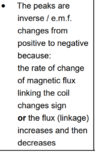
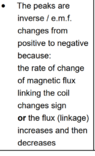
Here is a curve of induced emf against time. We know from Faraday's law that E = -N d(phi)dt and due to the negative sign, clearly E and d(phi)/dt must have opposite signs, i.e if E > 0it would not be possible for d(phi)dt > 0, as then -N d(phi)dt = E <0 , when we already defined E >0, clearly a contradiction. You can clearly see that from t=0 to just after t=0.1, E > 0, therefore d(phi)dt < 0. However my solution from the textbook states that initially the flux linkage (N phi) increases, which means that N d(phi)dt >0, which is direct contradiction as clearly E > 0 at the start. Posted the solution down below.
1709379767659.png
 

Attachments

  • 1709379475977.png
    1709379475977.png
    23.7 KB · Views: 88
  • 1709379611490.png
    1709379611490.png
    23.7 KB · Views: 94
Physics news on Phys.org
You did not describe the physical situation that is taking place. If you have a magnet falling through a coil, the polarity of the induced emf will depend on whether the north pole is leading or trailing.
 
1709386071518.png
 
I used to own a torch like that. You have to understand that the polarity of the pulse is relative and depends, as I said, on whether the north pole of the magnet is leading or trailing and on which side of the voltmeter measures the emf pulse is connected to which side of the coil. You reverse one or another, the polarity is reversed. You reverse both, the polarity stays the same.

Falling magnet_2.png
Look at the schematic on the right. The red wire is behind the coil and the blue wire is in front of the coil. When the magnet falls as shown, magnetic field lines point down and are increasing. The induced current will be opposing the down increasing magnetic field lines by creating magnetic field lines that are up. This means that current will flow from blue wire to red and from point A to B charging the capacitor and lighting up the LED.

When the magnet is below the coil, the magnetic field lines are still down but are decreasing. This means the current must flow in the opposite direction from before (B to A) to oppose to increase the decreasing magnetic field lines.

All this will be reversed if you flip the falling magnet upside down. Your drawing does not show which pole is leading.
 
While being the highest level before university (A-Level, here in the UK), my physics course is still fairly introductory, it is extremely common for them to miss out "crucial" information when writing questions as it is not really required to answer the question (usually) and they need the exam to be a good fit for all students, from those who get 5% to those who get 95%. All in all, I am generally not very comfortable with electromagnetism because I feel as though the textbook does not do a good job of teaching it. Do you have any Pre-University Physics Electromagnetism resources? Thanks
 
It is not clear to me whether the two explanations ("because: …. or ….") are intended to be equivalent statements of fact or a question for the reader to answer. If the first, I agree it is wrong, but if the second, you have answered it.
 
This screenshot is from the worked solution, everything that is written is meant to be true fact (if the author has done a good job), so it seems to me that the two explanations are both meant to be true. In that case surely something is off right?
 
kuruman said:
Your drawing does not show which pole is leading.
@sdfsfasdfasf's point is that the text says "… e.m.f. changes from positive to negative because … the flux increases then decreases." That statement in itself appears at odds with Lenz's law. (I read that Lenz added the minus sign.)
The sign must be based on some convention about which way the emf is measured and, perhaps, which way the coil is wound, but I have not been able to track down a statement of either.
Maybe Faraday used an opposite convention, and the quoted textbook uses that too.
 

Similar threads

Replies
8
Views
1K
  • · Replies 3 ·
Replies
3
Views
1K
  • · Replies 2 ·
Replies
2
Views
2K
Replies
7
Views
1K
  • · Replies 14 ·
Replies
14
Views
1K
  • · Replies 3 ·
Replies
3
Views
2K
  • · Replies 2 ·
Replies
2
Views
982
  • · Replies 1 ·
Replies
1
Views
1K
  • · Replies 2 ·
Replies
2
Views
942
Replies
6
Views
3K