Velocity u > c? Faster Than Light Comm?

  • Context: Undergrad 
  • Thread starter Thread starter f todd baker
  • Start date Start date
  • Tags Tags
    Communication
Click For Summary

Discussion Overview

The discussion revolves around the concept of whether information can be transmitted faster than the speed of light (c) using a setup involving moving wires. Participants explore the implications of wire movement and the transmission of information in relation to special relativity, considering both theoretical and practical aspects.

Discussion Character

  • Exploratory
  • Debate/contested
  • Technical explanation

Main Points Raised

  • One participant proposes a scenario where two non-parallel wires intersect, with one wire moving perpendicular to the other, leading to a velocity u that could exceed c, but argues that since this point carries no mass or information, it does not violate special relativity.
  • Another participant counters that any change in distance between the wires cannot propagate faster than c, thus limiting the transmission of information.
  • A different viewpoint suggests that if all but one wire are parallel and moving at the same velocity, the distance between them remains constant, implying no information is transmitted in the u direction.
  • One participant emphasizes that while the diagonal wire's movement is irrelevant, the setup of the wires must occur within the constraints of c, indicating that information cannot be transmitted instantly.
  • Another participant clarifies that information is transmitted in the direction of the wire's movement (v), with observers receiving information at different times based on their position, and that communication in the u direction would require physical interaction with the wires.
  • A later reply highlights that the coding of information cannot exceed the speed of light, reinforcing the idea that transmission speed is limited.
  • One participant introduces a practical consideration, stating that the speed of transmission through the wires is limited to the speed of sound in the material, which is significantly slower than c, even in the best materials like diamond.

Areas of Agreement / Disagreement

Participants express differing views on the possibility of faster-than-light communication through the wire setup. While some agree that the transmission of information is constrained by the speed of light, others explore the implications of wire movement and its relation to information transfer, leading to an unresolved discussion.

Contextual Notes

Limitations include assumptions about the idealized nature of the thought experiment and the dependence on the physical properties of materials used for the wires, which affect transmission speed.

f todd baker
Messages
61
Reaction score
22
On my website (unnamed since I have been previously reprimanded for "promoting" the site!) I got a question, pretty straightforward, the essence of which is: Two long wires are not parallel and make an angle θ with each other; they cross at one point and one wire is moving with velocity v perpendicular to the first; the point where they cross moves with a velocity u.
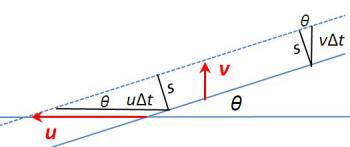
fasterthanlife.JPG


It is easy to show that u=v/tanθ and u may be larger than c. But this point has no mass and carries no information so, no problem with special relativity (just like a sweeping laser spot moving across the moon with v>c). But then I got a followup question suggesting having an array of moving wires the spacing of which is coded information. What am I missing?
 

Attachments

  • fasterthanlife.JPG
    fasterthanlife.JPG
    5.5 KB · Views: 461
Physics news on Phys.org
If the distance between the wires changes, that change can not travel along the wire at infinite speed. In fact it is limited to c or less.
 
All wires but one are moving with the same velocity and are parallel. The distance between any two of them does not change.
 
Oh. I missed that. There is nothing that says that information set up earlier can not be read fast. The wires that you describe can not be set up over a distance faster than c. It would take a long time to set up the parallel wires of that length. Your example is just a more complicated case of sending information and storing it in a safe in a distant location. Then the safe can be opened and read instantly. That does not mean that the information was transmitted instantly.
 
  • Like
Likes   Reactions: Dale
I second @FactChecker here. The information is transmitted at the time of setting up the spacing between the wires. The diagonal wire is actually completely irrelevant.
 
No information is being transmitted in the u direction - it's being transmitted in the v direction. It's just that observers spaced perpendicular to that get the information with different delays. The only way to communicate in the u direction is to poke one of the wires as it passes, and then this is just a complicated variant on "can I communicate faster than light by pushing a rigid rod".
 
f todd baker said:
But then I got a followup question suggesting having an array of moving wires the spacing of which is coded information. What am I missing?
The coding can't travel faster than ##c##.
 
Though this is an idealized thought experiment: here's some practical cold water tossed on it:

The speed of transmission will be far slower than c; it is limited to the speed of sound in the material that the wires are made of.

Even if they were made of the hardest substance currently known - diamond - their best transmission speed will be only 12km/s - the speed of sound in diamond.
 

Similar threads

  • · Replies 25 ·
Replies
25
Views
2K
  • · Replies 2 ·
Replies
2
Views
2K
  • · Replies 36 ·
2
Replies
36
Views
5K
  • · Replies 28 ·
Replies
28
Views
2K
  • · Replies 3 ·
Replies
3
Views
2K
  • · Replies 10 ·
Replies
10
Views
3K
  • · Replies 2 ·
Replies
2
Views
3K
  • · Replies 3 ·
Replies
3
Views
2K
  • · Replies 35 ·
2
Replies
35
Views
11K
Replies
1
Views
2K