What is the fault current calculation for a broken line touching a pole?

Click For Summary
The discussion centers on calculating fault current when a broken line contacts a grounded pole, with the assumption that the neutral of the distribution transformer is not grounded. The participant acknowledges the role of capacitance between the lines and the ground, questioning whether this model is sufficient for calculating fault current. They suggest that the fault current would be minimal, primarily influenced by the capacitance of the healthy phases and the transformer winding. The impact of a hypothetical scenario where a monkey touches a live line while on the pole is also considered, with the conclusion that the current would likely remain insignificant. The participant expresses uncertainty about the nature of the Earth as a conductor and its ability to handle large currents.
I_am_learning
Messages
681
Reaction score
16
Last time I was talking about Isolated Voltage, and some of you people were really helping me about, but I posted (did) something stupid and got the thread deleted.
I am sorry for that.

Now, I want to talk about my confusion in a different (safe) way.
fault.jpg


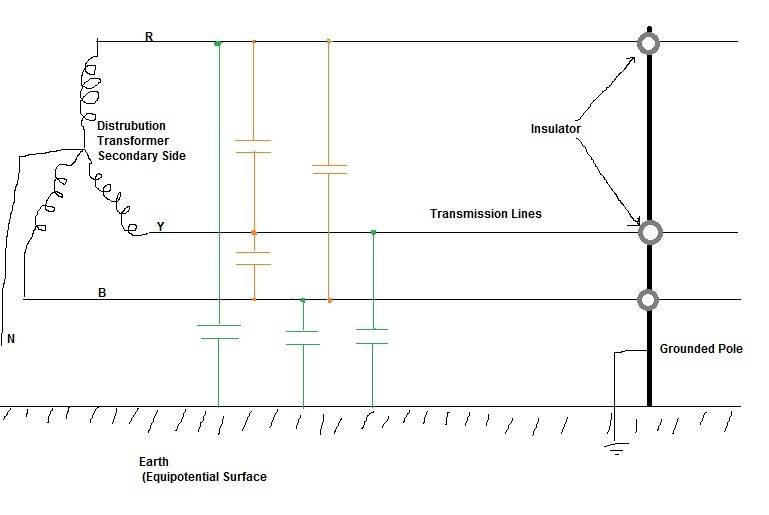
The above figure shows a distribution line along with a Pole. I understand there exist capacitance between lines (shown in pink) and between lines and ground(shown in green) if we treat the Earth as an infinite equipotential surface (conductor). Also the pole is grounded. But please note that the neutral of Distribution Transformer isn't grounded. Also assume that no grounding is done in any other part of the system.

Now, the question is what happens if one of the lines break and comes in contact with the body of the pole? How much fault current will flow?

Thanks.
 
Engineering news on Phys.org
The point I am unsure off is, can I calculate the fault current based on above model (capacitances between lines and Between line and earth) only OR I have somthing missing in that model?
If I follow only that model, the fault current will not be significantly large, only the capacitor between the faulted Line and Earth shorts out. The faulted line is still capacitively Isolated from other lines.
Do the circuit breaker trip?
 
in this circuit , fault current would depend on capacitance of healthy phases with ground. capacitance of transformer winding with tank(which would be grounded) will play significant role.

current would be proportional to system voltage. and for low voltage <1kV current would be insignificant.
 
Ok, instead of one of the phase shorting to the pole, If a monkey sitting on the pole touches one of the phase how much (tentative) current will flow?
Its again dependent upon the various capacitances and, I think its magnitude will be insignificant.

The reason I am being not totally sure is because someone here had previously told me that the Earth isn't something to be taken just as a plain conductor. It can sink in huge currents, weather you close the circuit or not! Its actually at 0 potential he said, and that anything that comes between Earth and high potential will be burned down.

I don't have enough reason to agree to that.
 
I am trying to understand how transferring electric from the powerplant to my house is more effective using high voltage. The suggested explanation that the current is equal to the power supply divided by the voltage, and hence higher voltage leads to lower current and as a result to a lower power loss on the conductives is very confusing me. I know that the current is determined by the voltage and the resistance, and not by a power capability - which defines a limit to the allowable...

Similar threads

  • · Replies 6 ·
Replies
6
Views
4K
Replies
6
Views
2K
  • · Replies 79 ·
3
Replies
79
Views
6K
  • · Replies 8 ·
Replies
8
Views
6K
Replies
4
Views
4K
  • · Replies 1 ·
Replies
1
Views
4K
Replies
10
Views
7K
Replies
5
Views
8K
  • · Replies 66 ·
3
Replies
66
Views
33K
  • · Replies 13 ·
Replies
13
Views
6K