FBD of Flexible and Rigid Body Coupling

Click For Summary
SUMMARY

The discussion centers on the force balance in a system involving flexible and rigid body coupling, specifically addressing the signs of the constraint force Q(t). The user derived the equation Q(t) = k[u(L,t) - y] + c[(du/dt) - (dy/dt)], but encountered discrepancies with the professor's solution regarding the signs of the k and c terms. The resolution identified a sign error in the free body diagram (FBD), where the positive direction of Q was incorrectly indicated. This clarification was provided by Dr.D, leading to a better understanding of the force balance.

PREREQUISITES
  • Understanding of Free Body Diagrams (FBD)
  • Knowledge of spring-damper systems
  • Familiarity with force balance equations
  • Basic principles of dynamics and kinematics
NEXT STEPS
  • Review the principles of Free Body Diagrams in mechanical systems
  • Study the dynamics of spring-damper systems in detail
  • Learn about the implications of sign conventions in force balance equations
  • Explore advanced topics in rigid body dynamics and constraints
USEFUL FOR

Mechanical engineers, students studying dynamics, and professionals working with multi-body systems will benefit from this discussion, particularly those focusing on force analysis in coupled systems.

ThLiOp
Messages
8
Reaction score
0
Problem:

I am having a bit of problem with the signs on the force balance with the constraining force. The system is:
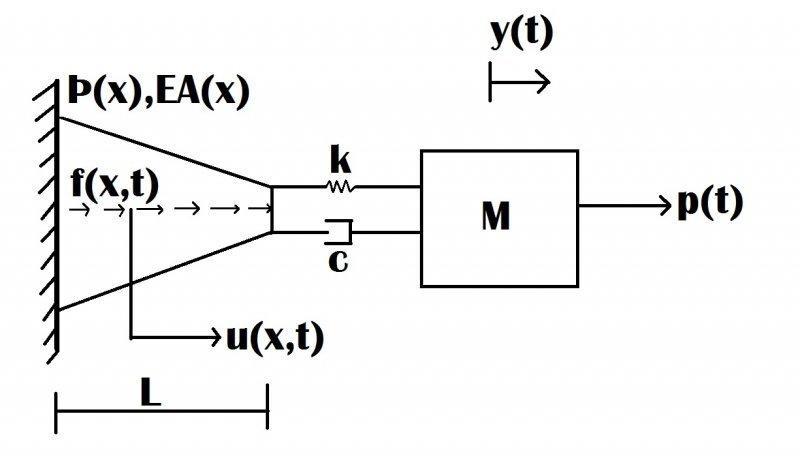
1.jpg
Attempt:

I drew the FBD with the constraining force for the lumped mass:
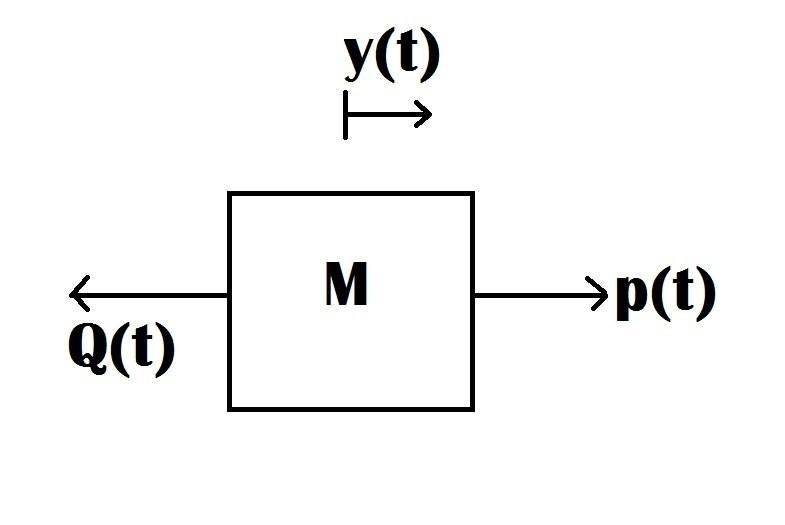
2.jpg

Then I tried to solve for the constraint force in terms of the spring and damper:
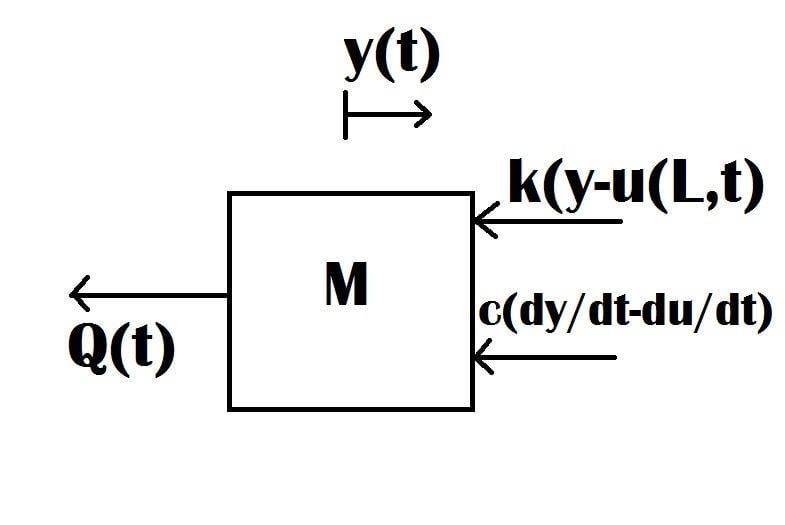
3.jpg


For the constraint force, Q(t), I end up getting:

Q(t) = k[u(L,t) - y] + c[(du/dt) - (dy/dt)]

The answer that the professor gives has the signs changed on the k and c terms. Where am I going wrong?

Thank you!
 

Attachments

  • 1.jpg
    1.jpg
    20.1 KB · Views: 562
  • 2.jpg
    2.jpg
    11.6 KB · Views: 481
  • 3.jpg
    3.jpg
    19.2 KB · Views: 516
Physics news on Phys.org
The expression you wrote for Q(t) is positive when u(L,t)>y And the same for derivatives. Now look at your FBD; it shows positive Q to the let. There is your sign error.
 
  • Like
Likes   Reactions: ThLiOp
Thank you Dr.D, that makes sense now!
 

Similar threads

  • · Replies 23 ·
Replies
23
Views
759
Replies
1
Views
4K
Replies
25
Views
9K
  • · Replies 1 ·
Replies
1
Views
4K
  • · Replies 3 ·
Replies
3
Views
2K
  • · Replies 7 ·
Replies
7
Views
4K
  • · Replies 1 ·
Replies
1
Views
4K
Replies
2
Views
1K
Replies
6
Views
3K
  • · Replies 11 ·
Replies
11
Views
2K