Fermi-Dirac integral with Taylor series expansion

2 replies · 2K views · last reply
arneet
Messages
8
Reaction score
0
Thread closed due to being posted in two forum sections
i am completely lost. there is an integral in my textbook in fermi dirac statistics whose result is written directly and am not able to understand . it is
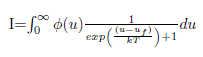
Integral from 0 to infinity of phi(u) times 1 over (exp((u - u_f)/kT) + 1), with respect to u, set equal to I.
.
on expansion by using the method of taylor's series the result should be

Sommerfeld expansion: the integral from 0 to u_f of phi(u) du, plus (pi^2/6)(kT)^2 times the partial derivative of phi with respect to u at u = u_f, plus 7(pi^4/360)(kT)^4 times the second partial derivative at u = u_f, plus further terms.

where u_f is such that function of u is zero for u greater than uf.
please reply as soon as possible. thanks.
 
I think this should have been posted in physics thread. Anyways, i will explain here...Assume u is greater than uf...so (u-uf) is so large...
so in 1+(exp(u-uf)/kT) can be approximated as (exp(u-uf)/kT)

The reciprocal of this term is (exp-(u-uf)/kT).

Hope this helps
 
  • Like
Likes   Reactions: arneet
Alpharup said:
I think this should have been posted in physics thread. Anyways, i will explain here...Assume u is greater than uf...so (u-uf) is so large...
so in 1+(exp(u-uf)/kT) can be approximated as (exp(u-uf)/kT)

The reciprocal of this term is (exp-(u-uf)/kT).

Hope this helps
thanks for replying,it helped.