Few Questions on source tranformation

Click For Summary

Discussion Overview

The discussion revolves around a specific question related to source transformation in electrical circuits, particularly focusing on the treatment of voltage sources in series and the handling of resistances in circuit analysis. The context includes homework-related queries and technical clarifications.

Discussion Character

  • Homework-related, Technical explanation, Debate/contested

Main Points Raised

  • One participant questions whether the smaller voltage source should be selected when different voltage sources are in series.
  • Another participant asserts that the resultant voltage from two series sources is the sum of their voltages, considering their polarities.
  • A participant challenges the interpretation of a solution regarding the disappearance of resistance, suggesting that it does not disappear but rather is mislabelled in the solution.
  • There is a discussion about the treatment of resistors in parallel, with one participant explaining that they can be replaced by an equivalent resistance.
  • One participant suggests that the thread should be moved to a homework sub-forum for more appropriate assistance.

Areas of Agreement / Disagreement

Participants express differing views on the handling of voltage sources in series and the treatment of resistances in the circuit analysis. The discussion remains unresolved with multiple competing interpretations of the problem.

Contextual Notes

There are indications of potential errors in the provided solution, such as mislabelled resistances, which may affect the understanding of the problem. The discussion also highlights the importance of context in circuit analysis.

clurt
Messages
27
Reaction score
0
It's question 1b) Please view attached
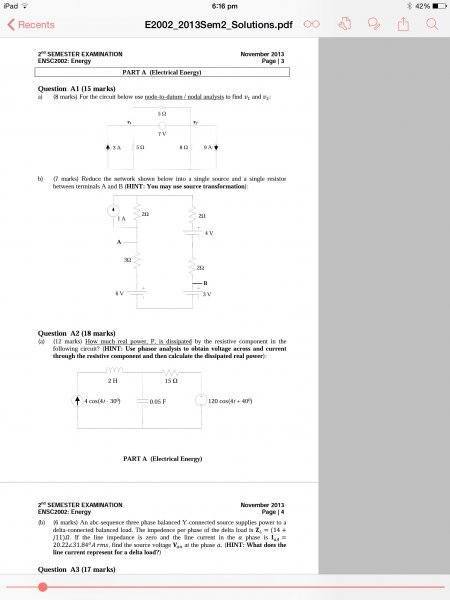
image.jpg
image.jpg


1. Just to clarify, when different voltage sources are in series you pick the smaller one?

2. First step, they turned the 1A and 2ohm into 2V, why does the resistance disappear? Then between the last two steps the 12/7 ohm resistance remains with 18/7 voltage. Why does one resistance disappear while the other doesn't?

Thanks on advance
 
Engineering news on Phys.org
clurt said:
It's question 1b) Please view attached
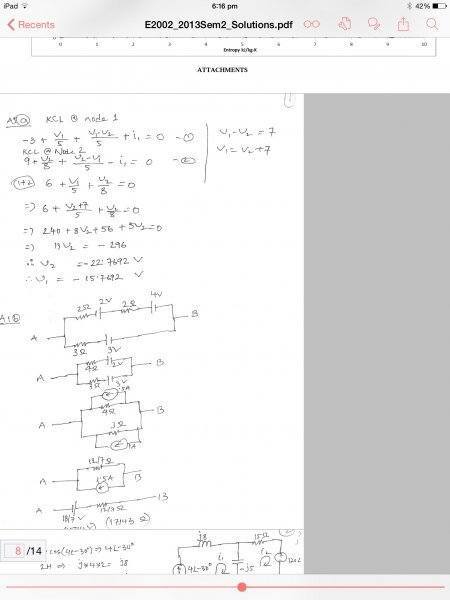
It would have been better if you'd cropped the attachment to just the relevant block in post #1 and in the process made it more legible.

1. Just to clarify, when different voltage sources are in series you pick the smaller one?
No! The 3v comes about because two sources are in series, +6v and -3v, so the resultant voltage is their sum with polarities taken into account.

2. First step, they turned the 1A and 2ohm into 2V, why does the resistance disappear?
It doesn't. The solution is in error. I expect the right side 2 ohm was probably intended to be labelled 4 ohms.

Then between the last two steps the 12/7 ohm resistance remains with 18/7 voltage. Why does one resistance disappear while the other doesn't?
Nothing disappears. The two resistors are in parallel, so they can be replaced by an equivalent one of the value equal to that when two resistors are in parallel.

Hope that helps.
 
Last edited:
This thread belongs in the homework sub-forum. You almost certainly would have received prompt assistance had you listed it there.

Could a mentor kindly move this to the appropriate forum ...
 

Similar threads

Replies
8
Views
2K
  • · Replies 15 ·
Replies
15
Views
2K
Replies
2
Views
2K
  • · Replies 7 ·
Replies
7
Views
3K
  • · Replies 4 ·
Replies
4
Views
2K
  • · Replies 6 ·
Replies
6
Views
8K
  • · Replies 18 ·
Replies
18
Views
5K
  • · Replies 8 ·
Replies
8
Views
3K
  • · Replies 10 ·
Replies
10
Views
2K
  • · Replies 38 ·
2
Replies
38
Views
5K