Fiber optics: using continous variation refractive indexes hold light?

Click For Summary
SUMMARY

The discussion centers on the application of continuous variation of refractive indices in fiber optics, specifically using a gradient-index approach to optimize light transmission. The Fermat principle is highlighted as a mathematical foundation for this concept, expressed through the integral equation \int_{0}^{end} n ds=minimum. Participants explore the implications of this principle and seek methods to derive the necessary calculations for varying refractive indices, particularly focusing on linear variations with respect to height.

PREREQUISITES
  • Understanding of gradient-index optics
  • Familiarity with Fermat's principle in optics
  • Basic calculus, particularly integral calculus
  • Knowledge of refractive index concepts
NEXT STEPS
  • Study the mathematical derivation of the Fermat principle in optics
  • Explore gradient-index materials and their applications in fiber optics
  • Learn about the numerical methods for solving integral equations in optics
  • Investigate linear and nonlinear refractive index profiles in optical fibers
USEFUL FOR

Optical engineers, physicists, and students studying fiber optics and gradient-index materials will benefit from this discussion, particularly those interested in advanced light transmission techniques.

tsuwal
Messages
105
Reaction score
0
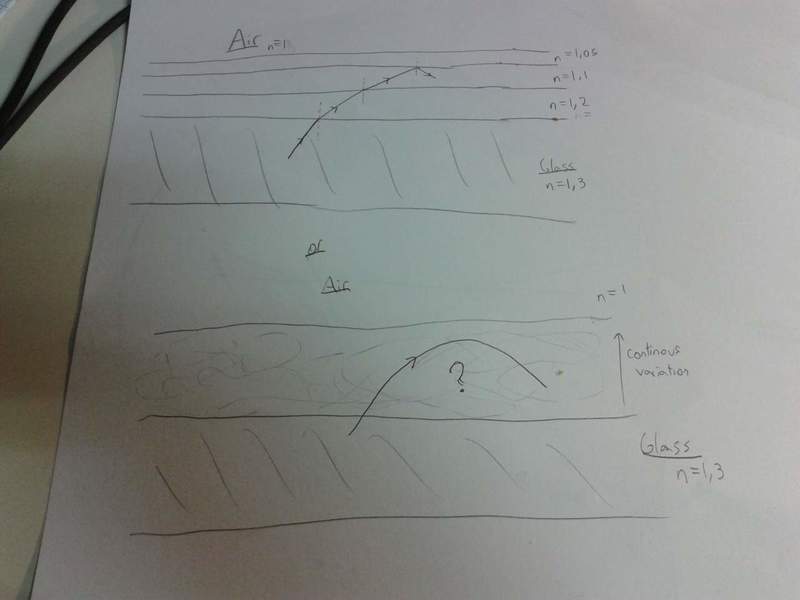
My teacher said that instead of using a fiber optic made of just one material we could use a set of materials with progressively low refractive index to turn the light back in, like so:
2013-03-27 01.11.36.jpg


In the case of a continuous variation of refraction index, how can you do the math. Can you please show me, the right way for it?
 
Science news on Phys.org
It was a good help, thanks.
The math at the bottom is the fermat principle

[itex]\int_{0}^{end} n ds=minimum[/itex]

this is because n=c/velocity, if you take the c out (factorize) you are summing the infinitesimal times of the path the light travels.
However, I can't get anywhere from here, I tried doing the following:

[itex]\int_{0}^{end} n ds=minimum \Leftrightarrow \int_{0}^{maximumheight} n(y)\sqrt{\frac{dx}{dy}^{2}+1} ds=minimum \Rightarrow \frac{d}{dt}\int_{0}^{maximumheight} n(y)\sqrt{\frac{dx}{dy}^{2}+1} ds=0[/itex]

we can pass the derivative to the inside of the integral and assume that n(y) varies linearly with y to simplify calculations but anyway, it doesn't like very nice.. Any suggestions?
 

Similar threads

  • · Replies 1 ·
Replies
1
Views
2K
  • · Replies 2 ·
Replies
2
Views
2K
Replies
12
Views
2K
  • · Replies 1 ·
Replies
1
Views
2K
Replies
5
Views
482
  • · Replies 1 ·
Replies
1
Views
3K
  • · Replies 2 ·
Replies
2
Views
2K
Replies
2
Views
433
  • · Replies 8 ·
Replies
8
Views
2K
  • · Replies 9 ·
Replies
9
Views
2K