Field Extensions - Remarks by Lovett - Page 326 .... ....

  • Context: Undergrad 
  • Thread starter Thread starter Math Amateur
  • Start date Start date
  • Tags Tags
    Field
Click For Summary
SUMMARY

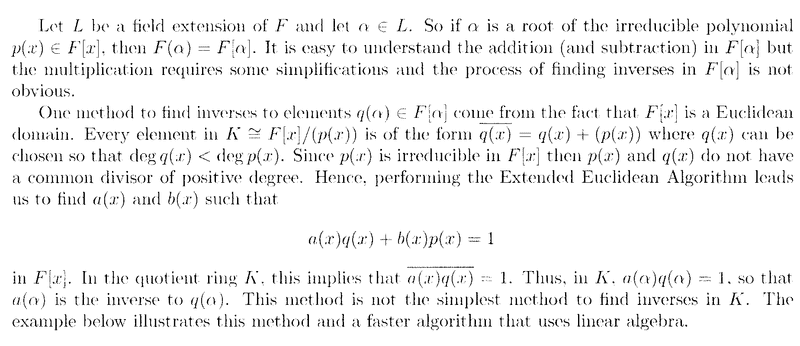
The discussion centers on the interpretation of remarks made by Stephen Lovett in "Abstract Algebra: Structures and Applications," specifically regarding Theorem 7.1.12 and Example 7.1.13 on page 326. The key point is the implication that if the quotient ring \( K \) satisfies \( \overline{ a(x) q(x) } = 1 \), then it follows that \( a( \alpha ) q( \alpha ) = 1 \) when substituting \( \alpha \) into the equation. This conclusion is reached by recognizing that substituting \( \alpha \) into the equation \( a(x)q(x) + b(x)p(x) = 1 \) simplifies to the desired result due to \( p(\alpha) = 0 \).

PREREQUISITES
  • Understanding of abstract algebra concepts, particularly field theory.
  • Familiarity with quotient rings and their properties.
  • Knowledge of polynomial functions and their roots.
  • Ability to interpret mathematical notation and implications in algebraic structures.
NEXT STEPS
  • Study the properties of quotient rings in abstract algebra.
  • Explore the implications of Theorem 7.1.12 in more detail.
  • Review polynomial equations and their roots in the context of field extensions.
  • Examine additional examples from "Abstract Algebra: Structures and Applications" to reinforce understanding.
USEFUL FOR

Students of abstract algebra, mathematicians interested in field theory, and educators teaching advanced algebra concepts will benefit from this discussion.

Math Amateur
Gold Member
MHB
Messages
3,920
Reaction score
48
I am reading "Abstract Algebra: Structures and Applications" by Stephen Lovett ...

I am currently focused on Chapter 7: Field Extensions ... ...

I need help with some remarks of Lovett following Theorem 7.1.12 and Example 7.1.13 on page 326 ...The remarks by Lovett read as follows:
?temp_hash=57434c130d005eb253bc7f82146fef36.png


In the above remarks from Lovett, we read the following:

" ... ... In the quotient ring ##K##, this implies that ##\overline{ a(x) q(x) } = 1##. Thus in ##K, \ a( \alpha ) q( \alpha ) = 1##. ... ... "My question is as follows:

Can someone please explain exactly why/how it is that ##\overline{ a(x) q(x) } = 1## implies that ##a( \alpha ) q( \alpha ) = 1## ... ... ?Help will be appreciated ...

Peter
 

Attachments

  • Lovett - Remarks on Field Extensions - page 326 ... ....pdf.png
    Lovett - Remarks on Field Extensions - page 326 ... ....pdf.png
    34.7 KB · Views: 468
Physics news on Phys.org
In the equation ##a(x)q(x)+b(x)p(x)=1##, substitute ##\alpha## for ##x##. Since ##p(\alpha)=0## (we were told ##\alpha## is a root of ##p(x)##) the equation collapses to the desired result.
 
  • Like
Likes   Reactions: Math Amateur

Similar threads

  • · Replies 4 ·
Replies
4
Views
2K
  • · Replies 18 ·
Replies
18
Views
3K
  • · Replies 6 ·
Replies
6
Views
2K
  • · Replies 2 ·
Replies
2
Views
2K
  • · Replies 15 ·
Replies
15
Views
2K
  • · Replies 5 ·
Replies
5
Views
2K
  • · Replies 12 ·
Replies
12
Views
3K
Replies
2
Views
2K
  • · Replies 2 ·
Replies
2
Views
2K
  • · Replies 2 ·
Replies
2
Views
2K