Field of a Trianglular Solenoid

  • Thread starter Thread starter Taulant Sholla
  • Start date Start date
  • Tags Tags
    Field Solenoid
Click For Summary

Homework Help Overview

The discussion revolves around the magnetic field of a triangular solenoid, specifically questioning the assertion that "the field is strongest at point Y." Participants express confusion regarding this claim and explore the implications of solenoid behavior and magnetic field properties.

Discussion Character

  • Exploratory, Conceptual clarification, Assumption checking

Approaches and Questions Raised

  • Participants question the validity of the claim about point Y being the strongest field point, with some suggesting that the field could be zero inside the triangle based on symmetry and solenoid characteristics.

Discussion Status

There is an ongoing exploration of the concepts related to magnetic fields and solenoids, with participants sharing thoughts on Maxwell's equations and the behavior of magnetic fields in relation to the geometry of the solenoid. No consensus has been reached, but various interpretations are being examined.

Contextual Notes

Some participants note the lack of responses to the initial claim, which raises doubts about its correctness. The discussion also reflects on the implications of the solenoid's finite nature and the assumptions made about the magnetic field distribution.

Taulant Sholla
Messages
96
Reaction score
5
Homework Statement
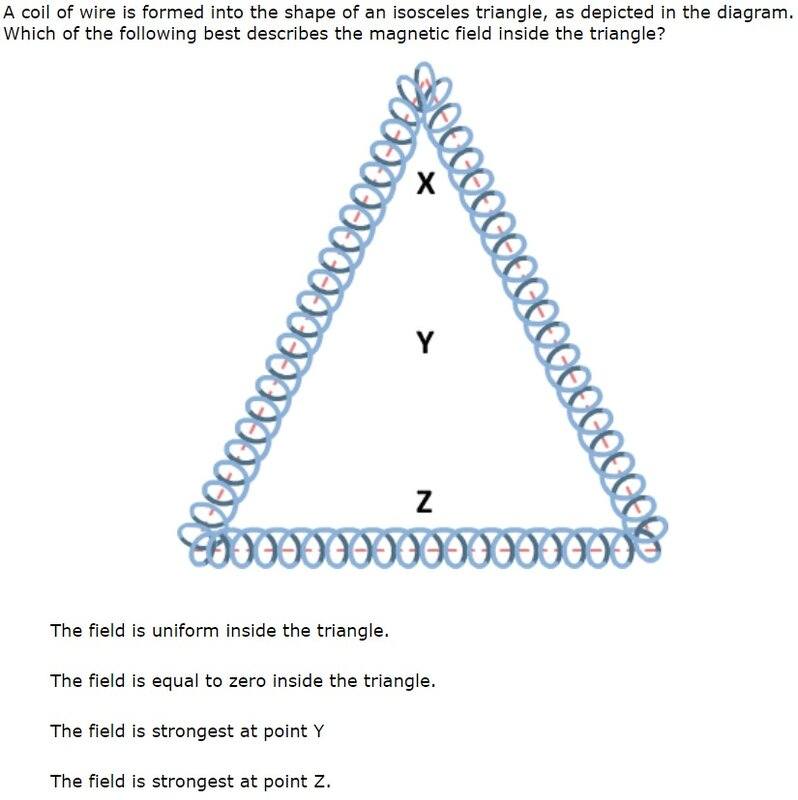
A coil of wire is formed into the shape of an isosceles triangle, as depicted in the diagram. Which of the following best describes the magnetic field inside the triangle?
Relevant Equations
b=uni
No calculators or equations are needed for this question. The correct answer is supposedly "The field is strongest at point Y" and I have no idea why.

solenoid triangle.jpg

I even coughed-up the following, but still can't see how this is the right answer.
attempt.JPG
 
Physics news on Phys.org
I'm guessing this might be an incorrect answer by the lack of responses? I certainly can't see a way at this choice is correct. Ideas?
 
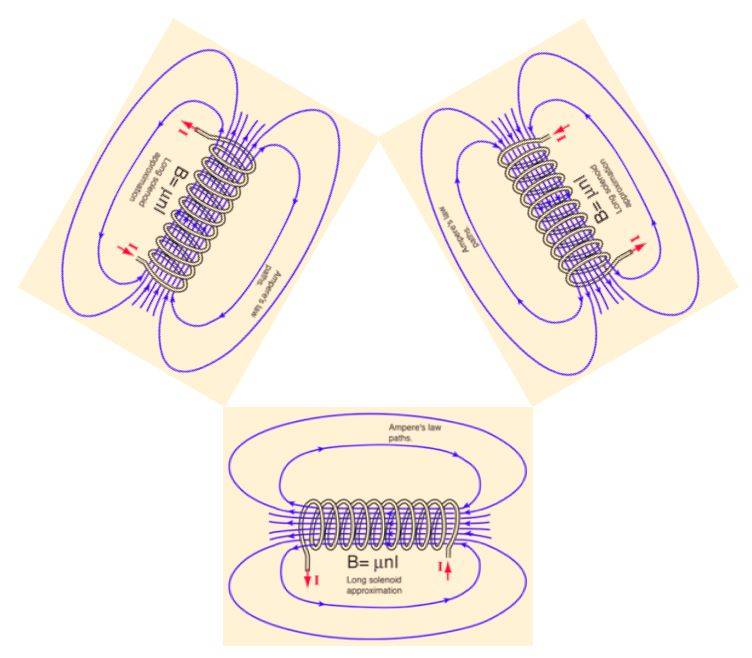
You know that for an infinite solenoid of radius ##R## the field is zero at distance ##r>R## from the axis. No solenoid is infinite, so at ##r>R## the magnetic field is approximately zero. The approximation becomes better and the field is closer to zero the closer you come to the solenoid. This is shown graphically in the pictures you scared up. Point Y is farthest from all solenoids therefore you are supposed to conclude that the field is strongest there, when you add the fields as vectors, where the infinite solenoid approximation is worst.

Having said that, let's see what Maxwell's equations have to say about this. One of these equations says that magnetic field lines form closed loops. Another one, a.k.a. Ampere's law says that if you take a line integral around a closed loop, the result is proportional to the current enclosed by the loop. So let's draw an arrow representing the magnetic field at point Y. It's part of a closed loop. Let's draw it as a closed oriented magnetic field line loop entirely inside the triangle. The integral ##\oint \vec B \cdot d\vec l## cannot be zero because the magnetic field is always along the contour, yet there is no current cutting through the plane of the loop. This is a contradiction. My initial thought when I saw this was that the field inside the triangle is zero.

Taulant Sholla said:
I'm guessing this might be an incorrect answer by the lack of responses? I certainly can't see a way at this choice is correct. Ideas?
Please be more patient. It's Sunday after all.
 
Last edited:
  • Like
Likes   Reactions: fresh_42 and etotheipi
kuruman said:
My initial thought when I saw this was that the field inside the triangle is zero.
Certainly, if we take the special case of an equilateral triangle and set Y at the centre then the field there is zero by symmetry.
So if the field is minimum at Y then it is also true that the field is zero everywhere in the triangle.
 
Last edited:
  • Like
Likes   Reactions: etotheipi
kuruman said:
You know that for an infinite solenoid of radius ##R## the field is zero at distance ##r>R## from the axis. No solenoid is infinite, so at ##r>R## the magnetic field is approximately zero. The approximation becomes better and the field is closer to zero the closer you come to the solenoid. This is shown graphically in the pictures you scared up. Point Y is farthest from all solenoids therefore you are supposed to conclude that the field is strongest there, when you add the fields as vectors, where the infinite solenoid approximation is worst.

Having said that, let's see what Maxwell's equations have to say about this. One of these equations says that magnetic field lines form closed loops. Another one, a.k.a. Ampere's law says that if you take a line integral around a closed loop, the result is proportional to the current enclosed by the loop. So let's draw an arrow representing the magnetic field at point Y. It's part of a closed loop. Let's draw it as a closed oriented magnetic field line loop entirely inside the triangle. The integral ##\oint \vec B \cdot d\vec l## cannot be zero because the magnetic field is always along the contour, yet there is no current cutting through the plane of the loop. This is a contradiction. My initial thought when I saw this was that the field inside the triangle is zero.Please be more patient. It's Sunday after all.
Thank you - very thought-provoking!
 

Similar threads

  • · Replies 9 ·
Replies
9
Views
2K
Replies
7
Views
2K
  • · Replies 15 ·
Replies
15
Views
2K
  • · Replies 3 ·
Replies
3
Views
2K
Replies
8
Views
1K
  • · Replies 11 ·
Replies
11
Views
4K
  • · Replies 1 ·
Replies
1
Views
2K
  • · Replies 1 ·
Replies
1
Views
2K
  • · Replies 31 ·
2
Replies
31
Views
3K
  • · Replies 6 ·
Replies
6
Views
2K