Find all the accelerations of the 3 masses and the 1kg pulley

  • Context: Graduate 
  • Thread starter Thread starter paul_harris77
  • Start date Start date
  • Tags Tags
    Pulley
Click For Summary
SUMMARY

This discussion focuses on calculating the accelerations of three masses and a 1kg pulley in a tension system using d'Alembert's principle. The correct tensions were determined to be 33N for the big pulley rope and 12N for the 1kg pulley rope, assuming gravitational acceleration (g) is 10 m/s². The user, Paul, questions the simplification of the system by eliminating the 1kg pulley, which leads to an incorrect tension calculation of 10N. The response clarifies that internal parts of the system accelerate differently, making such simplifications invalid.

PREREQUISITES
  • Understanding of d'Alembert's principle
  • Knowledge of tension in pulley systems
  • Familiarity with Newton's laws of motion
  • Basic concepts of gravitational acceleration (g)
NEXT STEPS
  • Study advanced applications of d'Alembert's principle in complex systems
  • Explore tension calculations in multi-mass pulley systems
  • Learn about the effects of varying mass accelerations on system dynamics
  • Investigate the implications of simplifying mechanical systems in physics
USEFUL FOR

Physics students, mechanical engineers, and anyone studying dynamics in multi-mass systems will benefit from this discussion.

paul_harris77
Messages
50
Reaction score
0
Dear All

I have a question about tension in a mass system with pulleys.
vpc1vl.jpg


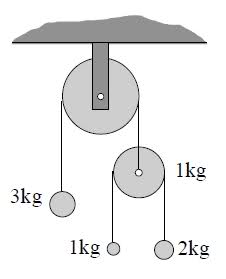
The question asks you to find all the accelerations of the 3 masses and the 1kg pulley. It also asks you to find the tensions in the ropes.

I have used d'Alembert's principle to do this and appear to have the correct answer for the tensions of 33N for the big pulley rope and 12N for the 1kg pulley rope (assuming g=10ms-2)

After doing this though, I am slightly confused. Surely the system could be simplified to the 3 kg mass on the left of the big pulley and a 4kg mass on the right hand side (eliminating the 1kg pulley). Then the tension in the remaining rope would be (4-3)g = 10N instead of 33N. Why is this not right?

Many thanks

Regards

Paul
 
Physics news on Phys.org


They 4kg mass you replace necessarily accelerates at one rate while the individual masses on the RHS are accelerating at different rates. They are not exerting the same reaction forces as their static weights so they don't "just add up".

Consider a third example of a simple pulley with two masses and a third mass on the right being dropped. It isn't appropriate to add in this third mass right? But why not?


paul_harris77 said:
Surely the system could be simplified to the 3 kg mass on the left of the big pulley and a 4kg mass on the right hand side (eliminating the 1kg pulley).
You can't replace a system with internal parts that accelerate differently with a single mass with a single acceleration. (Note that the force exerted on the 1 kg pulley by the hanging masses does not simply equal the weight of the hanging masses.)
 

Similar threads

  • · Replies 16 ·
Replies
16
Views
3K
  • · Replies 17 ·
Replies
17
Views
3K
  • · Replies 18 ·
Replies
18
Views
1K
  • · Replies 3 ·
Replies
3
Views
2K
  • · Replies 5 ·
Replies
5
Views
3K
  • · Replies 5 ·
Replies
5
Views
3K
  • · Replies 22 ·
Replies
22
Views
7K
  • · Replies 22 ·
Replies
22
Views
1K
  • · Replies 15 ·
Replies
15
Views
6K
  • · Replies 10 ·
Replies
10
Views
5K