How Does the Distance y Change When Mass x Varies in a Pulley System?

Click For Summary

Discussion Overview

The discussion revolves around a pulley system in static equilibrium, specifically examining how the distance y changes as the mass x varies. Participants explore the relationship between the angle of the rope, the vertical position of the mass, and the potential use of the system as a balance. The conversation includes mathematical reasoning and conceptual clarifications regarding the mechanics involved.

Discussion Character

  • Exploratory
  • Technical explanation
  • Conceptual clarification
  • Debate/contested
  • Mathematical reasoning

Main Points Raised

  • One participant describes the setup of the pulley system and seeks to understand how distance y changes with varying mass x, noting that the system is in static equilibrium.
  • Another participant agrees that the system can be used as a balance, emphasizing that the angle of the rope to the vertical is crucial for determining the weight of the central mass.
  • There is a question about whether the equation can be used to find the mass based on the vertical descent or change in y, with some participants suggesting that calling it a "sag" may be inaccurate.
  • It is asserted that the absolute level of y is necessary to calculate the angle, which is needed to determine the force, rather than just the change in y.
  • Participants discuss the possibility of determining the mass if the value of y is known, with one noting that they should have referred to the value of y instead of the change in y.
  • One participant mentions that they have not verified the calculations to confirm the correctness of the formula presented.

Areas of Agreement / Disagreement

Participants generally agree on the importance of the angle of the rope and the absolute level of y for calculations, but there are differing views on the terminology used (sag vs. change in y) and the implications of the equations presented. The discussion remains unresolved regarding the accuracy of the calculations and the specific use of the system as a balance.

Contextual Notes

Participants express uncertainty about the calculations and the definitions used, particularly concerning the relationship between the change in y and the absolute level of y. There are also unresolved questions about the implications of the system's mechanics.

person123
Messages
326
Reaction score
52
I was working on a pulley system as shown here:
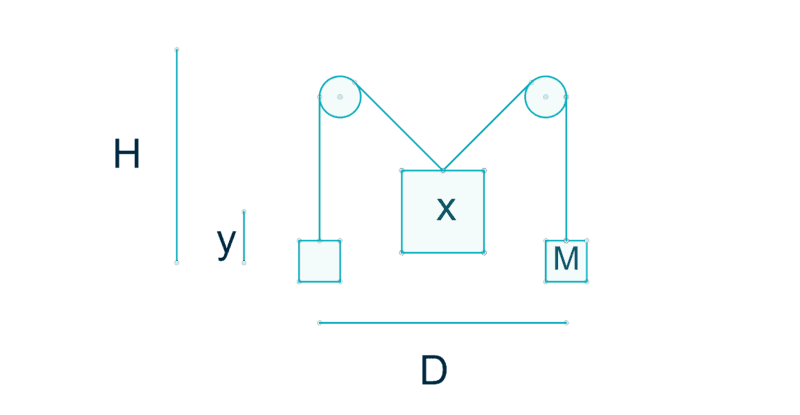
pulley.png

The mass on the right and left side is equivalent, and I am solving for when the system is in static equilibrium. Theta is the angle between the rope on either side of one of the pulleys. H and y are both measured from the original position of mass M, not its current location (it was simply meant as a reference point). The mass of the rope and friction are ignored. I wanted to find how the distance y changes as the mass x changes.

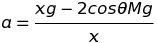
I first found the acceleration of the object, which is of course 0:

force.png

acceleration.png

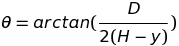
I then solved for theta, giving me:
theta.png

I then was able to find cosΘ:
costan.png

And I was then able to find the final equation by setting the first equation equal to 0:

equation final.png


Here is a link to the graph: https://www.desmos.com/calculator/wpttkfsvmb

I imagine that this system may be used as a balance, in which the sag of the rope tells you the mass of x as based on the equation. Would that be possible? Thanks in advance.

(As a side note, I feel dumb showing my work in the form of images, but I can't figure out how to use BB code editor—I might just be missing something obvious).
 
Physics news on Phys.org
person123 said:
I imagine that this system may be used as a balance, in which the sag of the rope tells you the mass of x as based on the equation. Would that be possible?
Yes it can be used as a balance. It's the angle of the rope to the vertical, not the sag, that tells us the weight of the central mass.
 
andrewkirk said:
Yes it can be used as a balance. It's the angle of the rope to the vertical, not the sag, that tells us the weight of the central mass.
Could you also use the equation to find the mass of the object based on the vertical descent, or the change in y? (It may have been inaccurate to call that a sag).
 
person123 said:
Could you also use the equation to find the mass of the object based on the vertical descent, or the change in y? (It may have been inaccurate to call that a sag).
No. We need the absolute level of y, not just its change, in order to calculate the angle. And we need the angle in order to calculate the force.
 
andrewkirk said:
No. We need the absolute level of y, not just its change, in order to calculate the angle. And we need the angle in order to calculate the force.
Yes—so if you were to know y, or the vertical position of the mass m, would you be able to determine the mass based on the formula I wrote? I should have wrote the value of y instead of the change in y.
 
person123 said:
Yes—so if you were to know y, or the vertical position of the mass m, would you be able to determine the mass based on the formula I wrote? I should have wrote the value of y instead of the change in y.
Yes we could determine the mass based on a formula of that sort. I have not checked the calculations to see whether the formula is exactly correct.
 

Similar threads

  • · Replies 16 ·
Replies
16
Views
3K
Replies
2
Views
2K
  • · Replies 22 ·
Replies
22
Views
7K
  • · Replies 40 ·
2
Replies
40
Views
5K
  • · Replies 2 ·
Replies
2
Views
2K
  • · Replies 10 ·
Replies
10
Views
1K
Replies
19
Views
2K
  • · Replies 29 ·
Replies
29
Views
4K
  • · Replies 11 ·
Replies
11
Views
3K
  • · Replies 2 ·
Replies
2
Views
4K