Find DFA Equiv: States, Transitions & Function

16 replies · 3K views · last reply
evinda
Gold Member
MHB
Messages
3,741
Reaction score
0
Hello! (Wave)

I want to find a DFA equivalent with the following:

View attachment 5867

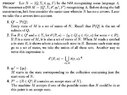
Do we have to follow the following procedure?

View attachment 5868

If so do we have to find the transition function having the following states?

$$\{A\} , \{ B \}, \{ C \}, \{ A,B \}, \{ A,C \}, \{ B,C \}, \{A,B,C\}$$
 
Attachments
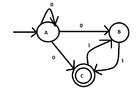
  • State diagram of a nondeterministic finite automaton with states A, B and C; A is the start state and C is the accepting state, with 0-loop on A, 0 edges from A to B and A to C, and 1 edges from B to C and C to B.
    dfa2.png
    2.8 KB · Views: 162
  • Printed proof from a textbook on converting an NFA to an equivalent DFA, covering the state set Q' = P(Q), the transition function delta', the start state q0' = {q0}, and the accept states F'.
    R.JPG
    37.3 KB · Views: 146
evinda said:
Hello! (Wave)

I want to find a DFA equivalent with the following:
Do we have to follow the following procedure?
If so do we have to find the transition function having the following states?

$$\{A\} , \{ B \}, \{ C \}, \{ A,B \}, \{ A,C \}, \{ B,C \}, \{A,B,C\}$$

Hey evinda! (Smile)

Yep, except that we should include $\varnothing$ as well. (Nerd)
 
I found the following transition function:

$$\delta': \begin{matrix}
& 0 & 1\\
\{A\} & \{A\} & \varnothing \\
\{B\} & \varnothing & \{C\}\\
\{C\} & \varnothing & \{B\}\\
\{A,B\} & \{A\} & \{C\}\\
\{A,C\} & \{A\} &\{B\} \\
\{B,C\} & \varnothing & \{B,C\}\\
\{A,B,C\} & \{A\} & \{B,C\}\\
\varnothing & \varnothing & \varnothing
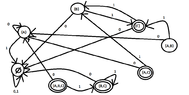
\end{matrix}$$So the dfa will look as follows, right? (Thinking)View attachment 5872
 
Attachments
  • State diagram of a DFA with states {A}, {B}, {C}, {A,B}, {A,C}, {B,C}, {A,B,C} and the empty state, with 0 and 1 transition arrows; {C}, {A,C}, {B,C}, {A,B,C} are double-circled accepting states.
    dfa3.png
    10.1 KB · Views: 159
evinda said:
I found the following transition function:

$$\delta': \begin{matrix}
& 0 & 1\\
\{A\} & \{A\} & \varnothing \\
\{B\} & \varnothing & \{C\}\\
\{C\} & \varnothing & \{B\}\\
\{A,B\} & \{A\} & \{C\}\\
\{A,C\} & \{A\} &\{B\} \\
\{B,C\} & \varnothing & \{B,C\}\\
\{A,B,C\} & \{A\} & \{B,C\}\\
\varnothing & \varnothing & \varnothing
\end{matrix}$$So the dfa will look as follows, right? (Thinking)

Hmm... the start state is missing... shouldn't we start with $q_0'=\{A\}$ as start state (rule 3)? (Wondering)

According to rule 2, shouldn't we have:
$$\delta'(q_0', 0) = \delta'(\{A\}, 0) = \bigcup_{r \in \{A\}} \delta(r, 0) = \delta(A,0) = \{A,B,C\}$$
(Wondering)
 
I like Serena said:
Hmm... the start state is missing... shouldn't we start with $q_0'=\{A\}$ as start state (rule 3)? (Wondering)

According to rule 2, shouldn't we have:
$$\delta'(q_0', 0) = \delta'(\{A\}, 0) = \bigcup_{r \in \{A\}} \delta(r, 0) = \delta(A,0) = \{A,B,C\}$$
(Wondering)

Oh yes, that's right! (Nod) Is everything else correct?
 
evinda said:
Oh yes, that's right! (Nod) Is everything else correct?

Well... we have indeed $\delta'(\{A\}, 1)=\varnothing$. (Nod)

But what should $\delta'(\{A,B,C\}, 0)$ be?
And $\delta'(\{A,B,C\}, 1)$? (Wondering)
 
I like Serena said:
Well... we have indeed $\delta'(\{A\}, 1)=\varnothing$. (Nod)

But what should $\delta'(\{A,B,C\}, 0)$ be?

$\{A,B,C \}$

I like Serena said:
And $\delta'(\{A,B,C\}, 1)$? (Wondering)

$\{B,C\}$

Right?
 
evinda said:
$\{A,B,C \}$

$\{B,C\}$

Right?

Right.

And isn't $\delta'(\{A,B\}, 0) = \{A,B\}$ and $\delta'(\{A,C\}, 0) = \{A,C\}$? (Wondering)
 
I like Serena said:
Right.

And isn't $\delta'(\{A,B\}, 0) = \{A,B\}$ and $\delta'(\{A,C\}, 0) = \{A,C\}$? (Wondering)

Isn't it $\delta'(\{A,B\}, 0) = \{A,B, C\}$ and $\delta'(\{A,C\}, 0) = \{A,B, C\}$ because of the transitions from A to C by reading 0 and from A to B by reading 0 respectively? Or am I wrong?
 
evinda said:
Isn't it $\delta'(\{A,B\}, 0) = \{A,B, C\}$ and $\delta'(\{A,C\}, 0) = \{A,B, C\}$ because of the transitions from A to C by reading 0 and from A to B by reading 0 respectively? Or am I wrong?

Oh yes. You are right! (Blush)
 
evinda said:
So we get the following dfa, right?

I think there are 2 arrows missing from $\{A,B,C\}$... (Thinking)

Btw, did you notice that 4 of those 8 states are not reachable from the start state? (Wondering)
 
I like Serena said:
I think there are 2 arrows missing from $\{A,B,C\}$... (Thinking)

Oh yes, right... I forgot to write the transition from $\{A,B,C\}$ to $\{A,B,C\}$ by reading 0, and the transition from $\{A,B,C\}$ to $\{B,C\}$ by reading 1.

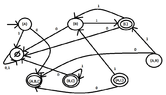
So the dfa is the following:

View attachment 5881

I like Serena said:
Btw, did you notice that 4 of those 8 states are not reachable from the start state? (Wondering)
Yes, the states $\{ B \}, \{C\}, \{A,B\}, \{A,C\}$. :eek:
But all the states of a dfa should be reachable from the start state, right? (Thinking)
 
Attachments
  • State diagram of a DFA with states {A}, {B}, {C}, {A,B}, {A,C}, {B,C}, {A,B,C} and the empty set, with transitions labeled 0 and 1 and accepting states drawn as double circles.
    ddfa.png
    9.1 KB · Views: 154
evinda said:
Oh yes, right... I forgot to write the transition from $\{A,B,C\}$ to $\{A,B,C\}$ by reading 0, and the transition from $\{A,B,C\}$ to $\{B,C\}$ by reading 1.

So the dfa is the following:

Yep. (Nod)

Yes, the states $\{ B \}, \{C\}, \{A,B\}, \{A,C\}$. :eek:
But all the states of a dfa should be reachable from the start state, right? (Thinking)

Does the definition require that?
Last time I checked we can have unreachable states - it's just that we might as well leave them out.
They're just making the diagram messier than it needs to be. (Emo)
Anyway, the procedure you quoted did include all of them.
That is, it specifically said that the set of states would be $q'=\mathcal P(q)$.
 
I like Serena said:
Last time I checked we can have unreachable states - it's just that we might as well leave them out.
They're just making the diagram messier than it needs to be. (Emo)

So a dfa equivalent to the given initial nfa is the following, right?View attachment 5882

In order to know which states are reachable from the starting state do we look at the states where we can go from the states where the starting state can go? (Blush)

I.e. in this case, we have

$\begin{matrix}
& 0 & 1\\
\{A\} &\{A,B,C\} & \varnothing
\end{matrix}$

and

$\begin{matrix}
& 0 & 1\\
\{A,B,C\} &\{A,B,C\} & \{B,C\}
\end{matrix}$

so we deduce that we have to include at the dfa the states $\{A\}, \{A,B,C\}$ and $\{B,C \}$, right? (Thinking)
 
Attachments
  • State diagram of a DFA with states labeled {A}, empty set, {A,B,C} and {B,C}; {A} is the start state, and {A,B,C} and {B,C} are accepting.
    ddfa.png
    4.5 KB · Views: 146
evinda said:
So a dfa equivalent to the given initial nfa is the following, right?

In order to know which states are reachable from the starting state do we look at the states where we can go from the states where the starting state can go? (Blush)

I.e. in this case, we have

$\begin{matrix}
& 0 & 1\\
\{A\} &\{A,B,C\} & \varnothing
\end{matrix}$

and

$\begin{matrix}
& 0 & 1\\
\{A,B,C\} &\{A,B,C\} & \{B,C\}
\end{matrix}$

so we deduce that we have to include at the dfa the states $\{A\}, \{A,B,C\}$ and $\{B,C \}$, right? (Thinking)

Yep. (Nod)

That leaves only to check where we can go from $\{B,C \}$. (Sun)
 
I like Serena said:
Yep. (Nod)

That leaves only to check where we can go from $\{B,C \}$. (Sun)

I got it... Thanks a lot! (Smirk)