Find Effective Voltage Across R,L,C in RLC Circuit

  • Thread starter Thread starter magnifik
  • Start date Start date
  • Tags Tags
    Voltage
Click For Summary

Discussion Overview

The discussion revolves around finding the effective voltage across each element (resistor, inductor, capacitor) in a series RLC circuit. Participants explore the relationships between current, voltage, and impedance, as well as the implications of phase differences in the circuit.

Discussion Character

  • Technical explanation
  • Mathematical reasoning
  • Debate/contested

Main Points Raised

  • One participant presents initial calculations for effective voltage and expresses uncertainty about the relationship between peak and effective voltages.
  • Another participant agrees with the inductive reactance value and discusses the phase relationship between supply voltage and voltages across the resistor, inductor, and capacitor, suggesting the use of a phasor diagram.
  • A later reply acknowledges that the initial participant has enough information, correcting an earlier assumption about the information provided.
  • One participant calculates the impedance and resistance using the formula Z = sqrt(R² + (XL - XC)²) and finds R based on the cosine of the phase angle.
  • Multiple participants report obtaining values for R and C, with some expressing uncertainty about the correctness of their calculations.
  • Another participant calculates the voltage across the resistor and capacitor, noting differences in results due to potential conversions between rms and peak values.

Areas of Agreement / Disagreement

Participants express differing views on the calculations and interpretations of the effective voltages and component values. There is no consensus on the correctness of the various approaches or results presented.

Contextual Notes

Some calculations depend on assumptions about whether the provided values are rms or peak, and there are unresolved questions regarding the values of R and C based on the information given.

magnifik
Messages
350
Reaction score
0
I am trying to find the effective voltage across each element (R,L,C) of a series RLC circuit like the one below. I am given the following values: Ieff = 1 Amp, Veff = 1 V, i(t) lags v(t) by 45°, L = 1, f = 2/2∏ Hz, L = 1 H
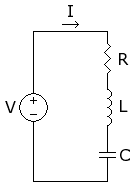
RLC_series_circuit.png


What I have done so far:
Veff = Vm/√2
=> Vm = √2
Ieff = Im/√2
=> Im = √2
XL = ωL = 2

v(t) = √2*sin(2t)
i(t) = √2*sin(2t - 45°)

i know the formulas for the peak voltages for the individual elements are
VR = Im*R
VL = Im*XL
VC = Im*XC

i'm not sure if those correspond to the effective voltages or if i have to use the equation Veff = Vm/√2
i am also having trouble finding R and XC from the information provided..
 
Last edited:
Physics news on Phys.org
I agree with your value for Xl.
If the current lags the supply voltage then the supply voltage LEADS the voltage across R because the voltage across R and the current are in phase.
Are you familiar with showing the voltages Vl, Vr, and Vc on a vector (phasor) diagram. Vl is drawn on the =+y axis, Vr is drawn on the +X axis (horizontal axis ) and Vc is drawn on the -y axis.
This means, from the information in your question, that the supply voltage (1volt) will be a vector from the origin at 45 degrees to the X axis.
Hope this is of some help
I think that you have not been given enough information! Do you know anything about R or C?
 
Sorry...you do have enough information,I had missed the current
 
Imax = Vmax/Z
=> Z = 1
(1) Z = sqrt(R2 + (XL - XC)2)
cosθ = R/Z, θ = 45°
1/√2 = R/1
R = 1/√2
From (1) I get C = 1/(4-√2)

I am not 100% sure this is correct
 
I got those values for R and C
 
technician said:
I got those values for R and C

thanks for the help. i got
VR = Im*R = 1
VL = Im*XL = 2√2
VC = Im*XC = 2√2 - 1
 
I got
Vr = 1 x Cos45 =0.7V
R = 0.7/1 = 0.7Ω
Vc = 1.3V
Xc = 1.3 (gives C= 0.38F)

I think the differences are due to the fact that I used the voltage and current values in the question. I assume these are rms values and I think you have converted these to peak values.

A good result !
Cheers
 

Similar threads

  • · Replies 5 ·
Replies
5
Views
3K
  • · Replies 3 ·
Replies
3
Views
4K
  • · Replies 5 ·
Replies
5
Views
2K
Replies
19
Views
3K
  • · Replies 8 ·
Replies
8
Views
3K
Replies
4
Views
2K
  • · Replies 4 ·
Replies
4
Views
2K
  • · Replies 22 ·
Replies
22
Views
3K
Replies
5
Views
2K
Replies
0
Views
2K