Find input values for smallest function amplitude

Click For Summary
SUMMARY

The discussion focuses on optimizing the parameters a, b, c, and d of a function y(x) to achieve the smallest possible amplitude over a specified range. The user seeks precise values for these parameters, with approximate values given as c = 60.0, d = 60.0, a = 22.0°, and b = 292.0°, all with a precision of 0.1. The suggested approach involves using a conventional minimization algorithm to find optimal values, although there is skepticism about the effectiveness of this method in significantly flattening the graph. The user is also advised to clarify the actual problem they aim to solve.

PREREQUISITES
  • Understanding of function optimization techniques
  • Familiarity with minimization algorithms
  • Basic knowledge of MATLAB or Mathematica for computational analysis
  • Concept of function amplitude in mathematical graphs
NEXT STEPS
  • Learn about MATLAB optimization functions such as fminunc or fmincon
  • Explore Mathematica's NMinimize function for parameter optimization
  • Research techniques for analyzing function amplitude and flatness
  • Investigate the role of parameter sensitivity in function behavior
USEFUL FOR

Mathematicians, engineers, and designers working on optimization problems, particularly those involving mechanical systems and function analysis.

TheFistGuy
Messages
7
Reaction score
1
Hello!

I have a function y(x) with variables a; b; c; d.

equa.PNG

I know what the values of a; b; c; d roughly should be, but I am trying to calculate them precisely, so the graph of the function over the region from a to a+90° would look as straight (horizontal with smallest possible amplitude) as possible.
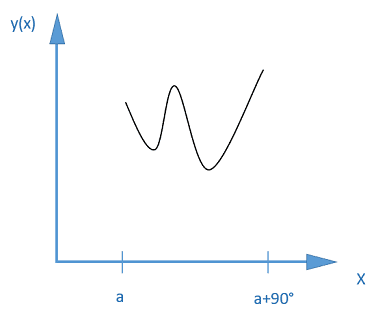
graph_s.png


How do I do this? Where do I start?
I haven't done any maths work in years but i still have access to Matlab, Mathematica, Mathcad from my collage days.

Any help greatly appriciated, as I can't find anything on the web, not knowing which keywords (proper terminology) I should be using.
 

Attachments

  • graph_s.png
    graph_s.png
    2.4 KB · Views: 484
  • equa.PNG
    equa.PNG
    3.7 KB · Views: 733
Last edited:
Physics news on Phys.org
c=d=0 makes it exactly flat. Is that really what you want?
What is the actual problem you want to solve?

In general: You can find the highest and lowest point for different (a,b,c,d) and then run a conventional minimization algorithm to find the optimum.
 
Ahh, I am actually designing a mechanism with some levers and I stumbled upon this problem, which I decided to solve mathematically.

So I know approximate values:
c = 60.0 (plus or minus 1.0)
d = 60.0 (plus or minus 1.0)
a = 22.0° (plus or minus 1.0)
b = 292.0° (plus or minus 1.0)

I am really interested in calculating a,b,c,d with a precision of 0.1, so that the graph would look as flat as possible.
 
While you can do the procedure I suggested I'm highly confident that the result is not what you want. It will almost certainly run into the limits of +- 1, and I guess you'll get c=59, d=59, and I'm not sure if the values for a and b even matter. It won't make the graph notably flatter, and I don't see what you would learn from this mathematical solution.
 

Similar threads

Replies
3
Views
2K
  • · Replies 5 ·
Replies
5
Views
3K
  • · Replies 5 ·
Replies
5
Views
2K
  • · Replies 7 ·
Replies
7
Views
3K
Replies
6
Views
2K
  • · Replies 18 ·
Replies
18
Views
3K
Replies
2
Views
2K
  • · Replies 20 ·
Replies
20
Views
2K
Replies
3
Views
2K
  • · Replies 3 ·
Replies
3
Views
3K