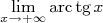
Find Limit of Function & 3 Sequence Theorems

  • Context: Undergrad 
  • Thread starter Thread starter lalapnt
  • Start date Start date
  • Tags Tags
    Function Limit
Click For Summary

Discussion Overview

The discussion revolves around finding the limit of the arctangent function as x approaches positive infinity, as well as exploring the existence of three sequence theorems. Participants express a desire to understand the process of proving limits and the relevant properties of the functions involved.

Discussion Character

  • Exploratory
  • Technical explanation
  • Conceptual clarification
  • Debate/contested
  • Mathematical reasoning

Main Points Raised

  • One participant seeks to learn how to find the limit of a function, specifically the arctangent function.
  • Another participant suggests drawing the graph of the tangent function and marking the positions of arctan100, arctan1000, etc., to understand their behavior as x approaches infinity.
  • A participant notes the importance of the arc tangent function's range, indicating that it is defined to take values between (−π/2, π/2), which may lead to multiple answers if not considered.
  • One participant expresses a need for a formal proof regarding the limit, suggesting that a definition of the atan function is necessary and proposes proving that tan(y) ≥ y for 0 < y < π/2 as part of the proof process.
  • Another participant mentions the necessity of understanding the graphs of various functions (logarithmic, trigonometric, etc.) and their inverses to approach such limit problems effectively.
  • A claim is made that the limit of arctgx as x approaches positive infinity converges to π/2, although this is presented without consensus or formal proof in the discussion.

Areas of Agreement / Disagreement

Participants express a mix of viewpoints regarding how to approach the limit problem and the proof process. There is no clear consensus on the methods or the formal proof required, indicating ongoing exploration and differing opinions.

Contextual Notes

Participants have not fully resolved the definitions and properties of the functions involved, nor have they established a complete formal proof for the limit in question. The discussion reflects varying levels of understanding and approaches to the topic.

lalapnt
Messages
17
Reaction score
0
how do you find the limit of this:

f2f7060d34f6c6a8b77a07d90e8c9b8f.png


this is not homework. I'm trying to learn how to do it.

EDIT:
and is there anything like 3 sequence theorems?
 
Physics news on Phys.org
welcome to pf!

hi lalapnt! welcome to pf! :smile:
lalapnt said:
how do you find the limit of this:

[PLAIN]http://www.matematyka.pl/latexrender/pictures/f/2/f2f7060d34f6c6a8b77a07d90e8c9b8f.png[/QUOTE]

just draw the graph of tanx

then mark the positions of arctan100, arctan1000, etc …

where are they heading to? :wink:
EDIT:
and is there anything like 3 sequence theorems?

sorry, not folloowing you :confused:
 
Last edited by a moderator:
Are you asking what the answer is or how to prove it? You'll need to use the fact that the arc tangent function is defined to take the (principal) values (−π/2, π/2). Otherwise there will be multiple answers.
 
yes you're right. i need to know how to do such a question. and also the "domain" of the function is
af72b8fb6367c22b1914412c4928665d.png


i want to know how to prove it. @haruspex

@tiny-tim do you have an idea what this is:
24262790f951d760e1e80d7eb2218787.png
 
Firstly, you have to know how to draw the graph of such funtions as (log, tang, cot, sin, cos...) then try to draw the inverse graph of these functions. You should also know about limit and its theorems. That's how I try to find a way to solve that kind of problems.
Now your question's solution:
[itex]\lim_{x\rightarrow+∞}arctgx =?[/itex]
When you draw the graph of arctgx and take the limit x goes to positive infinity, the function converges [itex]\frac{\pi}{2}[/itex]. Eventually, we conclude the answer is
[itex]\lim_{x\rightarrow+∞}arctgx = \frac{\pi}{2}[/itex]
 
Last edited by a moderator:
lalapnt said:
i want to know how to prove it.
For a formal proof, a starting point has to be a definition of the atan function. Having chosen one, can you prove tan(y) >= y for 0 < y < pi/2? From there it's not hard.
 

Similar threads

  • · Replies 2 ·
Replies
2
Views
3K
  • · Replies 1 ·
Replies
1
Views
2K
  • · Replies 3 ·
Replies
3
Views
3K
  • · Replies 36 ·
2
Replies
36
Views
4K
  • · Replies 9 ·
Replies
9
Views
3K
  • · Replies 3 ·
Replies
3
Views
2K
  • · Replies 3 ·
Replies
3
Views
3K
  • · Replies 21 ·
Replies
21
Views
6K
  • · Replies 7 ·
Replies
7
Views
3K
  • · Replies 4 ·
Replies
4
Views
3K