Find the area delimited by two polar curves

  • Thread starter Thread starter Astrowolf_13
  • Start date Start date
  • Tags Tags
    Area Curves Polar
Click For Summary
SUMMARY

The area delimited by the polar curves defined by the equations r=sin(θ) and r=√3*cos(θ) can be calculated using integration. The intersection points occur at θ=π/3 and the pole. The area is computed as Area=0.5*∫_0^(π/3) (sin(θ))^2 d(θ) + 0.5*∫_(π/3)^(π/2) (√3*cos(θ))^2 d(θ), resulting in 5π/24 + √3/4. Despite this calculation, the teacher incorrectly dismissed the solution, claiming the line at θ=π/3 is not a boundary, which is factually incorrect.

PREREQUISITES
  • Understanding of polar coordinates and curves
  • Knowledge of integration techniques in calculus
  • Familiarity with trigonometric functions and their properties
  • Ability to identify intersection points of polar equations
NEXT STEPS
  • Explore the geometric interpretation of polar curves
  • Learn about calculating areas between polar curves
  • Investigate alternative methods for area calculation, such as using Cartesian coordinates
  • Study the implications of boundaries in polar coordinate systems
USEFUL FOR

Students studying calculus, particularly those focusing on polar coordinates, as well as educators seeking to clarify misconceptions about polar area calculations.

Astrowolf_13
Messages
1
Reaction score
1
Homework Statement
Find the area limited by polar curves ##r=sin(\theta)## and ##r=\sqrt 3*cos(\theta)##.
Relevant Equations
##r=sqrt(3)*cos(\theta)##, ##r=sin(\theta)##, ##0 \leq \theta \leq pi/2##.
I attempted to solve this problem by finding the angles of an intersection point by equalling both ##r=sin(\theta)## and ##r=\sqrt 3*cos(\theta)##. The angle of the first intersection point is pi/3. The second intersection point is, obviously, at the pole point (if theta=0 for the sine curve and theta=pi/2 for the cosine curve). I then attempted to find the required area by summing its "parts":
$$Area=0.5*\int_0^\frac{\pi}{3} (sin(\theta))^2\, d(\theta) + 0.5*\int_\frac{\pi}{3}^\frac{\pi}{2} (\sqrt 3 *cos(\theta))^2\, d(\theta)$$
The final area I got is ##5*\pi/24 + \sqrt 3 /4##, which I checked on the Internet. However, my teacher disregarded this solution as incorrect (because, as I quote, line at angle pi/3 is not a boundary of either ##r=sin(\theta)## or ##r=\sqrt 3 *cos(\theta)##) and asked to use a different method to find the area, and this is what I'm struggling to do.
So the question is: is there any other method of finding this area or did I get the description of the homework statement wrong?
The graph should look like this:
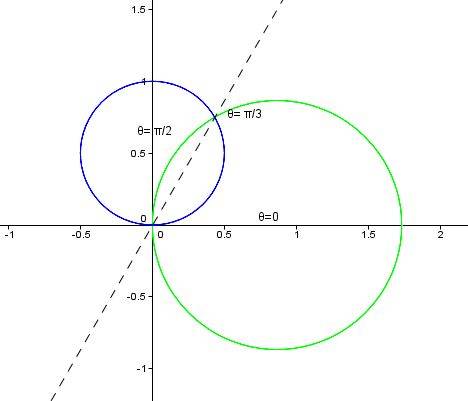
zQoUzGofTrWXsxrK7PgG_Capture.jpg
 
Last edited:
  • Like
Likes   Reactions: etotheipi
Physics news on Phys.org
I like your approach.

You can solve this without integrals, however. Let O be the origin and P the other intersection of the circles. Let M be the center of the cosine circle. Draw this triangle, then find the angle phi at M. From there you can calculate the "left" part of your area with simple geometry. Do the same for the other circle.

It's also possible to convert the circles to Cartesian coordinates and integrate there, but why would someone want to do that.
 
  • Like
  • Haha
Likes   Reactions: etotheipi and member 587159
Astrowolf_13 said:
However, my teacher disregarded this solution as incorrect (because, as I quote, line at angle pi/3 is not a boundary of either ##r=sin(\theta)## or ##r=\sqrt 3 *cos(\theta)##)
The graph should look like this:
View attachment 262079
Your teacher's statement that the dashed line is not a boundary of either circle is beyond ridiculous. You have a region that contains part of each circle and the dashed line is a boundary of each subarea. You have done the problem absolutely correctly. Nicely done. Your teacher deserves a demerit.
 
  • Like
Likes   Reactions: etotheipi

Similar threads

  • · Replies 20 ·
Replies
20
Views
2K
  • · Replies 19 ·
Replies
19
Views
2K
  • · Replies 4 ·
Replies
4
Views
1K
  • · Replies 14 ·
Replies
14
Views
2K
  • · Replies 1 ·
Replies
1
Views
2K
Replies
14
Views
2K
Replies
3
Views
2K
  • · Replies 10 ·
Replies
10
Views
2K
  • · Replies 14 ·
Replies
14
Views
2K
  • · Replies 5 ·
Replies
5
Views
2K