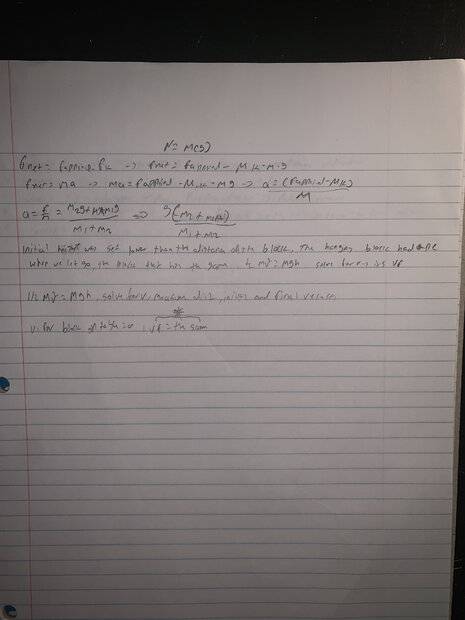
Find the coefficient of friction and acceleration with masses given

Join the discussion
Registration is free. Ask a follow-up in this thread, or start your own.
7 replies · 1K views
SSJBLOOD
Messages
5
Reaction score
0
Homework Statement
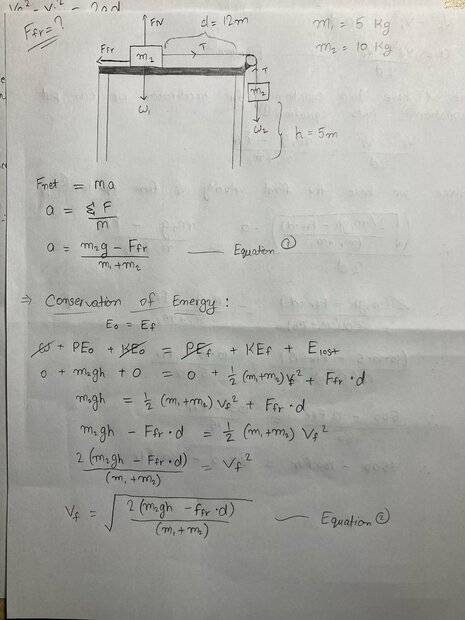
We need to find the kinetic friction and acceleration of a half Atwood system. The masses given are 295 grams and the smaller one is 147.5 grams.
Relevant Equations
\frac{1}{2}mv^{2}=mgh
\frac{g\left(m_{2}+m_{1}μ_{f}\right)}{m_{1}+m_{2}}
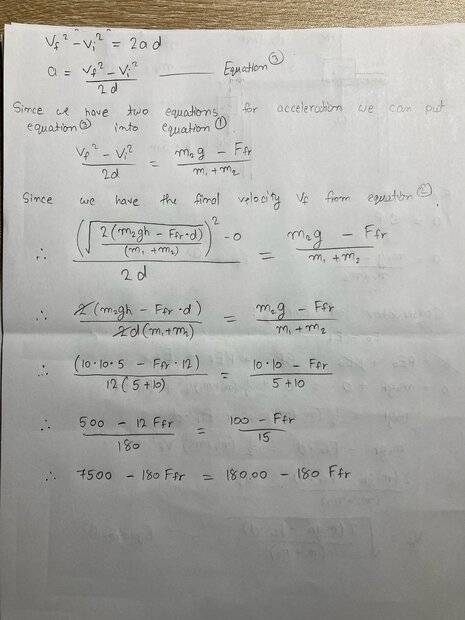
I tried to use the energy route but the acceleration was not a plausible one. It was just way too big.
new.jpeg
new2.jpeg
Image.jpeg
 
Physics news on Phys.org
What is the exact problem statement?
I see you are taking the distance for the friction as d=12m but the drop for the suspended mass is only 5m.
Since your KE takes the final velocity as applying to both masses, that should be when the upper mass has only moved 5m, no?
 
The only thing we were allowed to use was a meter stick to find the coefficient of kinetic friction between the block and the table surface. We weren't given the acceleration
 
SSJBLOOD said:
The only thing we were allowed to use was a meter stick to find the coefficient of kinetic friction between the block and the table surface. We weren't given the acceleration
You must know something else or there is not enough info. Did you time it until the suspended mass hit the floor? Or did the top mass stop before it reached the pulley and you measured how far it travelled in total?
 
SSJBLOOD said:
Yeah we had time it was 3.23 seconds
Then you can calculate the acceleration.