Find the flux of a vector field

Click For Summary
SUMMARY

The discussion centers on the proper methodology for calculating the flux of a vector field. A participant critiques an initial attempt, highlighting the incorrect equating of vector and scalar quantities and the misuse of the multiplication symbol in vector analysis. The correct approach requires a clear motivation for using specific variables, such as ##\rho##, and emphasizes the importance of obtaining an exact result rather than an approximation. The conversation underscores the necessity of adhering to vector analysis conventions to achieve accurate results.

PREREQUISITES
  • Understanding of vector fields and flux calculations
  • Familiarity with vector analysis notation and operations
  • Knowledge of scalar and vector quantities
  • Proficiency in mathematical expressions involving variables like ##\rho##
NEXT STEPS
  • Study the principles of vector calculus, focusing on flux integrals
  • Learn about the divergence theorem and its applications in vector fields
  • Explore the correct use of vector notation and operations in mathematical expressions
  • Practice solving vector field problems with an emphasis on exact results
USEFUL FOR

Students and professionals in mathematics, physics, and engineering who are involved in vector analysis and flux calculations will benefit from this discussion.
falyusuf
Messages
35
Reaction score
3
Homework Statement
Attached below.
Relevant Equations
Attached below.
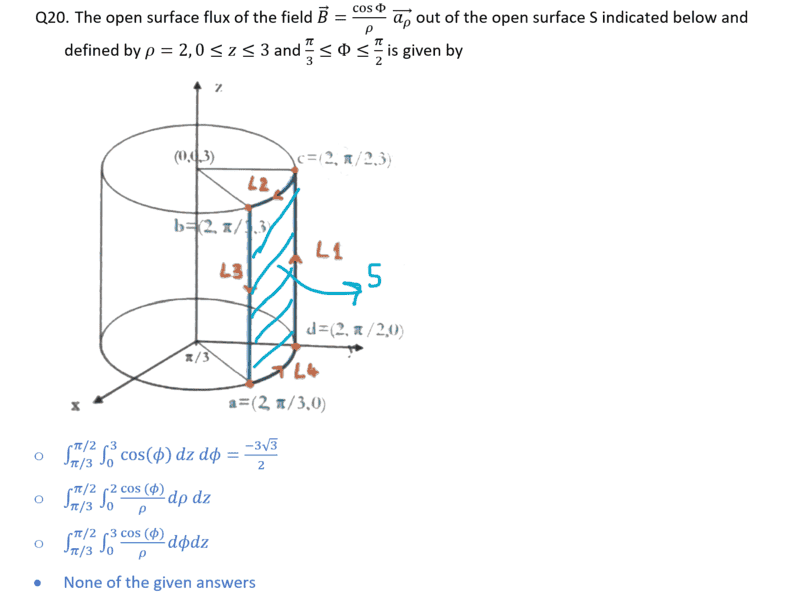
Question:
1646436275383.png

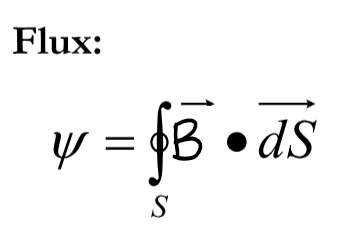
Equation:
1646436289968.png


Attempt:
1646439292931.png

Can someone verify my answer?
 
Last edited:
Physics news on Phys.org
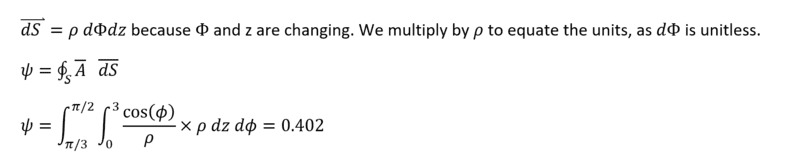
First of all, your assertion
1647165130602.png

cannot be correct because it is equating a vector quantity with a scalar quantity (i.e., you are missing a vector in the expression). The reason to multiply by ##\rho## is also not "to get the correct units" although having the correct units is a reasonable check that you did things correctly. You could also multiply by ##z## and get the correct units but the result would be wrong. You therefore need a better motivation for multiplying by ##\rho##.

In your last expression, you should not use ##\times## like this in an expression in vector analysis but reserve it for the vector cross product. Your result may also be simplified and evaluated exactly (i.e., there is no need to use an approximate result - the result is one of the proposed answers).
 

Similar threads

Replies
5
Views
1K
  • · Replies 2 ·
Replies
2
Views
4K
  • · Replies 1 ·
Replies
1
Views
1K
Replies
6
Views
2K
  • · Replies 6 ·
Replies
6
Views
2K
  • · Replies 5 ·
Replies
5
Views
2K
  • · Replies 2 ·
Replies
2
Views
2K
  • · Replies 16 ·
Replies
16
Views
1K
  • · Replies 2 ·
Replies
2
Views
2K
  • · Replies 4 ·
Replies
4
Views
2K