mathmari
Gold Member
MHB
- 4,984
- 7
Hey! 
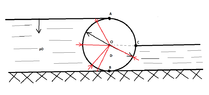
At the cylinder of the picture there are static pressures from environment fluid of density $\rho$. If we neglect the atmospheric pressure, calculate how much force and how much torque is needed so that the cylinder balance.
View attachment 4436
In my notes there is the solution, but I haven't really understood it...
The Euler equation is $$\rho \frac{D \overrightarrow{u}}{D T}=-\nabla p+\rho \overrightarrow{b}$$
Since the cylinder should be in balance we have that $\overrightarrow{u}=0$.
We also have that $\overrightarrow{b}=\overrightarrow{g}$
That means that $$\nabla p=\rho \overrightarrow{b}=\rho \overrightarrow{g}$$
Since $\overrightarrow{g}=-g\hat{k}$ we have that $$\nabla p=-\rho_0 g \hat{k} \Rightarrow \partial_xp=0 \ \ , \ \ \partial_yp=0 \ \ , \ \ \partial_zp=-\rho_0 g$$
$$\Rightarrow \frac{dp}{dz}=-\rho_0 g \Rightarrow p(z)=-\rho_0 g z+\lambda$$
Is it correct so far?? (Wondering) After that in my notes there is the following which I don't understand:
$$p(z)=-\rho_0 g z+\lambda$$
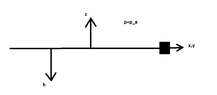
View attachment 4437
$$z=0 \ \ \ \ \ p(z=0)=\lambda =p_a \\ p(z)-p_a=-\rho g z=-\rho_0 g h$$
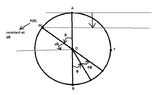
View attachment 4438
$$P(\theta)=\rho_0 g h(\theta)=\rho_0 g\frac{D}{2}(1-\cos \theta)$$
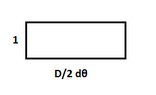
$$P(\theta) dA=P(\theta)\left (1 \cdot \frac{D}{2}d\theta\right )$$
View attachment 4439
$$F_{AB}=\int_{\theta=0}^{\theta=\pi} p(\theta)\frac{D}{2}d \theta \\ F_{B \Gamma}= \dots $$
Could you explain to me the part I don't understand?? (Wondering)
At the cylinder of the picture there are static pressures from environment fluid of density $\rho$. If we neglect the atmospheric pressure, calculate how much force and how much torque is needed so that the cylinder balance.
View attachment 4436
In my notes there is the solution, but I haven't really understood it...
The Euler equation is $$\rho \frac{D \overrightarrow{u}}{D T}=-\nabla p+\rho \overrightarrow{b}$$
Since the cylinder should be in balance we have that $\overrightarrow{u}=0$.
We also have that $\overrightarrow{b}=\overrightarrow{g}$
That means that $$\nabla p=\rho \overrightarrow{b}=\rho \overrightarrow{g}$$
Since $\overrightarrow{g}=-g\hat{k}$ we have that $$\nabla p=-\rho_0 g \hat{k} \Rightarrow \partial_xp=0 \ \ , \ \ \partial_yp=0 \ \ , \ \ \partial_zp=-\rho_0 g$$
$$\Rightarrow \frac{dp}{dz}=-\rho_0 g \Rightarrow p(z)=-\rho_0 g z+\lambda$$
Is it correct so far?? (Wondering) After that in my notes there is the following which I don't understand:
$$p(z)=-\rho_0 g z+\lambda$$
View attachment 4437
$$z=0 \ \ \ \ \ p(z=0)=\lambda =p_a \\ p(z)-p_a=-\rho g z=-\rho_0 g h$$
View attachment 4438
$$P(\theta)=\rho_0 g h(\theta)=\rho_0 g\frac{D}{2}(1-\cos \theta)$$
$$P(\theta) dA=P(\theta)\left (1 \cdot \frac{D}{2}d\theta\right )$$
View attachment 4439
$$F_{AB}=\int_{\theta=0}^{\theta=\pi} p(\theta)\frac{D}{2}d \theta \\ F_{B \Gamma}= \dots $$
Could you explain to me the part I don't understand?? (Wondering)
Attachments