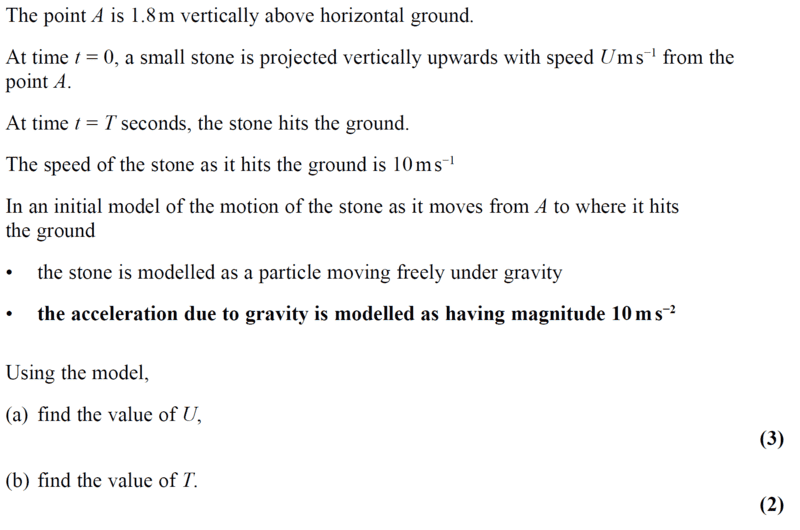
Find the initial velocity ##U##

Join the discussion
Ask a follow-up here, or get your own question answered by working scientists, mathematicians and engineers — people, not an autocomplete.
Real named experts · corrections over time · the nuance an AI answer skips
3 replies · 1K views
chwala
Gold Member
Messages
2,843
Reaction score
428
Homework Statement
see attached.
Relevant Equations
Mechanics
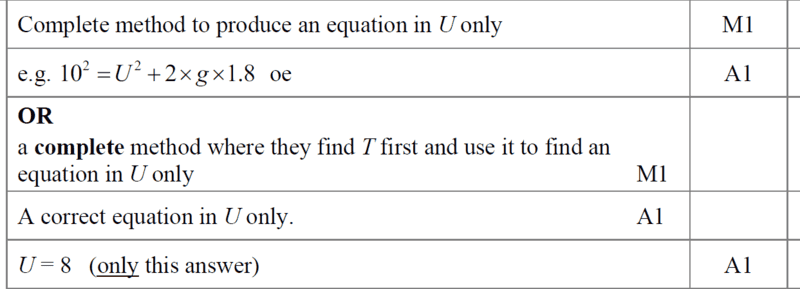
Now in determining the initial velocity;

in my understanding, if ##s=1.8## then we consider the stone's motion from the top to the ground. Why not consider ##s=3.6##, the total distance traveled by stone from start point ##t=0##? Is it possible to model equations from this point?

The stone when thrown upwards will reach a point where it is instantaneously at rest and then start the descent. In that case, it is clear that ##s=1.8##. I need insight on this very part.
1711750389691.png


1711750420378.png
 
Last edited:
Physics news on Phys.org
chwala said:
Thank @kuruman I am self-studying Mechanics. Noted.
Then I will add here a calculation that illustrates the point in post #2.

Problem
A stone is thrown straight up in the air with initial velocity ##v_0=3~##m/s and returns to the point at which it was launched. Find the time time of flight ##T##.

Solution
The height of the stone ##y## at any time ##t## above the point of launch is given by $$y=v_0~t-\frac{1}{2}g~t^2.$$ At the specific time ##t=T## when it returns to the launch point, the height of the stone above ground is zero. With ##t=T## the equation we have $$ 0=v_0~T-\frac{1}{2}g~T^2\implies T(v_0 -\frac{1}{2}g~T)=0.$$ One or the other of the terms in the product on the right must be zero.

A. ##T=0## which says that the stone is at zero height when it is launched, a fact that we already knew and built in the equation. We reject this solution because we are looking for a time after launch, i.e. ##T>0.##

B. ##v_0 -\frac{1}{2}g~T=0 \implies T=\dfrac{2v_0}{g}.## This is the solution that we want.

Answer
##T=\dfrac{2\times 3~(\text{m/s})}{10~(\text{m/s}^2)}=0.6~\text{s}.##

You can see from this example that the total distance traveled up and down does not enter the picture and is not needed. Good luck with your self-study. We are here to help.
 
Reply
  • Like
Likes   Reactions: chwala