Find the refractive index for the lens and find the image distance

Click For Summary
The discussion focuses on calculating the refractive index of a lens and the image distance when the lens is placed in water. The refractive index for air is 1.00, and for water, it is 1.33. Participants confirm that the solution should express answers in terms of the given variables, including the focal length (f), radii of curvature (R1, R2), and the refractive index of water. There is uncertainty about whether the problem can be solved using only the refractive index of air, but it is clarified that the refractive index of water is necessary for the calculations. Overall, the calculations presented appear correct, but the final expressions may need to align with the instructor's expectations regarding the use of given symbols.
Karl Karlsson
Messages
104
Reaction score
12
Homework Statement
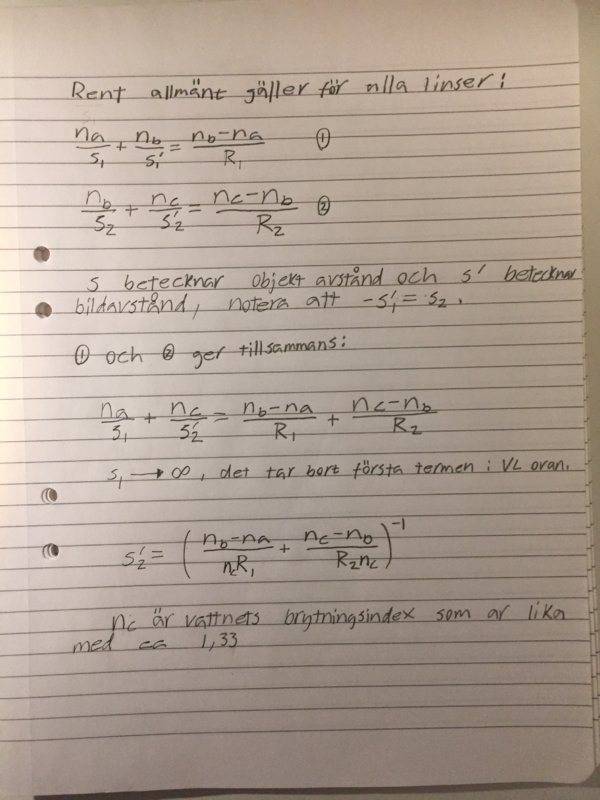
A thin lens has an upper radius of curvature đť‘…1 and a lower radius of curvature đť‘…2. When the lens is completely surrounded by air, it has a focal distance đť‘“. The lens is then placed in the interface between air and water inside a vessel (see figure). Calculate the refractive index for the glass and the distance below the water surface on which the image of a distant object will end up?
Relevant Equations
A thin lens has an upper radius of curvature đť‘…1 and a lower radius of curvature đť‘…2. When the lens is completely surrounded by air, it has a focal distance đť‘“. The lens is then placed in the interface between air and water inside a vessel (see figure). Calculate the refractive index for the glass and the distance below the water surface on which the image of a distant object will end up?

Skärmavbild 2019-12-04 kl. 22.25.29.png


The refractive index for water is given to nc = 1.33 and for air na = 1.00

My attempt:
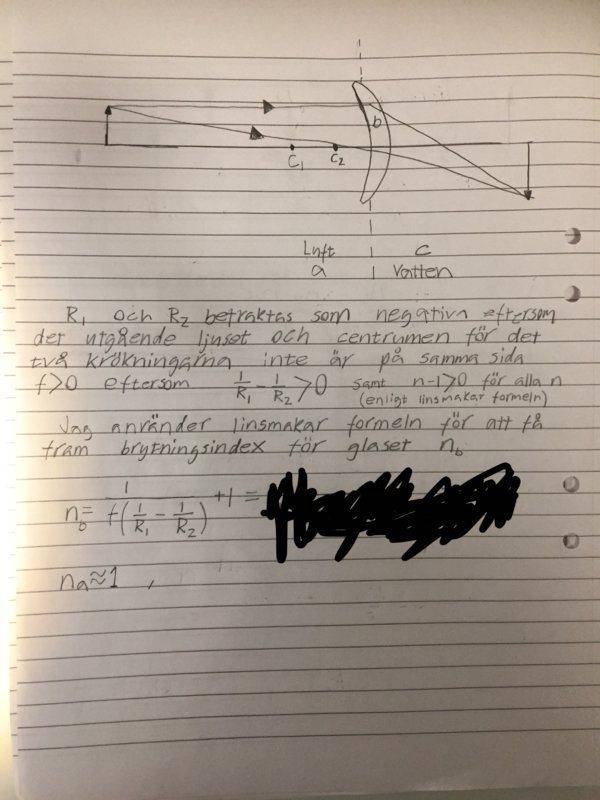
IMG_0486-2.JPG


IMG_0487.JPG

Is my solution correct? I have nowhere to check the answer and I have not done any similar problem before. Have I missed something?
 
Last edited:
Physics news on Phys.org
Your work looks good to me. But, they might want you to express the final answer in terms of the givens: ##f##, ##R_1##, ##R_2##, ##n_{air}##, and ##n_{water}##.
 
TSny said:
Your work looks good to me. But, they might want you to express the final answer in terms of the givens: ##f##, ##R_1##, ##R_2##, ##n_{air}##, and ##n_{water}##.
I assumed the refractive index for water was given because I could not solve the problem without it. Can the problem be solved if one only knows the refractive index for air?
 
Karl Karlsson said:
I assumed the refractive index for water was given because I could not solve the problem without it. Can the problem be solved if one only knows the refractive index for air?
You can assume ##n_{water}## to be known. But since no numerical values are given in the statement of the problem, I don't think you will need to use a particular value for ##n_{water}##.

I think they want you to express your answers in terms of the symbol ##n_{water}## as well as the given symbols ##R_1##, ##R_2##, and ##f##. Here, ##f## is the focal length with air on both sides of the lens.

For the first question, you found the index of refraction of the glass in terms of these symbols and it looks right.

Your answer to the second question also looks correct to me. But I was wondering if you are expected to express your answer in terms of only the "given" symbols ##R_1##, ##R_2##, and ##f## (as well as ##n_{water}##). It could be that the way you expressed the answer is completely adequate. It depends on your instructor.
 
  • Like
Likes Karl Karlsson
Thread 'Correct statement about size of wire to produce larger extension'
The answer is (B) but I don't really understand why. Based on formula of Young Modulus: $$x=\frac{FL}{AE}$$ The second wire made of the same material so it means they have same Young Modulus. Larger extension means larger value of ##x## so to get larger value of ##x## we can increase ##F## and ##L## and decrease ##A## I am not sure whether there is change in ##F## for first and second wire so I will just assume ##F## does not change. It leaves (B) and (C) as possible options so why is (C)...

Similar threads

  • · Replies 7 ·
Replies
7
Views
2K
  • · Replies 3 ·
Replies
3
Views
1K
  • · Replies 3 ·
Replies
3
Views
1K
  • · Replies 2 ·
Replies
2
Views
1K
  • · Replies 3 ·
Replies
3
Views
2K
  • · Replies 1 ·
Replies
1
Views
2K
  • · Replies 2 ·
Replies
2
Views
3K
  • · Replies 9 ·
Replies
9
Views
2K
  • · Replies 5 ·
Replies
5
Views
1K
  • · Replies 8 ·
Replies
8
Views
5K