Solve Snell's Law: Glass Cube Refractive Index = 1.77

  • Thread starter Thread starter DylanXO
  • Start date Start date
  • Tags Tags
    Law Snell's law
Click For Summary

Homework Help Overview

The problem involves a ray of light traveling in a glass cube immersed in water, specifically examining the conditions under which light is refracted at the glass-water interface. The subject area pertains to optics, particularly Snell's Law and the concept of total internal reflection.

Discussion Character

  • Exploratory, Conceptual clarification, Assumption checking

Approaches and Questions Raised

  • Participants discuss the application of Snell's Law, with one noting the calculation of the refractive index of glass based on the critical angle. There are questions about the correctness of the original poster's understanding and results, with some expressing confidence in the calculations while others suggest further exploration of the concept of total internal reflection.

Discussion Status

The discussion is active, with multiple participants affirming the original poster's calculations while also encouraging further reading on related concepts. There is an acknowledgment of varying refractive indices for glass, and some participants are exploring the implications of the critical angle in the context of the problem.

Contextual Notes

Participants note that the original poster is uncertain about the results compared to textbook values, leading to a discussion about the variability of refractive indices for different types of glass. The critical angle of 48.7° is identified as significant in understanding the behavior of light at the interface.

DylanXO
Messages
5
Reaction score
1

Homework Statement


A ray of light is traveling in a glass cube that is totally immersed in water. You find that if the ray is incident on the glass-water interface at an angle to the normal greater than 48.7°, no light is refracted into the water. Calculate the refractive index of the glass.

Homework Equations


Snell's Law:
snells_law_formula_2.png

Refractive Index of Water: 1.33

The Attempt at a Solution


Na = Nb*Sin(Θb)/Sin(Θa)
Na = 1.33*Sin(90°)/Sin(48.7°)
Na = 1.77
Glass Cube Refractive Index = 1.77

I feel that I have made an error or that I'm not grasping the concept correctly. Any guidance or explanation would be highly appreciated.
 

Attachments

  • snells_law_formula_2.png
    snells_law_formula_2.png
    538 bytes · Views: 1,519
  • Like
Likes   Reactions: joaopcnogueira
Physics news on Phys.org
No, it looks right to me. What makes you think it isn't?
 
This looks good to me. This phenomenon is called total internal reflection, in case you want to explore it a bit.
 
  • Like
Likes   Reactions: joaopcnogueira and DylanXO
DylanXO said:
...I feel that I have made an error or that I'm not grasping the concept correctly...

Seems correct to me as well. glasses refractive indices are typically around that value. Any part of the concept you are confused about?
 
Doc Al said:
This looks good to me. This phenomenon is called total internal reflection, in case you want to explore it a bit.
Thank you, I think some additional reading on that will help resolve any confusion I'm having.
 
renec112 said:
Seems correct to me as well. glasses refractive indices are typically around that value. Any part of the concept you are confused about?
It was more the result itself from textbooks I have checked and a quick look online, it seemed that the indices for glass were lower. Although I understand now, that the indices for glass are varying.
 
The incidence angle 48.7º in this case, is the critical angle, i.e, the angle which makes the refraction angle 90º. We know that because in the statement of the problem, we can read the following:

[..] You find that if the ray is incident on the glass-water interface at an angle to the normal greater than 48.7°, no light is refracted into the water.

The fact that for any angle greater than 48.7º no light is refracted into the water, means that 48.7º is the critical angle and the refraction angle is 90º.

That is the reason you have used 90º into the Snell's Law.

Reference: https://en.wikipedia.org/wiki/Total_internal_reflection
 
DylanXO said:
It was more the result itself from textbooks I have checked and a quick look online, it seemed that the indices for glass were lower. Although I understand now, that the indices for glass are varying.
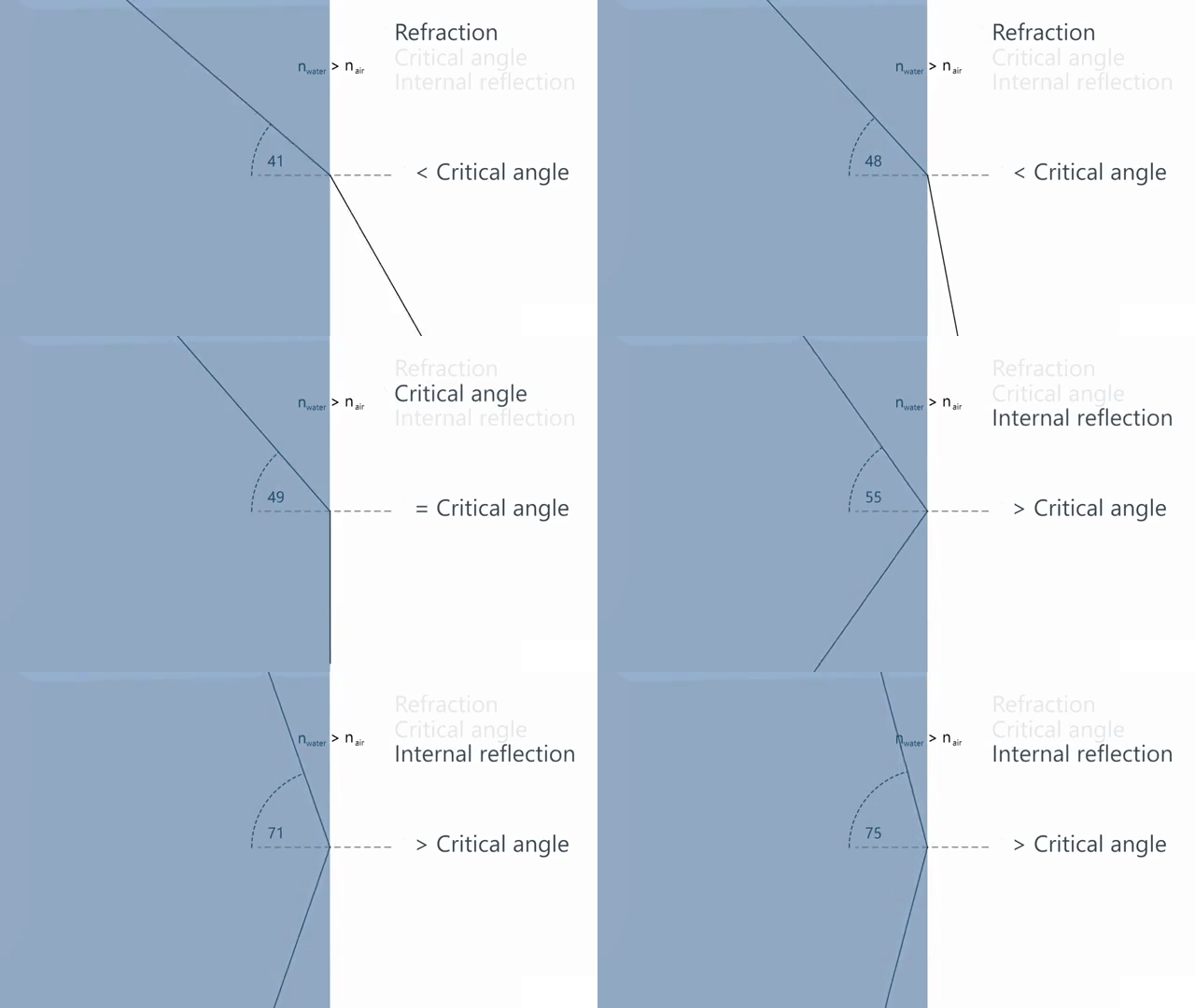
I forgot i once made this animation about it:

It's showing a light ray going from water (bigger index) to air(lower index) - an example where internal reflection can happen.
 
  • Like
Likes   Reactions: DylanXO and joaopcnogueira
renec112 said:
I forgot i once made this animation about it:

It's showing a light ray going from water (bigger index) to air(lower index) - an example where internal reflection can happen.
Amazing animation, thanks for share!
 
  • Like
Likes   Reactions: renec112 and DylanXO

Similar threads

  • · Replies 1 ·
Replies
1
Views
2K
  • · Replies 1 ·
Replies
1
Views
3K
Replies
3
Views
2K
  • · Replies 7 ·
Replies
7
Views
7K
  • · Replies 4 ·
Replies
4
Views
3K
  • · Replies 1 ·
Replies
1
Views
3K
  • · Replies 3 ·
Replies
3
Views
6K
  • · Replies 1 ·
Replies
1
Views
2K
  • · Replies 2 ·
Replies
2
Views
2K
  • · Replies 5 ·
Replies
5
Views
31K