Find the Speed of Blocks A & B After Moving 2.70cm

  • Thread starter Thread starter TinaChan90
  • Start date Start date
  • Tags Tags
    Blocks Speed
Click For Summary
SUMMARY

The discussion focuses on calculating the speed of two blocks, A and B, after they have moved 2.70 cm. Block A, with a mass of 2.20 kg, is on a tabletop, while block B, with a mass of 2.27 kg, hangs from a frictionless pulley. The coefficient of kinetic friction between block A and the tabletop is 0.344. Participants emphasize the importance of applying Newton's laws and energy methods to solve for the velocity of the blocks, clarifying that velocity is a fundamental concept in various physics problems, not limited to circular motion.

PREREQUISITES
  • Understanding of Newton's laws of motion
  • Familiarity with kinetic friction concepts
  • Knowledge of energy conservation principles
  • Basic proficiency in kinematic equations
NEXT STEPS
  • Study the application of Newton's second law in pulley systems
  • Explore energy conservation in mechanical systems
  • Learn how to calculate kinetic friction forces
  • Review kinematic equations for linear motion
USEFUL FOR

Students and educators in physics, particularly those focusing on mechanics and dynamics, as well as anyone preparing for physics examinations or practical applications involving pulley systems and friction.

TinaChan90
Messages
1
Reaction score
0
As shown in the figure , block A (mass 2.20kg ) rests on a tabletop. It is connected by a horizontal cord passing over a light, frictionless pulley to a hanging block B (mass 2.27kg ). The coefficient of kinetic friction between block A and the tabletop is 0.344.
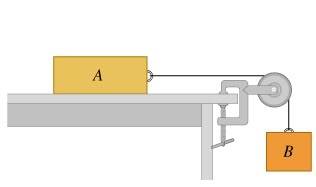
problem.jpg


After the blocks are released from rest, find the speed of each block after moving 2.70cm
---

Asking for V.

And I am so confused since we only only use V in circular motion, So I don't even know how to set it up
 
Physics news on Phys.org
Are you familiar with energy methods, Newton's laws, and / or the kinematic equations?? The velocity or speed is used quite often in Physics problems, so surely you must have seen it other than in circ motion problems, is that right??
 

Similar threads

Replies
13
Views
4K
Replies
29
Views
3K
Replies
1
Views
1K
  • · Replies 3 ·
Replies
3
Views
2K
  • · Replies 2 ·
Replies
2
Views
2K
  • · Replies 11 ·
Replies
11
Views
3K
  • · Replies 33 ·
2
Replies
33
Views
2K
  • · Replies 11 ·
Replies
11
Views
3K
  • · Replies 7 ·
Replies
7
Views
3K
  • · Replies 45 ·
2
Replies
45
Views
8K